Choosing bulk salad containers is not only a price comparison. For food packaging buyers, the real cost of poor salad packaging often appears after delivery: cracked lids, unstable stacking, cloudy PET appearance, leaking chilled foods, damaged cartons, inconsistent reorder quality, and customer complaints from retail shelves or takeaway channels.
For supermarkets, salad bars, delis, cafes, meal-prep brands, cloud kitchens, catering companies, and foodservice distributors, salad packaging must perform across several stages: filling, closing, stacking, cold storage, transport, retail display, customer handling, and disposal. A container that looks acceptable in a sample photo may still fail when filled with leafy salads, pasta salad, fruit salad, grain bowls, deli sides, or heavier chilled food portions.
This is why buyers should evaluate bulk salad containers with a structured wholesale checklist. The right decision combines material choice, container structure, lid security, retail clarity, food-contact suitability, carton packing, supplier consistency, and factory support. YIHAO supports buyers who need practical packaging solutions for chilled salads, deli foods, fruit portions, prepared meals, and grab-and-go retail programs.
Why Bulk Salad Containers Need a Wholesale Buying Standard
Salad packaging sits between fresh produce packaging, deli packaging, and prepared food packaging. It must protect delicate ingredients, show product freshness, hold liquid-prone foods, support labels, stack in cartons, and remain clean in refrigerated displays. This combination makes salad containers more demanding than basic takeaway boxes.
Light leafy salads need headspace and a lid that does not crush the food. Pasta salad, potato salad, grain bowls, and protein salads need stronger bases because the filling weight is higher. Fruit salad needs clear presentation and better moisture control. Retail salad programs need stable stacking and consistent appearance across repeat orders. Foodservice distributors need carton efficiency and reliable supply.
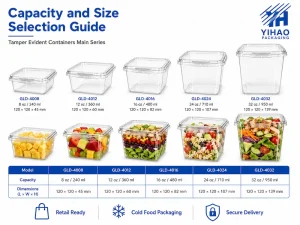
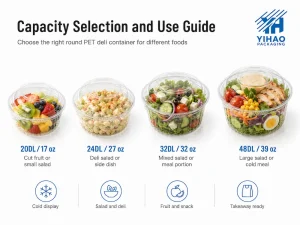
Instead of buying one container only by capacity, professional buyers should review the full deli and salad containers category. This helps compare hinged deli containers, round bowls, square containers, large-capacity salad bowls, and matching lids according to actual food application.
Start with the Food Application Before Choosing Size
The first step in buying bulk salad containers is not choosing ounces or milliliters. The first step is defining the food application. A container for leafy salad does not face the same pressure as a container for pasta salad, fruit salad, deli sides, or shared chilled food. The same size can perform differently depending on food density, moisture level, toppings, dressing placement, and stacking weight.
For leafy green salads, buyers need enough internal space to protect lettuce, toppings, and dressing cups. For pasta salads and grain bowls, buyers need stronger base support and stable sidewalls. For fruit salad, buyers need clarity, moisture control, and reliable lid fit. For deli sides, buyers need portion consistency and clean cold-case display. For catering and large shared portions, buyers need deeper structures, stronger lids, and better carton protection.
A smart supplier should ask about food type, filling weight, display method, storage temperature, transport route, label design, and expected order volume before recommending a container. This is one of the easiest ways to separate a basic trader from a serious PET deli container factory.
Compare PET, rPET, and PP for Salad Packaging
PET and rPET are widely used for clear chilled salad and deli packaging because they provide strong transparency, clean product visibility, and crisp retail presentation. For supermarkets, cafes, and grab-and-go displays, clear packaging helps customers see leafy greens, toppings, fruit, grains, and proteins before purchase.
rPET can support recycled-content packaging goals when the material source, food-contact suitability, and documentation are properly confirmed. PP is usually reviewed for applications requiring better heat resistance, especially when microwave use or warm food contact is involved. However, chilled salad packaging normally prioritizes clarity, lid fit, cold-case stability, and display value.
Buyers should ask the supplier to confirm the material, intended temperature range, food-contact suitability, and recommended use conditions. A chilled PET salad container should not be promoted as microwave-safe unless the supplier provides clear material confirmation. A recycled-content claim should be supported by documentation, not treated as a generic marketing phrase.
For fast packing environments, PET hinged deli containers reduce lid-base matching errors. For premium salad presentation, round PET salad bowls create strong top-view display. For shelf efficiency and carton organization, square PET deli containers support compact layouts and stable stacking.
Buyer Decision Matrix for Bulk Salad Containers
| Buyer Type | Best Container Type | Main Concern | Suggested Packaging Focus |
|---|---|---|---|
| Supermarket | Clear PET salad bowls | Cold-case shelf display | Clarity, stacking strength, label area |
| Deli counter | Hinged deli containers | Fast packing | Easy closure, lid fit, portion consistency |
| Meal-prep brand | Square PET deli containers | Stacking and portion control | Base strength, carton efficiency, repeat supply |
| Foodservice distributor | Mixed salad container range | Bulk supply stability | Factory capacity, carton packing, reorder control |
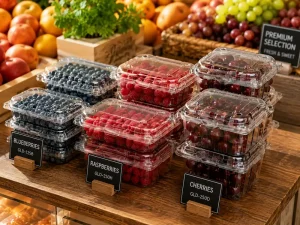
| Fruit salad brand | Clear leak-resistant containers | Moisture and juice movement | Lid seal, cold-chain testing, clear visibility |
Checklist 1: Container Clarity and Retail Display Value
Clear food packaging is part of the selling function. A salad container should make fresh ingredients easy to see from the top and front display angles. Leafy greens, tomatoes, corn, berries, pasta, cheese, protein, and sauces should look clean and appetizing without grey, blue, cloudy, or distorted plastic appearance.
When comparing samples from a clear food packaging supplier, test filled containers under store-like lighting, not only under office lighting. Check whether the lid creates excessive glare, whether the sidewall distorts the food view, and whether ribbing or uneven thickness reduces the premium appearance. For retail salad programs, poor clarity can weaken freshness perception even when the food quality is good.
Buyers should also check how labels affect display. A label that is too large can block the food. A label placed on a curved lid can wrinkle. A label that covers too much of the surface can reduce the visual advantage of clear packaging. The best clear salad packaging balances branding, food visibility, barcode readability, and recycling design considerations.
Checklist 2: Lid Fit, Closure Security, and Leak Resistance
Lid fit is one of the strongest indicators of manufacturer quality. A container can look attractive in a catalog but fail if the lid is hard to close, pops open during stacking, or becomes loose in refrigerated transport. For bulk salad containers, lid performance should be tested with real food, not only with empty samples.
For hinged structures, check whether the lid closes evenly around the rim. Open and close the container several times to test hinge strength. For separate-lid containers, check whether staff can match lids and bases quickly during high-volume packing. A good lid should close securely without requiring excessive force because too much pressure slows operation and can damage delicate foods.
Moisture control is also important. Fruit salad, marinated vegetables, deli sides, pasta salads, and chilled meals can release liquid during storage. For these foods, buyers should test tilted handling, carton movement, and stacked storage. leak-proof clear food containers are especially relevant when the product range includes moisture-prone chilled foods.
Checklist 3: Stacking Strength and Cold-Chain Performance
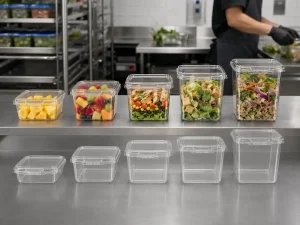
Wholesale buyers should judge salad packaging as a system. Containers are nested in cartons, filled on a line, closed by staff, stacked in chilled storage, transported through cold-chain handling, displayed in refrigerated cases, and carried by customers. Any weak point can create product loss.
Stacking strength depends on base geometry, lid geometry, wall thickness, rib design, material consistency, and mold accuracy. A weak lid can deform under weight. A weak base can bow when filled with pasta salad, grain bowls, or fruit portions. Poor nesting can slow packing. Inconsistent rims can create closure problems across bulk orders.
Test real filled weight before buying. Stack several filled samples in chilled conditions for several hours and inspect the bottom containers. For larger portions, large salads and fruit platters need stronger lid and base design. For family packs and shared chilled food, large shared chilled food packaging should be tested with extra attention to stacking pressure and carton protection.
Checklist 4: Hinged, Round, Square, or Separate-Lid Structure
The best container structure depends on packing speed, food type, retail presentation, and storage method. Hinged deli containers reduce lid-base mismatch because the lid stays attached. They suit deli counters, salad bars, fruit portions, toppings, snacks, and compact grab-and-go foods. clear hinged deli containers are practical for small portions, side salads, nuts, fruit, and chilled snacks.
Round salad bowls are stronger for premium visual presentation. They work well for meal salads, fruit bowls, chilled noodles, poke-style bowls, grain bowls, and higher-value takeaway foods. If a program uses several bowl sizes, compatible bowl lids help reduce purchasing complexity and inventory confusion.
Square deli containers support shelf efficiency, carton organization, and clean retail layout. They are useful for salad portions, fruit, deli meals, chilled sides, and meal-prep programs. For operations that need compact stacking and stable display, square deli containers offer a practical format without sacrificing visibility.
Checklist 5: Food-Contact Documentation and Material Traceability
A reliable deli container manufacturer should provide clear information about material type, food-contact suitability, intended use conditions, and quality control. Buyers should not rely on vague phrases such as “food grade” without supporting documentation. The supplier should confirm whether the product is PET, rPET, PP, or another material and explain whether it is designed for chilled food, room-temperature display, hot food, or microwave use.
For recycled-content packaging, traceability becomes more important. Ask whether the rPET is post-consumer or post-industrial, whether it is suitable for food-contact use, and what documentation can be provided for the target market. Buyers selling into different regions should also review local rules for recycling claims, labeling, extended producer responsibility, and single-use plastic requirements.
Food-contact documentation protects the buyer, the brand owner, and the final consumer. It also prevents incorrect product claims in tenders, retail compliance forms, packaging labels, and online product descriptions.
Checklist 6: Wholesale Supply Capacity and Reorder Stability
Wholesale buyers need more than good samples. They need stable repeat orders. A supplier may send attractive samples but fail in bulk shipments if clarity, thickness, lid fit, carton count, or delivery timing changes between batches. For bulk salad containers, consistency matters because supermarkets, food brands, and distributors often run fixed menus and scheduled promotions.
Ask the supplier about production capacity, mold stability, lead time, carton packing, warehouse planning, and repeat-order control. Confirm whether the supplier can support scheduled shipments and stable packaging appearance across different production batches. If the packaging is used for a retail chain, batch consistency becomes even more important.
A strong salad container supplier should also understand container families. Many buyers need small deli containers, medium salad bowls, large bowls, matching lids, and related chilled food packaging at the same time. A supplier with a broader salad and deli range helps buyers build a flexible sourcing plan instead of managing too many disconnected packaging items.
Checklist 7: Sample Testing Before Bulk Orders
Sample testing is the most practical way to reduce sourcing risk. Buyers should test empty containers, but final judgment should come from filled containers. Use the actual food type, filling weight, dressing format, label design, storage time, and transport condition.
A useful sample test includes six steps. First, fill the container with the target food and check appearance. Second, close the lid repeatedly and record closure consistency. Third, stack filled containers in chilled storage and inspect deformation. Fourth, place samples in cartons and simulate delivery movement. Fifth, apply the planned label and check visibility, adhesion, and scanning. Sixth, open the container as a customer would and evaluate convenience.
For salad programs with multiple portion sizes, test the full packaging range. A small side-salad container may pass easily, while a large bowl may need a stronger lid. A square deli container may stack better, while a round bowl may present better on the shelf. Real testing reveals these differences before bulk ordering.
Checklist 8: Carton Packing, Freight, and Warehouse Efficiency
The purchase price of bulk salad containers is only one part of landed cost. Carton quantity, nesting height, carton dimensions, pallet loading, freight volume, warehouse space, and damage rate all affect the real cost. A cheaper container can become more expensive if it ships inefficiently or cracks during handling.
Ask for pieces per carton, carton dimensions, gross weight, pallet loading suggestions, and storage recommendations. If lids are packed separately, confirm lid carton quantity and matching logic. For foodservice distributors, carton labels should clearly show size, material, lid compatibility, and item code so warehouse teams can work quickly.
Operational efficiency matters in high-volume packaging. Containers that separate cleanly from the stack reduce labor frustration. Lids that match clearly reduce packing mistakes. Cartons that survive warehouse handling reduce repacking, returns, and customer complaints.
Supplier Comparison Table for Bulk Salad Containers
| Evaluation Point | What to Check | Why It Matters | Buyer Risk If Ignored |
|---|---|---|---|
| Material | PET, rPET, PP, food-contact suitability, use conditions | Matches chilled, hot, or display requirements | Incorrect claims or wrong-use failures |
| Clarity | Transparency, gloss, fogging, display angle | Improves retail freshness perception | Lower shelf appeal and weak product visibility |
| Lid Fit | Closure force, snap consistency, lid-base matching | Protects food during filling and handling | Leaks, open lids, customer complaints |
| Stacking | Filled stacking, lid strength, base support | Protects product in storage and transport | Crushing, deformation, repacking labor |
| Label Area | Flat label space, barcode position, chilled adhesion | Supports branding and retail scanning | Blocked visibility or label failure |
| Carton Packing | Pieces per carton, nesting, pallet efficiency | Controls landed cost | Higher freight cost and warehouse pressure |
| Supplier Capacity | Lead time, mold stability, repeat-order consistency | Supports wholesale supply continuity | Stockouts and batch inconsistency |
| Documentation | Material data, food-contact documents, test support | Supports compliance and buyer confidence | Retail approval delays or claim disputes |
How to Choose a Reliable Bulk Salad Container Supplier
A reliable supplier should do more than quote prices. The supplier should understand chilled food packaging, container families, material differences, lid compatibility, carton packing, and wholesale reorder planning. Good supplier communication is visible from the first inquiry. A capable supplier asks about food type, portion size, temperature, filling process, display channel, label placement, carton requirements, and target market.
When comparing a manufacturer, wholesale partner, or supplier, review how clearly they answer technical questions. Do they explain PET, rPET, and PP differences? Do they recommend a structure based on your food application? Do they warn against incorrect use conditions? Do they provide sample support? Do they help compare hinged, round, and square formats without pushing only one product?
A strong supplier relationship becomes more valuable as order volume grows. When a salad brand adds new SKUs or a distributor expands its chilled food range, the packaging supplier should help adjust container size, lid type, carton packing, and reorder planning with minimal friction.
Recommended Buying Process for Wholesale Salad Packaging
A practical sourcing process begins with the menu. Define the salad types, portion sizes, filling weights, storage temperature, sales channel, and label requirements. Then choose the container structure: hinged deli container, round salad bowl, square deli container, large bowl, or separate-lid format. After that, request samples and test them with real food.
Once samples pass the first review, ask for carton packing details, documentation, lead time, and wholesale pricing by quantity tier. Do not focus only on the lowest unit price. Compare total value: clarity, lid fit, closure security, stacking performance, freight efficiency, complaint reduction, and supplier stability.
For expanding programs, build a packaging range instead of buying one isolated item. Small portions, standard meal salads, premium bowls, and larger shared packs should feel visually consistent. For compact chilled foods, recycled PET hinged deli containers support clean takeaway presentation. For larger menu portions, larger fresh food portions require more space and stronger structure.
Need Bulk Salad Containers for Wholesale Ordering?
If your team is comparing bulk salad containers for salad bars, supermarkets, delis, cafes, meal-prep brands, or chilled food distribution, start with real sample testing. Review container clarity, lid fit, stacking strength, carton packing, material documentation, and supplier capacity before confirming a bulk order.
YIHAO supports wholesale buyers with clear PET salad bowls, hinged deli containers, square deli containers, matching lid solutions, and practical packaging options for different chilled food applications. For buyers managing multiple salad and deli SKUs, a structured container range helps reduce sourcing complexity and improve retail presentation.
Common Mistakes When Buying Bulk Salad Containers
The first mistake is choosing by capacity only. Two containers with similar capacity can perform very differently because of rim design, base shape, lid height, and stacking structure. The second mistake is testing empty containers instead of filled containers. Salad packaging should be tested with real food weight, moisture, labels, and transport conditions.
The third mistake is ignoring label placement until the final stage. Labels affect visibility, scanning, branding, and recycling compatibility. The fourth mistake is mixing suppliers without checking lid compatibility and visual consistency. If a salad range uses containers from several suppliers, the final shelf display may look inconsistent.
The fifth mistake is assuming all clear plastic containers are the same. PET, rPET, PP, hinged structures, bowl systems, and square deli formats serve different requirements. The sixth mistake is accepting unclear documentation. Buyers should request material and food-contact information early, especially for retail or export programs.
FAQ
1. What are bulk salad containers used for?
Bulk salad containers are used for retail salads, deli sides, fruit salad, pasta salad, grain bowls, chilled prepared foods, grab-and-go meals, meal-prep portions, and foodservice distribution. Buyers usually choose them for clear display, portion control, cold-chain handling, and wholesale packing efficiency.
2. What material is best for clear salad containers?
PET and rPET are commonly selected for clear chilled salad containers because they provide strong transparency and clean retail presentation. PP is usually considered when heat resistance or microwave use is required. Buyers should confirm the material and intended use conditions with the supplier before ordering.
3. How do I choose a reliable bulk salad container supplier?
Choose a supplier that provides stable quality, clear material documentation, sample support, lid compatibility guidance, carton packing details, and wholesale reorder capacity. A reliable supplier should also understand different salad applications, including leafy salads, deli foods, fruit portions, and larger chilled food packs.
4. Are PET salad containers suitable for cold food display?
Yes, PET salad containers are widely used for chilled food display because they offer clear visibility, clean presentation, and good stiffness for cold-case applications. Buyers should still test lid fit, stacking strength, label placement, and filled food performance before confirming a bulk order.
5. What should I test before ordering wholesale salad containers?
Before ordering wholesale salad containers, test clarity, lid fit, closure force, stacking strength, filled weight performance, moisture control, carton packing, label placement, chilled storage, and transport handling. Real food testing is more reliable than judging empty samples only.
References
- U.S. Food and Drug Administration, Recycled Plastics in Food Packaging.
- U.S. Food and Drug Administration, Guidance for Industry: Use of Recycled Plastics in Food Packaging: Chemistry Considerations.
- Association of Plastic Recyclers, APR Design Guide for Plastics Recyclability.
- NAPCOR, PET Design and Bale Specification Guidelines.
- U.S. Environmental Protection Agency, Recycling Basics and Benefits.
- European Commission, Single-Use Plastics Directive Overview.
- European Commission, Packaging and Packaging Waste Policy Framework.
- RecyClass, Design for Recycling Guidelines for PET Packaging.
Deep Dive Insights
How should buyers compare bulk salad containers beyond unit price?
Buyers should compare total packaging performance, not only unit cost. The stronger evaluation includes lid fit, stacking strength, cold-case clarity, filled food testing, carton efficiency, supplier documentation, repeat-order stability, and damage rate during transport. A lower unit price loses value quickly if containers crack, deform, leak, or create repacking labor.
Why does container structure matter for salad and deli foods?
Salad and deli foods vary in density, moisture, texture, and display requirements. Leafy salads need headspace and clean visibility. Pasta salads and grain bowls need stronger bases. Fruit salads need better moisture control. Deli sides need portion consistency. A single structure rarely performs equally well across every food type, so buyers should match structure to application.
What makes a supplier suitable for wholesale salad packaging?
A suitable supplier provides stable production, clear material guidance, sample support, food-contact documentation, carton packing data, and responsive technical communication. For wholesale buyers, supplier reliability matters as much as product appearance because repeat orders must remain consistent across batches.
Which option is stronger for retail display: hinged containers or salad bowls?
Hinged containers are stronger for fast packing, side portions, deli counters, and compact grab-and-go foods. Salad bowls are stronger for premium top-view display, meal salads, fruit bowls, chilled noodles, and larger prepared food portions. The best choice depends on how the product is filled, displayed, transported, and consumed.
What should buyers consider before making sustainability claims?
Buyers should confirm material type, recycled content documentation, label design, local recycling acceptance, and applicable market rules before using claims such as recyclable or recycled-content packaging. Clear PET and rPET packaging can support practical sustainability goals, but the claim should match the actual package design and local recycling system.
Final Note / Practical Takeaway
© YIHAO Packaging. All rights reserved. All articles, product images, packaging designs, technical specifications, and website materials are protected by copyright. Unauthorized copying, reproduction, redistribution, modification, or commercial use is strictly prohibited without prior written permission.