Choosing between hinged deli containers vs separate lid containers is not only a packaging style decision. For food packaging buyers, it affects packing speed, lid inventory, shelf display, food protection, stacking behavior, takeout handling, and total wholesale cost. A container that looks convenient in a sample room may behave very differently in a busy prep kitchen, supermarket cold case, delivery route, or high-volume packing line.
YIHAO works with food packaging buyers who need practical container choices for salads, fresh-cut fruit, deli sides, sandwiches, bakery portions, chilled ready-to-eat foods, and takeaway meals. This guide explains where hinged packaging performs better, where separate lid systems make more sense, and how buyers should compare both options before sample testing or bulk purchasing.
Hinged Deli Containers vs Separate Lid Containers: Which Format Should Buyers Choose?
The fastest way to compare both formats is to start from the buyer’s real operating need. Hinged containers solve speed and simplicity. Separate lid containers solve flexibility and menu variation.
| If You Need… | Choose… | Why It Works |
|---|---|---|
| Faster packing | Hinged deli containers | The lid is attached, so staff handle fewer parts |
| More lid height options | Separate lid containers | Flat, dome, and high-profile lids support different food heights |
| Fewer SKUs | Hinged containers | Base and lid stay as one finished pack |
| Better salad bowl presentation | Separate lid salad bowls | The bowl structure and lid profile support layered ingredients |
| Standardized grab-and-go foods | Hinged food containers | They suit repeatable portions and quick shelf replenishment |
| Mixed menu programs | Separate lid systems | They give buyers more compatibility and lid profile choices |
What Are Hinged Deli Containers?
Hinged deli containers are one-piece containers where the base and lid are connected by a flexible hinge. The packer opens the container, fills the base, closes the attached lid, applies the label, and moves the product forward. There is no independent lid to search for, count, match, or store separately.
This structure is common in clear PET clamshell packaging, grab-and-go deli packs, fresh food containers, sandwich packs, fruit portions, snack assortments, and retail cold-case displays. For fast-moving chilled foods, PET hinged deli containers deliver a clear operating advantage because they reduce manual steps and help keep the packing line organized.
Hinged containers also create a clean visual presentation. Clear PET material allows customers to see the food from the top and sides, making it suitable for salads, fresh-cut fruit, sandwiches, bakery items, deli portions, and chilled ready-to-eat foods. For small and medium portions, clear hinged deli packaging supports both retail display and practical takeaway handling.
What Are Separate Lid Deli Containers?
Separate lid deli containers use a base and an independent lid. The lid may be flat, dome-shaped, vented, high-profile, low-profile, or designed to fit several base sizes. This format is common for salad bowls, round deli containers, square deli containers, large portion packs, prepared meals, fruit bowls, and menu programs where buyers need more lid flexibility.
The biggest advantage of separate lid systems is choice. A buyer can select a base size and then pair it with the lid profile that fits food height, display style, stacking requirements, and customer handling. A low-profile lid works for compact deli sides, while a dome lid protects leafy salads, toppings, fruit, noodles, and premium meal bowls from being crushed.
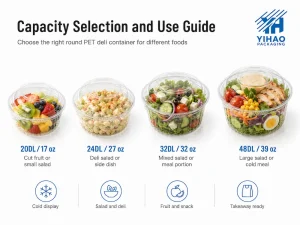
For salad and deli programs, round PET deli containers and square PET deli containers help buyers build a broader packaging system around different food types, portion sizes, and shelf presentation needs.
Core Comparison: Workflow, Display, Cost, and Flexibility
| Comparison Point | Hinged Deli Containers | Separate Lid Containers |
|---|---|---|
| Packing speed | Fast because the lid is already attached | Requires matching and applying a separate lid |
| Inventory control | Simpler SKU handling | More lid/base combinations to manage |
| Food height flexibility | Limited by the fixed lid profile | Better when flat, high, or dome lids are available |
| Retail display | Strong for compact grab-and-go packs | Strong for salads, large portions, and premium display |
| Takeout handling | Convenient for quick-service and single-portion foods | Useful for larger portions and varied menu programs |
| Wholesale planning | Best for standardized programs | Best for mixed menus and multi-size systems |
For buyers comparing hinged deli containers vs separate lid containers, the better format depends on operational pressure. If the main challenge is speed, labor efficiency, and simple SKU control, hinged containers usually win. If the main challenge is menu variation, lid height, and presentation flexibility, separate lid containers usually perform better.
When Hinged Deli Containers Are the Better Choice
Choose hinged containers when packing speed matters
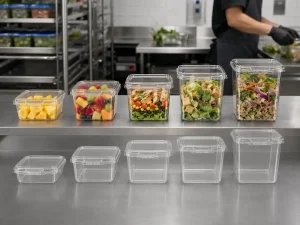
Hinged containers reduce manual handling steps in the packing line. Staff do not need to pick a separate lid, confirm lid size, align the lid, and press around the rim. This matters in supermarket prep rooms, central kitchens, cafes, delis, and grab-and-go food programs where teams pack large quantities of portions within a limited production window.
For standardized foods such as fruit portions, small salads, deli sides, snack packs, sandwiches, and bakery portions, hinged containers keep the process simple. A clear hinged container also reduces the risk of missing lids, wrong lids, or uneven closure caused by rushed handling.
Choose hinged containers for compact grab-and-go foods
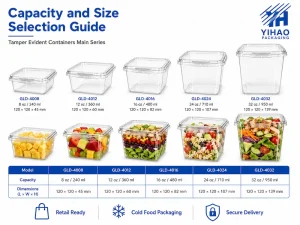
Hinged containers work especially well when the food height is predictable. Sandwiches, fruit portions, deli sides, cookies, snack assortments, and compact salad portions benefit from a fixed lid structure. For lighter portions, small hinged food containers give buyers a clean, simple, and efficient pack for chilled display and takeaway use.
Clear PET hinged formats also support impulse buying. Customers see the food clearly without opening the pack, while the attached lid keeps the product protected during shelf handling, customer pickup, and takeaway movement.
Choose hinged containers when lid inventory must stay simple
Lid inventory becomes a hidden cost when teams manage many container sizes. Separate lids must be ordered, stored, counted, protected from dust, and paired correctly. Hinged packaging removes that extra inventory layer. For buyers who prefer fewer SKUs and faster warehouse handling, hinged packaging is often the cleaner choice.
This is why many retail food programs use hinged PET clamshell containers for specific grab-and-go categories. A sandwich line may use clear PET clamshell containers, while a deli counter may use larger hinged packs for fuller chilled food portions.
When Separate Lid Containers Are the Better Choice
Choose separate lid containers when menu variety is broad
Separate lid containers perform better when one operation sells many foods with different heights, textures, and portion styles. A salad bowl program may include leafy salads, protein salads, fruit mixes, pasta salads, chilled noodles, grain bowls, and topped meal salads. These foods do not always fit one lid height.
With separate lid systems, the buyer can pair the base with a flat lid for compact foods or a dome lid for taller foods. This makes dome takeout container lids useful for salads, toppings, fruit bowls, and foods that need extra headspace without crushing the presentation.
Choose separate lid containers for salad bowls and larger portions
Separate lid salad bowls are strong for retail deli packaging because they offer better height flexibility and a more premium serving impression. Large salads, fruit bowls, family-size portions, and chilled meal bowls often look better in bowl-style containers with independent lids.
For medium salad portions, clear PET salad bowls support grab-and-go use. For fuller meal salads and chilled ready-to-eat foods, buyers often move toward larger bowl systems or compatible lid programs that create better vertical space and stronger shelf presence.
Choose separate lid systems for compatibility planning
Separate lid systems make sense when one lid fits multiple bases or one base accepts different lid profiles. This structure helps buyers build a more flexible wholesale packaging range. For square container programs, a universal PET lid can simplify ordering across several compatible container sizes.
Wholesale buyers should still verify lid fit before bulk purchasing. A lid that appears compatible may perform differently under stacking, chilled storage, transport vibration, label pressure, or customer handling. Samples should be tested with real food weight, real filling conditions, real labels, and real shelf display conditions.
Material Considerations: PET, rPET, PP, and Food Use
For chilled deli packaging, clear PET and rPET are widely used because they support high product visibility, rigid structure, and clean retail presentation. PET works well for cold-case display, fresh-cut fruit, salads, deli sides, bakery portions, and ready-to-eat chilled foods. Buyers comparing hinged food containers and separate lid salad bowls should confirm whether the selected material matches the intended food type, temperature, storage duration, and distribution route.
For hot-fill, reheating, or microwave use, buyers should not assume that a clear PET container is suitable unless the supplier clearly confirms the intended condition of use. When a food program requires heat resistance or microwave reheating, microwave safe containers should be evaluated separately from standard clear PET deli packaging.
When recycled content is involved, food-contact suitability matters. Buyers should ask whether the rPET source, recycling process, and intended food-contact use are appropriate for the target market. This is especially important for export buyers, private-label food brands, and retailers that need documentation for their compliance files.
Retail Display: Which One Looks Better on Shelf?
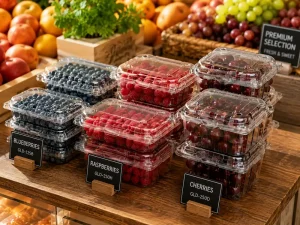
Hinged containers and separate lid containers both support strong retail display, but they present food differently. Hinged clamshells create a compact, clean, and practical shelf look. They are especially effective for single portions, sandwiches, cut fruit, small deli salads, snack packs, and bakery items that benefit from clear top visibility.
Separate lid containers create a more bowl-like or prepared-meal presentation. This works well when the product has height, layers, toppings, or premium portion value. Salad bowls, fruit bowls, chilled noodle bowls, pasta salads, and deli meal bowls often look more abundant in separate lid systems.
For retail deli packaging, buyers should compare three visual details before selecting the format:
- Top visibility: Can customers see the main ingredients clearly?
- Side visibility: Does the container show freshness, color, and portion depth?
- Label placement: Does the label support branding without blocking the food?
A good container should make the food look fresh, organized, and ready to buy. If the package hides the ingredients or crushes the food, the lower packaging cost may reduce final sales value.
Leak Resistance and Closure Performance
Leak resistance depends on container design, rim structure, lid fit, food type, handling angle, and transport conditions. A hinged container may close quickly, but buyers still need to test whether the closure holds under real use. A separate lid container may offer a strong rim fit, but the lid must be applied correctly and matched to the right base.
For wet foods, sauced salads, juicy fruit, and deli sides, sample testing is essential. Test filled samples upside down, sideways, stacked, refrigerated, and transported. The test should include real food weight, not only water. Foods with oil, dressing, syrup, or small particles may behave differently from plain water.
Buyers should also check how the container performs after labeling. A large label can pull on the lid, add tension to the hinge, or interfere with rim closure. This is one reason retail buyers should approve the full packaging system, not just the empty container.
Stacking, Storage, and Distribution
Hinged containers often simplify packing-line flow, but they may use more open storage space depending on shape and nesting design. Separate lid containers may nest efficiently when bases and lids are stored separately, but they require two inventory streams.
For wholesale deli packaging, buyers should compare empty nesting height, filled stacking stability, case pack efficiency, warehouse shelf space, production-line handling speed, chilled stacking performance, and lid separation risk. A container that looks excellent in a sample room may not be the best option in a warehouse or high-volume packing operation.
| Operational Factor | Why It Matters | Buyer Checkpoint |
|---|---|---|
| Empty nesting | Affects storage space and case efficiency | Compare nested height and carton quantity |
| Filled stacking | Affects shelf display and transport stability | Test real food weight under chilled conditions |
| Lid fit | Affects leakage, closure, and customer handling | Approve lid and base together |
| Label placement | Affects visibility, barcode scanning, and lid pressure | Test with final label size and adhesive |
Wholesale Buying: How to Compare Cost Correctly
Do not compare hinged and separate lid containers only by unit price. The better wholesale decision includes labor, lid matching, storage, packaging waste, speed, customer experience, and product appearance. A slightly higher-cost container may reduce labor and errors. A separate lid system may cost more in SKU management but create stronger menu flexibility.
For example, large hinged deli containers can be efficient when the food program uses repeatable portions. But when the operation sells different salad heights and toppings, a separate bowl and lid system may reduce food damage and improve presentation.
Wholesale buyers should ask whether the package supports the full cost picture: production speed, lid matching, storage space, product display, staff training, customer use, and reorder simplicity. A lower unit cost is not always a lower operating cost.
Questions to Ask Before Ordering Samples
Before ordering samples, buyers should translate the packaging decision into practical questions. This helps prevent choosing a container that looks good online but fails under real operating conditions.
- Will the food be packed cold, room temperature, or warm?
- Does the product need flat, dome, or high-profile lid space?
- Will the container be stacked after filling?
- Does the label affect lid closure or food visibility?
- Is one container size enough, or does the program need a full size range?
- Will the buyer reorder by container only, lid only, or matched sets?
- Does the food release moisture during chilled storage?
- Will customers open and reclose the package after purchase?
- Does the package need to fit retail shelves, delivery bags, or catering trays?
For buyers who need packaging for prepared meals and bakery display, a clear separate lid food container gives another option when hinged clamshells do not provide enough lid-height flexibility.
Best Applications for Hinged Deli Containers
Hinged containers are especially suitable for standardized, visible, chilled, and fast-packed food categories. They perform well when the food height is predictable and the operator wants fast closure without separate lid handling.
- Fresh-cut fruit portions
- Small and medium deli salads
- Grab-and-go snack packs
- Sandwiches and wraps
- Bakery portions and cookies
- Cold deli sides
- Prepared chilled foods with fixed portion height
Best Applications for Separate Lid Containers
Separate lid containers are better when food height, menu variation, and lid choice matter. They give packaging teams more control over presentation and compatibility across a broader food program.
- Meal salads with toppings
- Fruit bowls and mixed fruit portions
- Chilled noodle bowls
- Pasta salads and grain bowls
- Large deli sides
- Prepared meal portions
- Food programs requiring flat and dome lid options
Buyer Decision Matrix
| Buying Situation | Recommended Choice | Reason |
|---|---|---|
| High-speed grab-and-go packing | Hinged container | Attached lid reduces handling steps |
| Meal salads with toppings | Separate lid container | Dome or high lid provides headspace |
| Small fruit or snack portions | Hinged container | Compact, clear, and easy to close |
| Multiple base sizes under one lid system | Separate lid container | Better compatibility planning |
| Simple SKU control | Hinged container | No independent lid inventory |
| Premium salad bowl presentation | Separate lid container | Better food height and visual volume |
Supplier Checklist for Wholesale Deli Packaging
Before placing a wholesale order, packaging buyers should evaluate more than price and appearance. A reliable supplier should help verify material, structure, lid fit, sample performance, and packaging consistency.
- Material confirmation: Confirm PET, rPET, PP, or other material according to food type and use condition.
- Closure testing: Test hinge, rim, snap fit, lid pressure, and opening resistance.
- Food compatibility: Test with actual salad, fruit, dressing, bakery, or deli food.
- Stacking performance: Test empty nesting and filled stacking under chilled conditions.
- Label layout: Confirm label size, adhesive behavior, barcode area, and product visibility.
- Transport simulation: Check vibration, tilting, and case handling.
- Wholesale consistency: Confirm repeatable forming quality, clear material appearance, and stable lid fit.
- Factory support: Work with a supplier that understands tooling, production, sample review, and bulk order quality control through factory-direct packaging support.
Common Mistakes Buyers Should Avoid
Choosing by container shape only
A round bowl, square container, or hinged clamshell may look suitable, but the real decision depends on food height, fill weight, lid fit, shelf display, packing speed, and transport. Shape alone does not define performance.
Ignoring lid compatibility
Separate lid systems must be tested carefully. Even a small rim difference can affect closure, stacking, leakage, and customer handling. Buyers should always approve lid and base together.
Using one package for every food type
A single container rarely fits every food category. Fresh fruit, leafy salad, pasta salad, sandwiches, bakery portions, and sauced deli sides behave differently. A practical packaging range usually combines hinged containers and separate lid systems.
Overlooking recyclability design details
Material choice is important, but labels, inks, adhesives, colors, size, and attachments also affect recyclability. Buyers should avoid broad claims unless the package design, local collection access, and market acceptance support the claim.
Practical Recommendation
For most food packaging teams, the best strategy is not to choose only one format. Use hinged containers for fast, standardized, compact grab-and-go foods. Use separate lid containers for salads, larger portions, mixed menus, and products needing lid-height flexibility.
A strong deli packaging program often includes small hinged containers for snack packs and deli sides, medium hinged containers for fruit and salads, clear PET clamshells for sandwiches, round PET bowls for salad and fruit bowls, square PET containers for premium chilled foods, and separate flat or dome lids for flexible menu presentation.
This combined approach gives buyers speed where speed matters and flexibility where food presentation matters. It also supports better wholesale planning because each package format has a clear role instead of forcing one container style into every application.
FAQ
1. What is the main difference between hinged deli containers and separate lid containers?
Hinged deli containers have the lid attached to the base, while separate lid containers use an independent lid. Hinged containers are faster for packing and simpler for inventory. Separate lid containers offer more flexibility for salad bowls, larger portions, lid height options, and mixed food programs.
2. Are hinged food containers better for grab-and-go packaging?
Yes, hinged food containers are often better for grab-and-go packaging when the food height is predictable and the packing line needs speed. They reduce lid matching, simplify handling, and create a clean retail-ready pack for fruit, snacks, sandwiches, deli sides, and compact salads.
3. When should buyers choose separate lid salad bowls?
Buyers should choose separate lid salad bowls when the product needs more headspace, stronger bowl presentation, or different lid profiles. They are suitable for meal salads, fruit bowls, pasta salads, chilled noodles, grain bowls, and larger deli portions.
4. Are PET clamshell containers suitable for hot foods?
Standard PET clamshell containers are mainly selected for chilled and cold display foods. Buyers should not use PET for hot-fill, microwave, or reheating applications unless the supplier clearly confirms the intended use. Hot food programs normally require materials and containers designed for those temperature conditions.
5. How should wholesale buyers test deli containers before bulk orders?
Wholesale buyers should test real food weight, lid fit, stacking, chilled storage, label placement, leakage, transport handling, and customer opening experience. Testing should include the exact food type and packaging workflow instead of judging only empty samples.
References
- U.S. Food and Drug Administration, Recycled Plastics in Food Packaging.
- U.S. Food and Drug Administration, Guidance for Industry: Use of Recycled Plastics in Food Packaging: Chemistry Considerations.
- Association of Plastic Recyclers, APR Design Guide for Plastics Recyclability.
- European Commission, Commission Regulation (EU) 2022/1616 on recycled plastic materials and articles intended to come into contact with foods.
- NAPCOR, PET Recycling Reports and PET recycling industry resources.
- Federal Trade Commission, Guides for the Use of Environmental Marketing Claims.
Deep Dive Insights
How should buyers think about hinged deli containers vs separate lid containers?
Buyers should compare the two formats by workflow first, not by shape. Hinged containers reduce packing steps and simplify lid control, making them suitable for standardized grab-and-go foods. Separate lid containers create more flexibility for salads, larger portions, dome lids, and multi-size packaging systems.
Why does lid structure affect total packaging cost?
The lid structure affects labor, storage, inventory counting, packing speed, lid mismatch risk, and customer handling. A separate lid system may offer better food presentation, but it also adds another SKU to manage. A hinged system may look slightly less flexible, but it can reduce labor pressure and improve packing consistency.
What should buyers prioritize before choosing a format?
Buyers should prioritize food height, moisture level, display style, stacking requirement, labeling method, distribution route, and reorder structure. The best format is the one that protects the food and fits the real packing workflow.
Option to consider for mixed food programs
For mixed deli, salad, fruit, and prepared food programs, a combined packaging system is often stronger than one single format. Hinged containers can cover fast-moving standard portions, while separate lid bowls and containers can support premium salads, larger portions, and foods that need extra headspace.
Consideration for wholesale packaging selection
Wholesale buyers should approve samples under real conditions before bulk orders. The test should include actual food, final labels, chilled storage, stacking, transport movement, and customer opening. This prevents packaging decisions based only on empty samples or catalog photos.
Final Note / Practical Takeaway
© YIHAO Packaging. All rights reserved. All articles, product images, packaging designs, technical specifications, and website materials are protected by copyright. Unauthorized copying, reproduction, redistribution, modification, or commercial use is strictly prohibited without prior written permission.