Choosing the right hinged food containers is not only a packaging decision. It affects retail display, takeaway handling, packing speed, lid security, chilled shelf organization, and customer confidence. For supermarkets, cafes, bakeries, deli counters, salad bars, convenience stores, foodservice brands, and distributors, the best container format is the one that matches the food, the selling channel, and the expected handling process.
YIHAO supports food packaging buyers with clear PET and rPET packaging solutions for chilled food, fresh produce, deli items, salads, snacks, desserts, and grab-and-go retail programs. For wholesale buyers, foodservice distributors, and private-label packaging teams, working with a reliable manufacturer and supplier helps reduce lid mismatch, unstable carton planning, weak closure performance, and repeat-order inconsistency.
This guide compares hinged deli containers, PET clamshell containers, separate lid salad bowls, square PET containers, and takeout container lids so buyers can make a practical packaging decision before sampling, customization, or wholesale ordering.
Why Hinged Food Containers Work Well for Retail Display and Takeaway
Hinged food containers combine the base and lid into one connected structure. This simple format solves several operational problems at once. Staff do not need to match a separate lid to each base, packing speed is faster during busy hours, and the container usually closes in one clear motion. For grab-and-go retail programs, that matters.
In chilled food packaging, visibility is one of the strongest advantages. Clear PET hinged containers allow salads, fruit cups, sandwiches, pastries, deli sides, and snack packs to be displayed directly through the lid. For retail buyers, this improves shelf impact because customers see color, portion size, layering, freshness cues, and ingredient arrangement before purchase.
Compared with many opaque, paper-based, or multi-part formats, hinged deli containers are especially practical for cold display counters, convenience stores, takeaway fridges, supermarket meal programs, prepared food shelves, and deli counters. They provide a direct visual connection between the food and the customer.
Hinged Deli Containers vs Separate Lid Containers: Which One Should Buyers Choose?
The common question for food packaging buyers is not whether hinged formats are always better. The stronger question is when hinged formats create more value than separate lid formats. A useful deli container comparison should look at workflow, food height, sealing expectations, merchandising style, storage, and SKU management.
| Comparison Point | Hinged Food Containers | Separate Lid Containers | Best Buying Logic |
|---|---|---|---|
| Packing Speed | Fast, because lid and base are connected | Requires lid matching and lid storage | Choose hinged for high-volume grab-and-go packing |
| SKU Control | Fewer matching issues and simpler inventory handling | More flexible but requires lid compatibility control | Choose hinged when teams want fewer lid errors |
| Retail Visibility | Strong for top-view and front-facing chilled display | Strong when dome lids or tall lids are needed | Choose based on food height and presentation style |
| Food Height | Best for controlled portions and stable food stacks | Better for tall salads, toppings, and larger bowl meals | Use separate lids when vertical space matters more |
| Takeaway Handling | Convenient for quick closing and direct handoff | Good when bowl depth and lid grip are priorities | Test lid fit, stacking, and transport movement before bulk orders |
| Storage and Operations | One-piece format simplifies daily packing workflow | Separate bases and lids need more organized storage | Choose based on staff workflow and back-of-house space |
For many chilled food programs, clear hinged deli containers are a practical starting point because they fit common retail needs such as deli salads, cut fruit, snack mixes, prepared sides, and refrigerated takeaway portions. Larger portions, family packs, or meal-sized chilled foods may need larger hinged packs with stronger stacking and clearer portion presentation.
Food Type Selection Matrix for Hinged Food Containers
A packaging buyer should not select one container format for every food category. The right format depends on food shape, portion size, moisture level, shelf display, takeaway movement, and customer opening experience. The matrix below gives a practical starting point for comparing hinged food containers, separate lid bowls, square PET containers, and PET clamshell containers.
| Food Type | Best Container Format | Why It Works | Buyer Checkpoint |
|---|---|---|---|
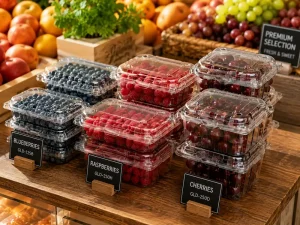
| Cut Fruit and Berries | Hinged PET deli container or PET clamshell container | Clear display supports color, freshness, and portion visibility | Check ventilation, condensation, stacking, and chilled shelf clarity |
| Deli Salads and Side Dishes | Hinged deli container or square PET container | Fast closing, clear display, and organized shelf presentation | Test lid fit, label placement, and takeaway movement |
| Large Salads and Bowl Meals | Separate lid salad bowl | More depth, better topping room, and flexible lid options | Confirm lid diameter, lid height, and stacking behavior |
| Sandwiches and Wraps | PET clamshell container | Flat display area and clear lid improve grab-and-go presentation | Check hinge strength, closing feedback, and shelf orientation |
| Bakery Portions and Pastries | PET clamshell container | Transparent structure protects shape while showing product texture | Check product height, lid clearance, and crush resistance |
| Chilled Prepared Foods | Square PET container or separate lid food container | Structured shape helps shelf blocking and carton efficiency | Test closure, label area, and storage stability |
Best Applications for Hinged Food Containers
Retail Display Foods
Retail display demands clarity, neat stacking, and consistent product presentation. Hinged food containers work well when the product must be visible from the top and front. They are commonly used for fruit portions, deli sides, chilled noodles, snack trays, sandwiches, bakery portions, dessert slices, and small meal packs.
For display-heavy categories, PET clamshell containers are especially useful because the clear lid turns the package into a display window. This is important when the product’s color, freshness, and arrangement influence purchasing decisions.
Takeaway and Grab-and-Go Foods
Takeaway packaging must survive handling from counter to bag to customer. A good hinged container should close smoothly, resist accidental opening during normal handling, and maintain a clean appearance after packing. For cafes and foodservice counters, one-piece hinged construction also reduces the chance that staff choose the wrong lid during rush periods.
For grab-and-go salads, fruit, deli sides, and snack packs, hinged salad bowls help simplify packing while keeping the product visible. This format is useful when buyers want the bowl and lid to remain connected throughout the preparation and selling process.
Chilled Food and Cold Shelf Programs
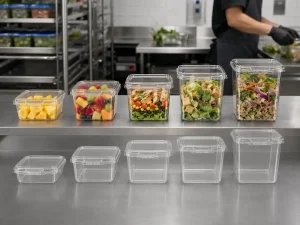
Chilled food packaging must support visibility, stacking, cold case organization, and clean handling. Hinged food containers are suitable for refrigerated foods when the material, closure, shape, and food-contact use are appropriate for the intended application. Buyers should confirm food type, storage condition, sample performance, and local compliance requirements before placing wholesale orders.
For chilled salad programs, fruit cups, cold noodles, deli salads, and prepared meal sides, deli and salad containers give buyers multiple structure choices: hinged deli containers, round PET bowls, square PET containers, and separate-lid formats.
When Separate Lid Salad Bowls Are the Better Choice
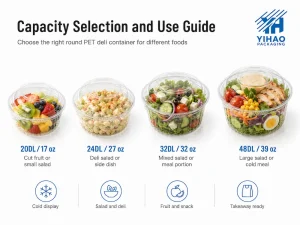
Hinged formats are efficient, but separate lid salad bowls still have a strong place in food packaging. They are often better when the food needs more bowl depth, more topping space, a higher lid profile, or stronger premium presentation. Grain bowls, large salads, fruit platters, chilled noodles, layered toppings, and shared portions often benefit from a bowl-and-lid structure.
separate lid salad bowls also allow buyers to manage different lid styles across compatible bowl sizes. This is useful when a brand sells several SKUs with different topping heights or presentation needs. However, buyers must control lid compatibility carefully. A separate-lid system only works well when bases, flat lids, dome lids, and case inventory are managed correctly.
For larger salads and chilled food bowls, buyers often need reliable large salad bowl lids that match the bowl diameter, stacking expectation, and transport process. Lid mismatch is one of the easiest problems to avoid during sampling, but one of the most expensive problems to discover after a bulk shipment arrives.
Takeout Container Lids: What Buyers Should Check
Takeout container lids affect more than closure. They influence shelf appearance, stacking stability, anti-fog performance, label placement, and customer opening experience. Whether a buyer chooses hinged containers or separate lids, the lid should be checked under real packing conditions.
For PET bowl systems, takeout container lids should be evaluated for rim fit, clarity, closing feedback, stacking performance, label space, and handling after refrigeration. If the lid will carry a label, sticker, tamper strip, or branding element, buyers should test how the label affects opening, condensation, shelf appearance, and recycling compatibility.
PET Clamshell Containers and Hinged Deli Containers: Material and Design Factors
PET is widely used for clear chilled food packaging because it supports high visual clarity and strong retail presentation. In PET clamshell containers and hinged deli formats, buyers should review wall thickness consistency, hinge flexibility, lid clarity, rim strength, stacking shape, and closure feel.
For sustainability positioning, rPET content may be attractive to brands and retailers, but claims must remain accurate and region-specific. Buyers should confirm food-contact suitability, recycled-content documentation, local acceptance of PET recycling, and label or adhesive compatibility. A clear container can lose recycling value when labels, inks, adhesives, or mixed materials interfere with local sorting and recycling systems.
Food brands should not select a container only because it looks clear in a sample photo. Real testing should include packing speed, chilled shelf stacking, label placement, condensation behavior, customer opening, and transport simulation. This practical testing process separates a good-looking sample from a packaging format that performs well in daily retail use.
Square PET Containers for Deli Sides, Salads, and Fresh Food
Round bowls are strong for salads and layered meals, while square PET containers are useful when shelf space, carton packing, and modular display matter. Square shapes often present well in refrigerated shelves because they reduce wasted space between units and create a tidy retail block.
For buyers comparing hinged and separate-lid systems, a separate lid food container may be better when the product needs a flatter base, a flexible lid option, or a more structured display surface. This is especially relevant for prepared meals, deli sides, bakery display, or foods that require a more controlled top profile.
Tamper Evidence and Retail Trust
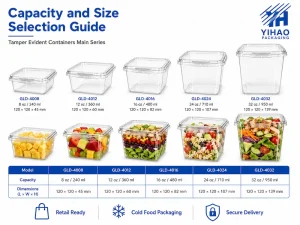
Not every chilled food item requires tamper evidence, but some retail programs benefit from visible security features. Pre-packed foods, grab-and-go chilled items, refrigerated deli portions, and third-party retail programs may need extra customer confidence. In those cases, tamper evident containers should be compared with regular hinged formats.
The buying logic is direct: use standard hinged containers when speed, display, and convenience are the main priorities; consider tamper-evident formats when product security, retail trust, and visible opening control matter more. Buyers should decide this early because tamper-evident structures affect mold design, closure behavior, packing workflow, and customer opening experience.
Sample Testing Checklist Before Wholesale Orders
Before wholesale orders, buyers should test packaging with real food, real labels, and real operating conditions. Empty samples are useful for first inspection, but they do not reveal every issue that appears during actual packing, chilled storage, retail display, or takeaway movement.
| Testing Item | What to Test | Why It Matters |
|---|---|---|
| Real Food Fill Test | Pack the actual salad, fruit, deli side, sandwich, pastry, or chilled food | Confirms height, portion appearance, and lid clearance |
| Chilled Shelf Test | Place packed samples under intended refrigeration conditions | Reveals condensation, stacking, visibility, and shelf presentation issues |
| Closure Test | Open and close the lid repeatedly during packing simulation | Checks hinge flexibility, closing feedback, and staff handling comfort |
| Label Placement Test | Apply barcode labels, ingredient labels, or brand stickers | Confirms scanning, visibility, opening path, and recycling impact |
| Stacking Test | Stack filled containers in shelves, cartons, and cold storage | Checks deformation, lid pressure, and display stability |
| Takeaway Movement Test | Simulate bagging, handoff, transport, and customer handling | Shows whether the lid stays secure during normal movement |
| Supplier Consistency Check | Review product family, repeat-order support, sample response, and carton logic | Reduces long-term procurement risk for wholesale buyers |
Manufacturer, Wholesale, and Supplier Checklist
A reliable food packaging manufacturer should help buyers compare container structure, material, lid fit, display needs, packing process, and carton logic before bulk ordering. The best supplier conversation is not simply “what is your price?” It should start with the food type, storage condition, sales channel, and expected handling process.
| Buyer Question | Why It Matters | What to Check Before Wholesale Orders |
|---|---|---|
| What food will be packed? | Different foods create different height, moisture, oil, and display needs | Test with real salad, fruit, deli, bakery, or chilled food samples |
| Will the product be sold chilled? | Cold display affects condensation, stacking, and lid clarity | Run chilled shelf and handling tests before bulk purchase |
| Is one-piece or separate-lid packing better? | Workflow affects labor speed and inventory control | Compare packing time, lid matching, storage, and staff handling |
| Does the lid close securely? | Weak closure increases complaints and product loss | Test closure feedback, rim fit, stacking, and takeaway movement |
| Where will labels be placed? | Labels affect branding, barcode scanning, and recyclability | Test label size, adhesive, placement, and customer opening |
| Is the supplier ready for repeat orders? | Wholesale buyers need consistency, not one-time samples | Confirm product family, sample process, carton logic, and communication speed |
How to Choose the Best Hinged Food Containers
The best hinged food containers are selected through a practical decision process, not by capacity alone. Capacity matters, but food height, lid clearance, shelf display, label position, stacking strength, and staff workflow usually matter more in real operations.
1. Start with the Food Category
Fruit portions, deli sides, sandwiches, salads, pastries, desserts, nuts, chilled noodles, and prepared foods do not need the same container. A shallow PET clamshell may work well for sandwiches or bakery items, while a deeper hinged deli container may suit salads, fruit, and deli portions.
2. Match the Container to the Display Method
If the product sells through visual appeal, clarity matters. If the product is stacked in a chilled shelf, lid shape and stacking stability matter. If the product is sold through takeaway counters, closing speed and transport handling matter.
3. Compare Hinged vs Separate Lid Workflow
For high-speed packing, hinged formats reduce lid-matching problems. For large salads, premium bowls, and topping-heavy meals, separate lids offer more flexibility. This is the central logic behind hinged deli containers vs separate lid containers.
4. Test Before Bulk Orders
Sampling should include real food, actual labels, chilled storage, stacking, opening, closing, and transport movement. A packaging sample should be tested like a working retail product, not only viewed as an empty container.
Common Buying Mistakes to Avoid
One common mistake is choosing only by capacity. Capacity is important, but food height, display area, lid shape, and closure structure often matter more in real retail conditions. Another mistake is testing containers without labels. Labels can change visibility, lid opening, barcode scanning, and recycling compatibility.
Buyers should also avoid mixing too many similar SKUs without clear logic. A strong packaging line usually has a clear purpose for each format: small hinged deli packs for snacks and sides, medium hinged packs for salads and fruit, PET clamshell containers for sandwiches and bakery display, separate lid bowls for larger salads, and square PET containers for modular shelf display.
Final Buyer Recommendation
For retail display, takeaway, and chilled food programs, hinged food containers are the best first option when buyers need speed, clarity, one-piece handling, and efficient shelf presentation. Separate lid salad bowls are better when food height, bowl depth, premium presentation, and lid flexibility are more important. PET clamshell containers are strong for sandwiches, bakery display, fruit, and snack packs where the lid acts as a clear merchandising window.
The best result comes from building a balanced packaging system rather than choosing one format for every food. A serious wholesale buyer should compare hinged deli containers, PET clamshell containers, round salad bowls, square PET containers, and takeout container lids as a complete product line.
FAQ
1. What are hinged food containers used for?
Hinged food containers are used for salads, deli sides, fruit portions, sandwiches, snacks, bakery items, chilled prepared foods, and grab-and-go meals. They are popular because the lid and base stay connected, which helps packing speed and inventory control.
2. Are hinged deli containers better than separate lid containers?
Hinged deli containers are better for fast packing, simple SKU control, and clear retail display. Separate lid containers are better when the food needs more bowl depth, taller lid space, or flexible lid matching. The best choice depends on food height, display style, and handling process.
3. Are PET clamshell containers good for chilled food?
PET clamshell containers are commonly used for chilled display foods such as fruit, sandwiches, bakery portions, deli items, and snack packs. Buyers should confirm material suitability, closure performance, label placement, and chilled shelf behavior before wholesale ordering.
4. When should buyers choose separate lid salad bowls?
Buyers should choose separate lid salad bowls when they need deeper bowls, higher lids, premium salad presentation, large meal portions, or flexible lid options across different bowl sizes.
5. What should a wholesale buyer ask a hinged food container supplier?
A wholesale buyer should ask about food-contact suitability, PET or rPET material options, sample testing, lid fit, carton packing, label placement, available container families, customization options, and repeat-order consistency.
References
- U.S. Food and Drug Administration, Packaging & Food Contact Substances.
- European Commission, Regulation (EU) No 10/2011 on plastic materials and articles intended to come into contact with food.
- Association of Plastic Recyclers, APR Design Guide Overview.
- Association of Plastic Recyclers, PET Rigid Design Guidance.
- USDA Food Safety and Inspection Service, Refrigeration and Food Safety.
- U.S. Code of Federal Regulations, 9 CFR Part 317 Labeling, Marking Devices, and Containers.
- European Commission, Union guidance on information in the supply chain for plastic food-contact materials.
- Food packaging industry best practices for chilled retail display, label testing, and supplier sampling.
Deep-Dive Insights: How Buyers Should Think About Hinged Food Containers
What makes hinged containers practical for chilled retail food?
Hinged food containers simplify the packing process because the lid and base stay connected. This helps foodservice teams reduce lid-matching mistakes, speed up counter packing, and keep chilled display shelves more consistent. For high-volume grab-and-go foods, this operational value is often as important as the container material itself.
Why do buyers still compare hinged formats with separate lid containers?
Separate lid containers remain valuable when food height, bowl depth, or premium presentation is more important than one-piece speed. Large salads, layered fruit bowls, chilled noodles, and topping-heavy meals often need more vertical space than a standard hinged format provides. This is why a serious deli container comparison should always include both hinged and separate-lid systems.
How should a wholesale buyer make the final decision?
The final decision should come from real sample testing. Buyers should pack the actual food, apply the actual label, store the container under chilled conditions, stack it in the intended shelf or carton, and simulate takeaway handling. A container that looks clear when empty still needs to prove closure strength, shelf stability, label compatibility, and customer opening comfort.
Option logic for retail and foodservice teams
Choose hinged PET deli containers when the priority is speed, clarity, and simple SKU control. Choose PET clamshell containers when sandwiches, bakery portions, fruit, or snacks need a clear merchandising window. Choose separate lid salad bowls when bowl depth and topping height matter. Choose square PET containers when modular shelf display and carton efficiency are important.
Consideration for supplier selection
A good supplier should not push one format for every application. The stronger approach is to recommend a practical packaging system based on food type, shelf display, packing workflow, and wholesale repeat-order needs. That is what turns packaging from a simple container purchase into a stable retail food packaging solution.
Final Note / Practical Takeaway
© YIHAO Packaging. All rights reserved. All articles, product images, packaging designs, technical specifications, and website materials are protected by copyright. Unauthorized copying, reproduction, redistribution, modification, or commercial use is strictly prohibited without prior written permission.