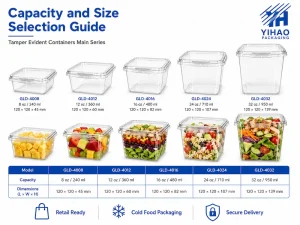
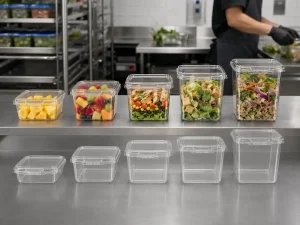
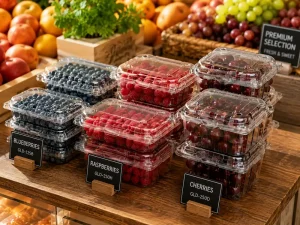
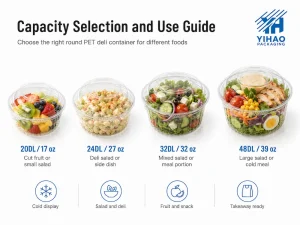
A practical deli container comparison is not only about choosing a box shape. For food packaging teams, it is a decision about menu type, chilled display, packing speed, lid control, stacking performance, leakage risk, retail presentation, supplier consistency, and long-term wholesale order stability. A salad bar, supermarket chilled case, meal prep counter, grab-and-go fridge, convenience store, and catering operation do not need the same container structure, even when all of them sell fresh prepared foods.
For buyers, the most common comparison is hinged deli containers vs separate lid containers. Hinged containers keep the lid and base connected, which simplifies handling and supports fast packing. Separate lid formats, including round salad bowls and square deli containers, give buyers more flexibility in lid height, topping space, stacking logic, and replacement lid management. Both formats have real value. The stronger choice depends on food type, service speed, shelf display, and how the product is handled before it reaches the customer.
YIHAO works with food packaging buyers who need clear food containers for chilled meals, salads, cut fruit, deli sides, snacks, bakery portions, and takeaway counters. This guide explains how to compare container formats before a wholesale order, so the buying decision is based on actual food behavior instead of only price, size, or visual appearance.
Why Deli Container Comparison Matters for Food Packaging Teams
Deli packaging sits in a demanding category. It needs to look clean, protect the food, help staff pack quickly, stack neatly, and support customer confidence in chilled display. The package is also part of the selling system. A clear lid helps customers inspect salad color, fruit freshness, pasta texture, sauce separation, ingredient layering, and portion value without opening the pack.
A useful deli container comparison should answer practical buying questions:
- Does the container match the food type: salad, fruit, deli side, pasta, snack, bakery portion, or chilled meal?
- Does the closure structure fit the packing speed and service environment?
- Does the lid height protect toppings, garnishes, sauces, or layered foods?
- Does the container stack well during filling, refrigeration, transport, and shelf display?
- Does the container family support multiple portion sizes without creating lid confusion?
- Can the supplier support consistent quality across repeat wholesale orders?
Many buyers start by asking for “a clear deli container,” but that phrase is too broad. A shallow hinged clamshell, a deep salad bowl, a square PET deli base, and a separate-lid food container solve different problems. Buyers should first define the food and display scenario, then compare the container family.
Deli Container Comparison by Packaging Structure
A professional deli container comparison should begin with structure, not capacity. Hinged containers, separate lid bowls, square PET bases, and PET clamshell containers each solve a different packaging problem. Buyers should compare how the lid closes, how the food sits inside the base, how the container stacks after filling, and how the finished pack looks in a chilled retail case.
| Packaging Structure | Best Use | Main Advantage | Buyer Checkpoint |
|---|---|---|---|
| Hinged deli containers | Deli sides, fruit portions, snacks, compact meals | Fast packing because lid and base stay connected | Check hinge depth, lid pressure, and stacking stability |
| Separate lid salad bowls | Leafy salads, grain bowls, fruit bowls, meal salads | More vertical space and flexible lid choice | Check lid fit, rim strength, and headspace |
| Square PET deli containers | Prepared meals, pasta salads, chilled sides, snacks | Efficient shelf layout and carton organization | Check matching lids and stack pressure |
| PET clamshell containers | Grab-and-go display, fresh food, bakery crossover items | Clear visibility and simple opening logic | Check food height, closure feel, and display clarity |
Hinged Deli Containers vs Separate Lid Containers: The Core Difference
The biggest structural difference is simple: hinged deli containers connect the lid and base into one piece, while separate lid containers use an independent base and matching lid. That difference affects filling speed, storage control, staff training, lid inventory, stacking behavior, and how the product looks on shelf.
| Comparison Point | Hinged Deli Containers | Separate Lid Containers |
|---|---|---|
| Structure | Lid and base are connected | Base and lid are packed as separate components |
| Best For | Fast packing, grab-and-go foods, portioned deli items | Salads, larger bowls, topping space, flexible lid selection |
| Operational Advantage | No lid matching during packing | Flexible lid height and replacement lid control |
| Display Advantage | Clear front-facing food visibility | Better height options for layered salads and premium meals |
| Buyer Risk | Wrong hinge depth may crush high toppings | Wrong lid match may reduce closure consistency |
In a high-speed deli counter, hinged deli containers reduce lid confusion because each unit already includes its lid. In salad programs, separate lid salad bowls often make more sense because buyers can choose bowl depth and lid shape based on toppings, sauces, and visual height.
Buyer Decision Matrix: Which Deli Container Should You Choose?
The best deli container format depends on the buyer’s main priority. Some teams need packing speed. Some need stronger visual display. Some need a universal lid system. Others need a full packaging range that supports multiple food categories. The following decision matrix gives buyers a practical starting point.
| Buyer Priority | Recommended Format | Reason | Best-Fit Scenario |
|---|---|---|---|
| Fast packing speed | Hinged deli containers | The lid and base stay connected, reducing lid matching work during service | Deli counters, commissary kitchens, grab-and-go programs |
| Premium salad display | Separate lid salad bowls | The bowl shape gives more height for toppings, greens, proteins, and layered ingredients | Meal salads, grain bowls, chilled salad bars |
| Efficient shelf layout | Square PET deli containers | The square footprint helps improve shelf organization, carton packing, and display alignment | Supermarkets, prepared food displays, chilled meal programs |
| Clear grab-and-go visibility | PET clamshell containers | Clear walls and lids help customers inspect freshness, portion value, and food color | Fresh fruit, snacks, bakery portions, chilled deli foods |
| Flexible lid management | Separate lid food containers | Buyers can manage different lid heights and replacement lid needs more easily | Multi-size packaging programs and wholesale foodservice ranges |
When Hinged Deli Containers Make the Most Sense
Hinged deli containers are strong choices for food programs that value speed, portion control, and clear product visibility. Because the lid stays attached, staff do not need to match a base with a separate lid during peak service. That helps supermarkets, cafes, convenience stores, delis, and commissary kitchens reduce packing mistakes.
For chilled prepared foods, clear hinged deli containers fit small salads, fruit portions, deli sides, snack packs, and compact ready-to-eat meals. The connected lid also helps maintain a neat presentation during takeaway, especially when products are handled by staff, delivery teams, or self-service customers.
Hinged formats work especially well when the food is not too tall. Pasta salad, cut fruit, cold noodles, potato salad, sandwiches, wraps, bakery bites, and snack assortments often fit better than high-piled leafy salads with delicate toppings. If a buyer uses hinged containers for tall salads, the lid profile must be checked carefully to avoid compression.
Best Applications for Hinged Food Containers
- Grab-and-go deli sides with controlled portions
- Fresh fruit packs and snack combinations
- Cold pasta, rice, couscous, and noodle salads
- Compact sandwich, wrap, bakery, and dessert portions
- Retail-ready foods that need quick filling and lid closing
Buyers comparing larger hinged food containers should focus on depth, hinge strength, closure feel, and stacking. A larger size is not automatically better. The right size should hold the food securely without excessive empty headspace.
When Separate Lid Salad Bowls Are the Better Choice
Separate lid salad bowls are often preferred when the food needs height, volume, and a more premium display shape. Round bowls support leafy salads, grain bowls, fruit bowls, pasta salads, and chilled meal bowls because the food can be arranged vertically. A separate lid also allows buyers to choose a flat lid, dome lid, or specialty lid depending on the menu.
For foodservice and retail teams, clear PET salad bowls help present colorful ingredients in a clean, highly visible way. Lettuce, tomatoes, toppings, cheese, noodles, grains, proteins, fruit, and sauces rely on appearance. A bowl shape often gives the product more visual value than a flat container.
The trade-off is inventory control. Separate lid systems require the buyer to manage matching bases and lids. If the lid size, rim fit, and carton labeling are not controlled, staff may choose the wrong lid during service. That can affect closure, stacking, and customer experience.
Best Applications for Separate Lid Salad Bowls
- Leafy salad bowls with toppings and dressing cups
- Grain bowls, protein bowls, and chilled noodle bowls
- Fruit bowls and premium grab-and-go fresh food
- Large portions where bowl depth improves presentation
- Food programs that need multiple lid heights in one container family
For premium meal salads, large salad bowls give buyers more room for layered ingredients. This matters when the product is sold as a full meal rather than a small deli side.
PET Clamshell Containers for Retail Display and Grab-and-Go Foods
PET clamshell containers are widely used because they combine clarity, rigidity, and convenient opening logic. In a deli context, the term may refer to hinged rectangular containers, square food boxes, bakery-style clamshells, or fresh food display packs. The common value is visibility: customers can see what they are buying before opening the pack.
For a deli container comparison, PET clamshell containers should be judged by food height, hinge movement, rim stability, stacking, anti-fog needs, and lid shape. A beautiful clamshell that crushes toppings is not a good match. A strong clamshell that hides the food behind heavy ribs or unclear surfaces may also reduce shelf appeal.
Buyers handling fresh fruit, salad toppings, snack mixes, or chilled deli packs can also compare PET clamshells with fresh-cut fruit containers. This is useful when the same store sells fruit cups, salad sides, deli portions, and snack packs in one chilled display area.
Square PET Deli Containers and Takeout Container Lids
Square PET deli containers give buyers a different type of control. They often use separate lids, which creates flexibility for flat lids, high lids, and shared lid systems across multiple base sizes. This is valuable for teams managing several menu portions while trying to reduce lid complexity.
For example, square PET deli containers fit salad sides, fruit mixes, deli meals, snack portions, and chilled prepared foods that need efficient shelf layout. Square geometry uses shelf space differently from round bowls. It may improve carton packing, fridge organization, and front-facing retail display depending on the buyer’s merchandising plan.
The lid system is the key. takeout container lids should be checked for rim fit, snap consistency, stacking pressure, lid height, and ease of opening. A shared lid can simplify purchasing, but only if it works reliably across the intended base sizes.
Comparison by Food Type: Which Deli Container Fits Best?
| Food Type | Better Container Direction | Buyer Reason |
|---|---|---|
| Small deli sides | Hinged deli containers or square PET containers | Controlled portions, fast packing, compact display |
| Leafy salads | Round salad bowls with separate lids | More vertical space for toppings and meal-style presentation |
| Fresh-cut fruit | Clear hinged packs, bowls, or fruit containers | Visibility, freshness impression, easy chilled display |
| Pasta and grain bowls | Round bowls or deeper square containers | Better depth and topping control |
| Bakery and deli crossover items | PET clamshell containers or separate lid food containers | Clear display and structure that protects product shape |
| Prepared chilled meals | Square PET or PP separate lid containers depending on use | Better meal layout, lid choice, and takeout handling |
For refrigerated retail programs, separate lid food containers help buyers bridge deli, bakery, and prepared meal categories. They are useful when the product needs a clean base-and-lid presentation rather than a connected hinge.
Material Choice: PET, rPET, and PP in Deli Packaging
PET and rPET are commonly considered for clear chilled food packaging because they support high product visibility. For food packaging teams, the main value is retail presentation. Salads, fruit, desserts, and deli sides all benefit from clear walls and lids that help customers inspect freshness before purchase.
When recycled plastic is involved, buyers should avoid vague claims. Recycled-content packaging for food-contact use must be evaluated according to the intended market, food type, supply chain, and supplier documentation. A supplier should explain material suitability, food-contact support, and whether the design is appropriate for the actual use condition.
PP is often used when heat tolerance is part of the requirement. If the food is meant for cold display only, PET or rPET may be more visually attractive. If the food is intended for reheating, buyers should compare cold deli containers with microwave-safe packaging rather than assuming one container can cover every use case.
Sample Testing Checklist Before Wholesale Deli Container Orders
Before confirming a wholesale order, food packaging teams should test samples with the actual food, filling weight, storage condition, and handling process. A container that looks good when empty may perform differently after filling, stacking, refrigeration, and transport.
| Testing Item | What to Check | Why It Matters |
|---|---|---|
| Lid fit test | Check whether the lid closes evenly without loose corners or excessive pressure | Poor lid fit creates handling problems and reduces customer confidence |
| Stacking test | Stack filled samples and inspect whether lower containers deform | Wholesale buyers need containers that survive packing, storage, and transport |
| Cold storage test | Place samples in refrigerated conditions and inspect clarity, lid stability, and condensation behavior | Chilled foods need stable presentation throughout display time |
| Transport test | Move filled containers in cartons or trays and check shifting, opening risk, and appearance | A container must perform beyond the packing table |
| Display test | Place the container under retail lighting and judge visibility, color presentation, and shelf appeal | Clear packaging should help the food sell itself |
| Opening test | Open and close the lid several times to check user experience | A package that is too tight or too loose may create complaints |
Supplier Checklist for Wholesale Deli Containers
A wholesale buyer should compare the supplier as carefully as the container. Good packaging performance depends on repeatable production, clear samples, reliable rim fit, stable carton packing, and realistic communication about material and use conditions. A low unit price can become expensive if lids mismatch, containers deform, or repeat orders vary in clarity and closure feel.
Before placing a wholesale order, ask the manufacturer these questions:
- Can you provide samples for the actual food type and filling weight?
- Are the base and lid designed as a matching system?
- Do the containers stack securely after filling?
- How is carton packing arranged to protect clarity and shape?
- Can the same supplier support hinged, round, and square formats?
- What food-contact documentation can be provided for the intended market?
- Can the supplier support wholesale repeat orders with stable quality?
- Can the supplier help buyers compare container structures before confirming mold direction or bulk order volume?
A strong supplier should not push only one container format. The better answer is to compare food type, application, handling, display, and volume. A professional manufacturer helps buyers build a packaging range, not just buy one item.
Common Buying Mistakes in Deli Container Selection
Choosing by capacity only
Capacity matters, but it does not tell the whole story. Two containers with similar volume may perform differently because of shape, depth, lid profile, rim design, and stacking behavior. Buyers should test real food portions, not only water volume.
Ignoring lid height
Many salad and deli products fail visually because the lid is too low. Leafy greens, croutons, fruit toppings, sauces, and bakery garnishes need headspace. A container that closes tightly but crushes the food is not the right match.
Mixing lids without control
Separate lid systems are useful, but they require disciplined inventory control. If several lids look similar, staff may use the wrong lid during rush hours. This creates closure problems and customer complaints.
Overusing one container family
No single deli container format fits every chilled food. A buyer may need hinged PET containers for fast snack packing, round bowls for meal salads, square containers for efficient shelf layout, and separate lid options for premium prepared foods.
Ignoring carton and warehouse handling
Packaging buyers sometimes evaluate a container only on the table, not in the warehouse. A deli container should be reviewed by carton packing, pallet movement, storage pressure, and picking efficiency. This is especially important for wholesale orders where containers move through several handling stages before use.
How to Build a Smarter Deli Packaging Range
A strong deli packaging range should work like a system. Instead of selecting random containers one by one, buyers should map containers by food type, portion size, lid requirement, and display role. This creates better consistency across the chilled case and simplifies future purchasing.
For example, a supermarket or foodservice team may use small hinged containers for fruit and deli sides, medium hinged containers for grab-and-go meals, round bowls for premium salads, square PET containers for chilled pasta and prepared foods, and larger bowls for family-size portions. This gives customers a clear visual language while giving staff practical packing options.
The category page for deli and salad containers should therefore act as a buyer pathway. From there, users can compare hinged containers, round bowls, square containers, and related lids based on their actual menu structure.
Practical Decision Framework for Food Packaging Teams
Use this framework before choosing a container format:
- Define the food: Is it leafy, wet, oily, tall, layered, fragile, or compact?
- Define the sales channel: Is it retail chilled display, takeaway, delivery, catering, or foodservice prep?
- Define the lid requirement: Does the food need a low lid, high lid, dome lid, or connected hinge?
- Define the material priority: Is clarity more important, or is reheating performance required?
- Define the handling path: Will the food move through filling, cold storage, transport, retail display, and customer takeaway?
- Define the supplier need: Do you need one SKU or a full range across sizes and formats?
For teams comparing large deli containers, the framework is especially important. Large formats are more sensitive to stacking, lid pressure, food movement, and shelf footprint. Buyers should test them with real food under chilled handling conditions before scaling.
FAQ
1. What is the main difference between hinged deli containers and separate lid containers?
Hinged deli containers have the lid and base connected, which supports faster packing and simpler handling. Separate lid containers use an independent base and lid, giving buyers more flexibility in lid height, bowl depth, and replacement lid control.
2. Are hinged deli containers better for grab-and-go food?
Hinged deli containers are often better for fast grab-and-go packing because staff do not need to match separate lids during service. They work well for deli sides, fruit portions, snacks, sandwiches, and compact chilled meals.
3. When should buyers choose separate lid salad bowls?
Buyers should choose separate lid salad bowls when the food needs more vertical space, premium presentation, or flexible lid options. They are especially useful for leafy salads, grain bowls, fruit bowls, and large chilled meal portions.
4. Are PET clamshell containers suitable for deli packaging?
Yes, PET clamshell containers are suitable for many deli packaging applications when the food is intended for chilled display and clear visibility. Buyers should still check hinge depth, lid height, rim fit, stacking, and food-contact suitability for the intended use.
5. What should wholesale buyers ask a deli container supplier?
Wholesale buyers should ask about material options, food-contact support, matching lids, sample testing, carton packing, closure consistency, stacking performance, available sizes, customization options, and repeat-order stability.
References
- U.S. Food and Drug Administration — Guidance for Industry: Use of Recycled Plastics in Food Packaging: Chemistry Considerations.
- U.S. Food and Drug Administration — Food Code 2022.
- U.S. Food and Drug Administration — Packaging & Food Contact Substances.
- USDA Economic Research Service — Food Expenditure Series and 2024 food spending data.
- Association of Plastic Recyclers — PET Thermoform Packaging Design Resource Document.
- Association of Plastic Recyclers — APR Design Guide for PET rigid packaging.
- European Union — Commission Regulation (EU) No 10/2011 on plastic materials and articles intended to come into contact with food.
- European Union — Commission Regulation (EU) 2022/1616 on recycled plastic materials and articles intended to come into contact with foods.
Deep-Dive Insights for Deli Container Buyers
How should buyers compare deli container formats?
Buyers should compare deli containers by food height, lid structure, filling speed, chilled display needs, stacking pressure, and supplier consistency. Capacity alone is not enough because two containers with the same volume may perform very differently in real foodservice use.
Why do hinged deli containers work well for fast packing?
Hinged deli containers reduce lid matching work because the lid and base are connected. This helps deli counters, supermarkets, and grab-and-go food programs pack faster with fewer lid inventory mistakes.
When are separate lid salad bowls a better option?
Separate lid salad bowls are better when the food needs more vertical space, premium presentation, or flexible lid choices. They are especially useful for leafy salads, grain bowls, fruit bowls, and meal-size chilled food portions.
What makes PET clamshell containers useful for retail display?
PET clamshell containers support clear product visibility, simple opening logic, and strong grab-and-go presentation. They are useful when customers need to inspect freshness, color, and portion value before purchase.
What should buyers check before ordering wholesale deli containers?
Buyers should test lid fit, stacking, chilled storage, transport handling, display clarity, carton packing, and repeat-order stability before scaling to a wholesale order.
Final Note / Practical Takeaway
© YIHAO Packaging. All rights reserved. All articles, product images, packaging designs, technical specifications, and website materials are protected by copyright. Unauthorized copying, reproduction, redistribution, modification, or commercial use is strictly prohibited without prior written permission.