Meal prep salad containers are no longer a simple “food box” decision for supermarkets, cafes, delis, foodservice brands, and prepared meal suppliers. The right packaging affects shelf presentation, ingredient separation, handling efficiency, consumer trust, and repeat purchase behavior. A clear lid, a reliable closure, a practical portion size, and a structure that fits chilled display are all part of the buying decision.
This guide focuses on meal prep salad containers for chilled ready-to-eat salads, cold meals, snack meals, protein bowls, fruit-and-salad combinations, and grab-and-go meals. It is written for packaging buyers who need to compare meal prep containers, salad meal containers, clear meal prep packaging, PET meal prep containers, and divided salad containers from a practical wholesale sourcing perspective.
YIHAO works as a food packaging manufacturer and solution provider for buyers who need clear, practical, and retail-ready disposable packaging. In the meal prep and salad category, the strongest packaging decisions usually come from matching food type, portion size, lid height, base depth, compartment structure, stacking logic, and display environment instead of choosing only by capacity.
Why Meal Prep Salad Containers Matter for Modern Food Retail
Meal prep and salad programs sit at the center of several foodservice trends: chilled convenience, healthier ready-to-eat meals, portion-controlled eating, workplace lunches, supermarket fresh counters, and takeaway meal solutions. Packaging has to support all of these moments without creating confusion for the buyer or frustration for the final consumer.
Good meal prep salad containers help solve five practical problems:
- Visibility: Clear PET packaging allows consumers to see greens, proteins, grains, toppings, fruit, and dressings before purchase.
- Portion control: Different container depths and footprints help brands separate snack salads, side salads, full meal salads, and family-size chilled portions.
- Ingredient protection: Lids, compartments, and base geometry help reduce mixing, crushing, and messy movement during transport.
- Retail handling: Stackable structures help with cold-case display, replenishment, and back-of-house organization.
- Brand perception: Clean, transparent packaging makes fresh food look more premium, organized, and trustworthy.
For B2B buyers, this means meal prep packaging should be evaluated as a merchandising tool, not only as a disposable container. A salad container that looks clear but stacks poorly creates operational problems. A container that closes securely but hides the food weakens retail presentation. A divided tray that separates ingredients but wastes too much space may increase cost per meal. The best choice balances structure, material, cost, and consumer experience.
Core Applications for Meal Prep and Salad Packaging
The same packaging family may serve several food programs, but each application has its own structural priority. A chicken Caesar salad, a fruit-and-nut snack pack, a pasta salad, a grain bowl, and a cold noodle meal do not need the same container logic.
Grab-and-Go Salad Meals
Grab-and-go salads need strong visual appeal and enough vertical room for layered ingredients. Greens need space, toppings need visibility, and protein portions should remain clearly presented. For this use, buyers often compare round PET salad bowls, square bowls, and hinged deli formats.
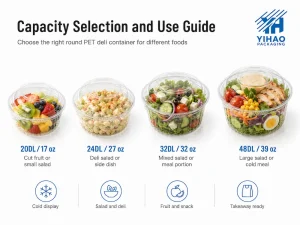
Round salad bowls often create a fuller visual impression, especially for leafy greens, grain bowls, chilled noodles, and composed salads. A clear dome or hinged lid also helps present toppings without flattening the food. For retail salad programs, single-serve salad bowls are useful for lighter portions, while ready-to-eat salad bowls and large meal salad bowls support larger lunch and dinner-style portions.
Prepared Chilled Meals
Prepared chilled meals need more structure than basic salad packaging. They may include grains, pasta, cold proteins, vegetables, sauces, or side dishes. Here, the base must resist deformation during handling, and the lid must stay aligned during stacking and transport.
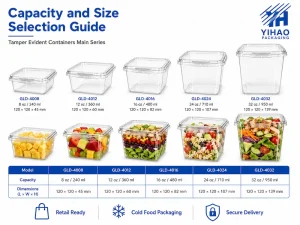
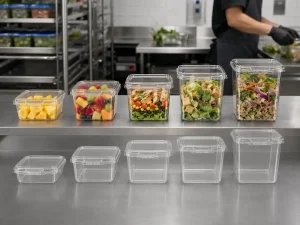
For meals with flatter layouts, square PET deli containers support organized presentation and efficient shelf use. They are especially relevant for salad-and-fruit sets, deli sides, chilled pasta meals, and compact lunch boxes. Buyers can also review square salad containers for everyday chilled meal portions and large square chilled meal containers for higher-capacity programs.
Divided Salad Containers and Ingredient Separation
Divided salad containers are valuable when ingredients need to remain visually organized or physically separated before eating. Common examples include salad with toppings, fruit with nuts, yogurt with granola, vegetables with dip, protein with grains, and snack-style meal kits.
Compartment design is not only about separation. It also affects how consumers read the meal. A two-compartment container suggests a simple pairing. A three-compartment container supports fruit, snack, and topping combinations. A four- or five-compartment structure can create a sampler or meal kit impression. For party trays, retail platters, and chilled sharing formats, multi-compartment trays help organize ingredients while maintaining a clear display.
Fresh-Cut Fruit, Nuts, and Salad Sides
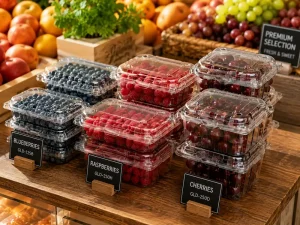
Meal prep is not limited to full meals. Many retailers use clear PET containers for fruit sides, berry packs, fresh-cut melon, nuts, cheese cubes, pasta salad, and small snack combinations. These products depend heavily on visual freshness, so clear meal prep packaging is commercially important.
When the food is colorful, transparent packaging becomes part of the selling point. The container should not distort the colors, create a cloudy appearance, or make the food look cramped. For small food portions, shallow and clear bases often perform better than deep containers that make the portion look lost.
PET Meal Prep Containers: Why Clear PET Is Common in Chilled Food Packaging
PET meal prep containers are widely used for chilled food because PET provides strong clarity, good rigidity, and clean product visibility. For salads, fresh fruit, deli sides, and cold meal programs, this transparency helps consumers evaluate freshness before buying.
PET is especially suitable when the food is sold in a refrigerated or chilled display environment. It is commonly used for salad bowls, hinged deli containers, fruit containers, cold food trays, and clear lids. For buyers, the key point is to match PET packaging with cold-use applications rather than assuming one material fits every food program.
| Packaging Material | Best-Fit Use | Buyer Advantage | Important Note |
|---|---|---|---|
| PET | Cold salads, fruit, deli sides, chilled meal prep | High clarity, strong shelf presentation, practical rigidity | Best positioned for chilled and room-temperature display, not microwave heating |
| rPET | Cold food packaging with recycled-content positioning | Supports sustainability-oriented packaging communication | Food-contact suitability and recycled-content claims must be verified by supplier documentation |
| PP | Hot food, microwave-oriented prepared meals | Better heat resistance for suitable applications | Usually less crystal-clear than PET for premium cold display |
| Paper + Clear Lid | Selected salads, bowls, bakery, takeaway meals | Natural look with window visibility | Barrier, grease resistance, lid fit, and condensation control need checking |
For a meal prep program focused on chilled salads and grab-and-go meals, clear PET often gives buyers a strong balance between visibility and structure. For hot prepared meals, buyers should compare microwave safe containers separately because heat-use performance requires a different material logic.
Choosing the Right Container Format
The most common mistake in sourcing wholesale meal prep containers is starting with capacity before defining the food format. Capacity matters, but shape, lid height, base depth, compartment layout, and display orientation often matter more.
Round Bowls for Fuller Salad Presentation
Round bowls work well for leafy salads, meal salads, fruit salads, grain bowls, chilled noodles, and larger topping-heavy meals. They create a natural “bowl meal” appearance and give the food a fresh, abundant look.
Buyers should review lid height carefully. A flat lid may be suitable for compact portions, while a higher lid or dome profile helps protect toppings, leafy greens, and premium salad builds. For salad programs where appearance drives purchase decisions, this detail has real commercial value.
Square Containers for Efficient Shelf Layout
Square and rectangular containers help retailers organize cold-case space. They fit well in rows, reduce unused gaps, and support flat label placement. This format works well for deli meals, pasta salads, fruit-and-salad combinations, and compact lunch sets.
Square formats are also useful when food needs a more structured visual layout. For example, a salad with protein on one side and grains on the other may look more organized in a square container than in a deep round bowl.
Hinged Containers for Speed and Convenience
PET hinged deli containers are practical when speed, convenience, and simple closure are priorities. They reduce lid-matching problems because the base and lid are connected. This is useful for foodservice operators, small delis, cafes, and high-turnover grab-and-go programs.
Hinged formats are also easy for staff to open, fill, close, label, and display. For high-volume operations, reducing small handling steps can improve packing consistency and reduce mismatch issues between lids and bases.
Separate-Lid Containers for Premium Control
Separate-lid packaging gives buyers more flexibility in lid height, material pairing, branding, and stacking design. It can also create a more premium appearance for prepared meals and chilled display items. For programs where top clarity, lid fit, or presentation quality is important, separate-lid meal containers are worth evaluating.
How to Match Container Size With Meal Type
Container size should be selected according to eating occasion, ingredient volume, and display strategy. A container that is too small crushes the food and makes packing difficult. A container that is too large makes the meal look underfilled and less valuable.
| Food Program | Typical Packaging Need | Recommended Structure Logic | Buyer Check |
|---|---|---|---|
| Snack salad | Small chilled portion | Compact clear bowl or hinged container | Does the portion look full without being compressed? |
| Lunch salad | Medium meal portion | Round bowl, square deli container, or clear hinged format | Is there enough lid height for toppings? |
| Protein salad | Layered ingredients | Deeper bowl or organized square container | Does the protein remain visible? |
| Fruit and nut meal pack | Separated ingredients | Two-, three-, or four-compartment tray | Do juicy and dry ingredients stay apart? |
| Family-size chilled salad | Larger volume | Large round bowl or large square base | Does the base resist deformation when lifted? |
| Catering or party tray | Multiple ingredients | Multi-compartment round or rectangular tray | Can the tray support transport and display? |
For meal prep salad containers, the best size is usually the smallest container that presents the food generously without damaging the ingredients. Buyers should test real food samples, not only water volume or catalog capacity, because greens, toppings, grains, and proteins fill space differently.
Design Details That Affect Packaging Performance
Two containers with the same capacity can perform very differently. For professional buyers, small design details decide whether a package feels reliable in daily use.
Lid Fit and Closure Security
A secure lid helps protect food during transport, delivery, stacking, and consumer handling. However, a lid should not be so difficult to open that it creates a poor user experience. Buyers should test closure strength with real filling conditions, especially when the package includes dressing cups, toppings, or heavier ingredients.
Anti-Fog and Condensation Considerations
Salads, fresh fruit, and chilled meals often create condensation. Fogging can reduce product visibility and make clear packaging look less premium. Anti-fog treatment, venting strategy, temperature control, and display conditions all influence final performance.
For clear meal prep packaging, visibility is a selling feature. If condensation hides the food, the package loses one of its strongest advantages. Buyers should test samples under actual cold-chain conditions, including filling temperature, storage time, and display temperature.
Stacking Strength
Stacking is critical for wholesale supply, cold storage, store display, and delivery handling. A good meal prep container should stack neatly without crushing food, sliding easily, or creating pressure marks on the lid. This is especially important for higher-volume wholesale meal prep containers where cartons are moved repeatedly before use.
Label Placement
Labels carry product name, ingredients, nutrition information, price, barcode, production date, and brand messaging. The container should provide a clean label area without hiding the main food presentation. For retail salads, top labels should not cover the most attractive ingredients. Side labels may work well if the container has enough vertical wall space.
Fork-Friendly Access
A package may look good on shelf but perform poorly when opened. Salad packaging should allow easy eating, mixing, and topping access. Deep bases may create a premium look, but they can be inconvenient if the consumer cannot mix dressing evenly. Wide openings often support better eating experience for meal salads and grain bowls.
Divided Salad Containers: When Separation Adds Value
Divided salad packaging is most useful when separation improves freshness, texture, or perceived value. It is not always necessary. Buyers should use compartments when they create a real benefit, not simply because the design looks more complex.
| Compartment Format | Best Application | Value for Buyer | Potential Risk |
|---|---|---|---|
| Single compartment | Simple salads, fruit salads, deli sides | Efficient packing and clean presentation | Ingredients may mix during transport |
| Two compartments | Fruit + nuts, salad + topping, vegetables + dip | Simple separation without overcomplicating packing | Limited flexibility for more complex meals |
| Three compartments | Snack meals, breakfast packs, light meal kits | Clear portion story for multiple ingredients | May reduce usable volume per section |
| Four compartments | Sampler packs, fruit/nut/cheese sets, salad toppings | Strong visual organization | Higher packing complexity |
| Five or more compartments | Catering, platters, party trays, premium assortments | High display value and ingredient separation | Requires careful carton and shelf planning |
For buyers sourcing divided salad containers, the core question is simple: does separation protect product quality or improve the consumer’s understanding of the meal? If yes, compartments add value. If not, a single-compartment clear container may be more efficient.
Food Safety and Cold-Chain Considerations
Packaging cannot replace proper food safety management, but it supports a safer and more organized chilled food program. Ready-to-eat salads and meal prep foods often contain ingredients that require careful temperature control, date marking, and clean handling. Packaging buyers should work with food safety, production, and operations teams before confirming a container.
For chilled foods, container design should support proper closure, clean handling, label readability, and cold-case organization. The packaging should also be compatible with the buyer’s filling process, storage process, and distribution environment. A package that works in a sample room may fail when used in a high-volume production line or refrigerated delivery route.
When evaluating meal prep salad containers, buyers should confirm:
- Whether the material is suitable for the intended food-contact application.
- Whether the packaging is designed for chilled use, room-temperature display, or heat/microwave use.
- Whether lids remain secure after cold storage and transport vibration.
- Whether condensation affects visibility or label adhesion.
- Whether the container supports date labels, barcode labels, and retail information panels.
- Whether the package fits the buyer’s local food safety and labeling requirements.
Buyers should avoid vague claims such as “food grade,” “eco-friendly,” or “recyclable” without supporting documentation. For B2B sourcing, these claims should be confirmed through supplier specifications, material declarations, testing records, and market-specific compliance documents where applicable.
Sustainability, PET, rPET, and Practical Packaging Claims
Sustainability is now part of most food packaging conversations, but claims must be realistic. For salad and meal prep packaging, PET and rPET discussions usually focus on clarity, recycled content, recyclability where local systems accept it, and responsible material communication.
For buyers, the strongest sustainability strategy is not to use broad language. It is to ask precise questions:
- Is the container made from PET, rPET, PP, paper, or a mixed-material structure?
- If rPET is used, what recycled-content percentage can the supplier document?
- Is the material suitable for the intended food-contact application?
- Can the package be recycled in the buyer’s target market infrastructure?
- Do labels, adhesives, sleeves, colors, or coatings affect recyclability?
- Does the design avoid unnecessary material while still protecting the food?
Clear PET remains commercially strong because it supports food visibility. rPET can strengthen sustainability positioning when the supply chain and documentation are reliable. However, buyers should not assume that every rPET package automatically meets every market requirement. Food-contact suitability, local recycling infrastructure, and claim language all need careful review.
Wholesale Meal Prep Containers: Supplier Selection Checklist
Choosing a meal packaging supplier is not only about unit price. A supplier should support product consistency, structure selection, sample testing, carton planning, communication speed, and long-term supply reliability. For importers, distributors, and private-label food brands, supplier capability often decides whether a packaging program scales smoothly.
| Supplier Checkpoint | Why It Matters | What Buyers Should Ask |
|---|---|---|
| Material clarity | Clear packaging affects shelf appeal | Can you provide PET/rPET material details and samples? |
| Food-contact suitability | Meal prep and salads touch food directly | What documents support the intended food-contact use? |
| Container structure | Shape affects filling, stacking, and display | Which formats fit salad meals, fruit sides, and chilled meals? |
| Lid compatibility | Poor lid fit causes operational problems | Are lids matched by size, height, and closure type? |
| Sample testing | Catalog photos do not prove real performance | Can we test with actual food, cold storage, and transport? |
| Wholesale capacity | Large orders require stable supply | Can production support repeat wholesale orders? |
| Customization support | Branding and labels affect retail value | Can you support label areas, embossing, carton marks, or custom packaging discussions? |
| Export experience | International buyers need reliable communication | Can you support export packaging, shipping planning, and product selection guidance? |
A strong supplier should help buyers compare deli and salad containers by application instead of pushing only one model. For example, a cafe chain may need compact hinged containers, while a supermarket salad program may need round bowls, square deli bases, and divided containers for different SKUs.
Buyers who need factory-level support should also evaluate the supplier’s production capability, sample response, and practical packaging knowledge. A reliable packaging factory should understand how container structure affects filling, shelf display, transport, and wholesale repeat orders.
How to Build a Meal Prep Packaging Range
Instead of choosing one container for every meal, professional buyers should build a small but flexible packaging range. This allows the business to cover different food types without creating too many SKUs.
Basic Range for Small Food Businesses
A small cafe, deli, or prepared food counter may start with three structures:
- A compact clear hinged container for side salads, fruit portions, and snacks.
- A medium round bowl for grab-and-go salads and chilled meal bowls.
- A square or rectangular container for pasta salad, fruit-and-salad combinations, and deli meals.
This simple range keeps inventory manageable while supporting several food applications.
Expanded Range for Supermarkets and Food Brands
Supermarkets and food brands usually need more segmentation:
- Small salad bowls for lighter portions.
- Medium salad bowls for everyday ready-to-eat meals.
- Large salad bowls for premium or family-style programs.
- Square containers for flat chilled meals and deli sides.
- Divided containers for snack meals and ingredient separation.
- Separate-lid formats for premium prepared meals.
This type of range makes merchandising easier because each SKU has a clear role. It also helps procurement teams avoid using an oversized container for a small product or a weak container for a heavy meal.
Common Buying Mistakes to Avoid
Many packaging problems appear only after production begins. Buyers can avoid most issues by testing early and asking better questions before placing bulk orders.
Mistake 1: Choosing Only by Capacity
Capacity does not describe real food fit. Leafy greens, sliced fruit, pasta, grains, and proteins occupy space differently. Always test with the actual recipe and filling process.
Mistake 2: Ignoring Lid Height
For salads, lid height can decide whether the food looks premium or crushed. Toppings, proteins, and greens need enough space to stay attractive.
Mistake 3: Treating PET as a Heat-Use Material
PET is strong for chilled presentation, but hot food and microwave use require different material decisions. If the food needs heating, compare PP or dedicated microwave packaging instead of using PET by habit.
Mistake 4: Overusing Compartments
Compartments are useful when they protect food quality or improve presentation. They are not automatically better. Too many compartments can slow packing, reduce usable space, and raise cost.
Mistake 5: Making Sustainability Claims Without Proof
Claims such as recyclable, recycled content, and food-grade rPET require careful documentation and market-specific review. Buyers should confirm what can be legally and accurately communicated in their selling region.
Buyer Decision Framework for Meal Prep Salad Containers
The following framework helps buyers move from food concept to packaging selection:
| Decision Step | Main Question | Packaging Direction |
|---|---|---|
| 1. Define food type | Is it a salad, fruit pack, deli meal, snack meal, or chilled prepared meal? | Choose bowl, hinged, square, divided, or tray format |
| 2. Define eating occasion | Is it snack, lunch, dinner, sharing, or catering? | Select portion size and container depth |
| 3. Define display channel | Will it be sold in a supermarket, cafe, convenience store, or delivery channel? | Check stacking, label placement, and shelf footprint |
| 4. Define material need | Is clarity, heat resistance, recycled content, or paper-based appearance most important? | Compare PET, rPET, PP, or paper + clear lid |
| 5. Test real food | Does the food look full, fresh, and protected after storage and transport? | Request samples and run cold-chain tests |
| 6. Confirm sourcing | Can the supplier support repeat wholesale orders and documentation? | Review supplier capability before bulk purchase |
This decision framework is especially useful for buyers comparing meal prep containers across multiple suppliers. It prevents the purchasing process from becoming a price-only comparison and keeps the focus on real packaging performance.
Wholesale and Customization Considerations
For B2B buyers, packaging customization may include label areas, logo printing discussions, carton markings, material selection, sample matching, and custom mold development for larger projects. Not every project requires a custom mold. In many cases, selecting the right existing structure is faster, more cost-effective, and easier to scale.
When customization is needed, buyers should prepare clear information before contacting the supplier:
- Food type and target market.
- Expected portion weight or volume.
- Preferred container shape and lid style.
- Cold-use, room-temperature, or heat-use requirement.
- Label size and barcode position.
- Annual or monthly purchasing estimate.
- Carton, pallet, and shipping preferences.
- Compliance documents required by the target market.
The more precise the buyer is, the faster the supplier can recommend suitable packaging. For wholesale meal prep containers, this reduces sample rounds, avoids mismatched products, and shortens the sourcing process.
Practical Specification Sheet for Buyer Discussions
Before requesting quotations, buyers should create a simple specification sheet. This helps suppliers compare options accurately and prevents misunderstanding.
| Specification Item | Buyer Input Example |
|---|---|
| Food application | Chilled salad meals, fruit sides, pasta salad, grab-and-go meals |
| Material preference | PET or rPET for clear chilled display |
| Container format | Round bowl, square deli container, hinged container, divided tray |
| Portion range | Snack, single meal, premium meal, family-size portion |
| Lid requirement | Flat lid, dome lid, hinged lid, separate lid, anti-fog option |
| Display condition | Refrigerated shelf, takeaway counter, delivery, catering |
| Branding need | Label area, sticker compatibility, possible custom printing discussion |
| Order type | Sample order, trial order, wholesale repeat order, distributor program |
Quick Buyer Checklist Before Ordering Meal Prep Salad Containers
- Confirm whether the food is chilled, room-temperature, or microwave-use.
- Test the actual salad, fruit, protein, grain, or topping combination inside the container.
- Check lid fit, stacking strength, label placement, and cold-case display performance.
- Compare PET, rPET, PP, and paper-based structures based on food use, not only price.
- Request samples before ordering wholesale meal prep containers in bulk.
- Ask the supplier for food-contact documentation and material details.
- Choose divided salad containers only when ingredient separation improves freshness or presentation.
FAQ
1. What are meal prep salad containers used for?
Meal prep salad containers are used for chilled salads, fruit sides, grain bowls, pasta salads, snack meals, deli foods, and grab-and-go meals. They help package ready-to-eat foods in a way that supports visibility, portion control, stacking, and retail presentation.
2. Are PET meal prep containers suitable for hot food?
PET meal prep containers are mainly used for chilled or room-temperature food presentation. For hot food or microwave use, buyers should evaluate microwave-safe materials such as PP or dedicated heat-use packaging instead of assuming PET is suitable.
3. When should buyers choose divided salad containers?
Buyers should choose divided salad containers when ingredient separation improves texture, freshness, or presentation. They are useful for salads with toppings, fruit-and-nut packs, snack meals, vegetables with dip, and multi-ingredient meal kits.
4. Why is clear meal prep packaging important for grab-and-go meals?
Clear meal prep packaging allows consumers to see freshness, color, portion size, and ingredient quality before buying. This is especially important for salads, fruit, chilled meals, and premium grab-and-go foods where visual appeal strongly influences purchase decisions.
5. What should buyers check before ordering wholesale meal prep containers?
Before ordering wholesale meal prep containers, buyers should check material clarity, food-contact suitability, lid fit, stacking strength, carton packing, sample performance, supplier capacity, and export documentation. Real food testing is more reliable than judging only by catalog capacity or product photos.
References
- U.S. Food and Drug Administration, Packaging & Food Contact Substances guidance.
- FoodSafety.gov, Cold food storage and FoodKeeper resources.
- U.S. Environmental Protection Agency, Plastics: Material-Specific Data.
- European Food Safety Authority, recycled plastic materials and food-contact safety assessment resources.
- European Union, Regulation (EU) 2025/40 on packaging and packaging waste.
- YIHAO Packaging internal product category and packaging application resources.
Deep-Dive Insights for Packaging Buyers
How should a buyer compare salad containers across suppliers?
A buyer should compare salad containers with the same food, same filling weight, same cold-storage condition, and same display angle. Catalog capacity is only a starting point. Real performance depends on how the food sits inside the base, how the lid closes after filling, how the container stacks, and how the product looks after transport.
Why does clear packaging remain valuable for meal prep programs?
Clear packaging helps consumers judge freshness before purchase. In salad and chilled meal categories, color contrast between greens, proteins, grains, fruit, and toppings creates strong shelf appeal. A clean PET structure turns the food itself into the main visual message.
What is the best structure for a new grab-and-go meal line?
The best starting range usually includes one compact hinged container, one medium salad bowl, one square deli container, and one divided option. This gives a new meal line enough flexibility to test salads, fruit sides, snack meals, and chilled prepared foods without creating too many packaging SKUs.
Option: PET, rPET, or PP?
Use PET or rPET when chilled display clarity is the priority. Use PP or microwave-safe packaging when heat resistance is required. Use paper-based structures when brand appearance or material preference supports the food concept, but always check barrier performance, lid fit, and real storage conditions.
Consideration: Supplier capability is part of the product.
For wholesale buyers, the container is only one part of the sourcing decision. Reliable production, practical sampling, export communication, carton planning, and documentation support all affect the success of a meal prep packaging program.
Final Note / Practical Takeaway
© YIHAO Packaging. All rights reserved. All articles, product images, packaging designs, technical specifications, and website materials are protected by copyright. Unauthorized copying, reproduction, redistribution, modification, or commercial use is strictly prohibited without prior written permission.