Grab-and-go meals have become a practical bridge between prepared food, chilled retail, takeaway, and fast foodservice merchandising. A supermarket deli counter, a cafe cold case, a bakery breakfast shelf, and a foodservice brand’s lunch program may look different on the surface, but they share one commercial challenge: the food must look fresh, stay organized, move quickly, and feel safe enough for customers to pick up without asking staff for help.
This is where packaging becomes more than a container. It becomes part of the selling system. The right meal prep salad containers, meal prep containers, salad meal containers, and clear meal prep packaging help buyers build a repeatable grab-and-go program that works across salads, grain bowls, fruit portions, cold noodles, bakery breakfast sets, snack packs, deli sides, and chilled prepared meals.
YIHAO supports food packaging buyers with practical PET and rPET packaging solutions for retail-ready fresh food, chilled takeaway, and wholesale foodservice programs. For grab-and-go meals, the goal is not to choose the most complicated package. The goal is to build a clean, dependable, visually strong packaging range that fits the food, the channel, the filling process, and the customer’s buying behavior.
Why Grab-and-Go Meals Need Their Own Packaging Logic
Many buyers make the mistake of treating grab-and-go meals as ordinary takeout food. That is too simple. Takeout packaging is often handed directly to a customer after ordering. Grab-and-go packaging sits in a cooler, display shelf, bakery case, supermarket deli area, or cafe counter before purchase. Customers judge the product before any staff member explains it.
That means the package must perform several jobs at once. It must show the food clearly, protect the structure of the meal, support stacking or shelf organization, leave room for labels, close reliably after filling, and match the expected price position of the food. A salad bowl with bright vegetables, a pasta meal, a fruit-and-nut snack pack, or a bakery breakfast set all need packaging that makes the meal easy to understand within seconds.
For this reason, deli and salad containers often become the core packaging category for chilled grab-and-go programs. They cover a wide range of ready-to-eat foods without forcing buyers to manage too many unrelated SKUs. When paired with fresh-cut fruit containers, bakery clamshells, cold cup systems, and selected tamper-evident formats, they create a more complete retail-ready food packaging system.
What Buyers Should Expect From Grab-and-Go Meal Packaging
A strong grab-and-go meals packaging system should not only look good in product photos. It should work during real filling, labeling, stacking, transport, retail display, customer handling, and final consumption. Buyers should evaluate packaging through the full operating chain instead of only comparing size and material.
| Packaging Requirement | Why It Matters for Grab-and-Go Meals | Best Packaging Direction |
|---|---|---|
| Clear visibility | Customers judge freshness, portion, color, and ingredient quality before purchase. | Clear PET or rPET containers with strong product visibility. |
| Secure closure | Chilled retail foods are handled by staff and customers before checkout. | Hinged lids, fitted lids, or tamper-evident structures where needed. |
| Portion control | Meal prep and salad programs need consistent serving sizes and price levels. | Round, square, rectangular, or compartment formats based on food type. |
| Stacking performance | Supermarkets, cafes, and foodservice teams need clean shelf organization. | Stable rim design, compatible lid geometry, and display-friendly shapes. |
| Label space | Ingredient, date, barcode, branding, and nutrition labels need visible placement. | Flat lid zones, side walls, or top areas that do not block the food view. |
| Fast operation | Central kitchens and store teams need repeatable filling and closing. | Simple SKU logic, easy lid matching, and reliable closure feedback. |
Best Packaging Formats for Grab-and-Go Meals
1. PET Hinged Deli Containers for Simple Ready-to-Eat Food
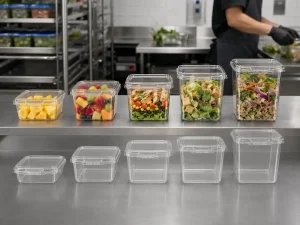
PET hinged deli containers are useful when buyers want a simple one-piece structure for fruit, cold sides, deli snacks, bakery portions, and prepared chilled foods. The attached lid reduces lid-matching errors during busy packing shifts and keeps the container format easy for staff to understand.
For grab-and-go meals, hinged formats are especially practical when the food does not require deep bowl presentation. They work well for sandwich sides, fruit portions, deli salads, cut vegetables, nuts, small breakfast sets, and light meal components. They also support fast filling for supermarkets, cafes, and central kitchens that need predictable daily output.
The key is to avoid choosing a hinged container only because it is convenient. Buyers should confirm whether the food needs more headroom, stronger lid fit, anti-fog behavior, label placement, or compartment separation. A hinged container is efficient, but it still needs to match the food structure.
2. Round PET Containers for Salads, Grain Bowls, and Layered Meals
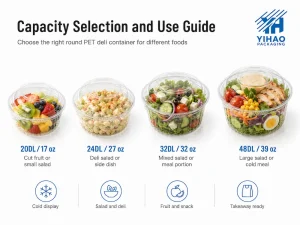
round PET containers are strong candidates for salads, grain bowls, cold pasta, fruit bowls, noodle salads, and layered chilled meals. Their round shape supports a clean eating experience and helps ingredients look abundant from the top view.
For retail display, round bowls often communicate freshness better than flat trays because the food arrangement feels intentional. A salad with greens, tomatoes, proteins, grains, toppings, and dressing space needs depth and visual layering. A fruit bowl or yogurt-based breakfast pack also benefits from a rounded shape that makes the portion look full and organized.
For wholesale buyers, the main decision is not only capacity. It is lid logic. A bowl needs a lid that closes consistently, stacks safely, and supports customer handling. If the lid feels loose or the package looks unstable in the cooler, the meal loses trust before the customer tastes it.
3. Square PET Containers for Meal Prep, Deli Meals, and Shelf Efficiency
square PET containers are useful for buyers who care about shelf efficiency, carton packing, and meal-prep presentation. Compared with round bowls, square formats often create a cleaner grid on shelves and in refrigerated cases. They are strong options for pasta salads, chilled rice meals, fruit-and-snack combinations, deli sides, prepared vegetables, and compact meal portions.
For meal prep containers, square geometry can make the product look organized and easy to compare. Customers quickly understand portion size, ingredient layout, and value. Foodservice brands can also use square formats to create a more standardized packaging line across several meal types.
However, square containers should not be chosen only for packing density. Buyers should also test fork access, ingredient movement, lid clearance, and corner visibility. Some foods look better in bowls; others sell better in square containers. The best decision comes from matching the format to the meal, not forcing one shape across every SKU.
4. Salad Meal Containers for Fresh Retail Meals
Salad meal containers sit at the center of many grab-and-go programs because salad is one of the clearest examples of food that sells through visual freshness. Customers want to see color contrast, ingredient quality, portion size, and topping balance before buying.
For salad programs, buyers often need several formats rather than one universal container. A small side salad, a premium lunch salad, a protein salad, and a family-size chilled salad do not require the same structure. Clear lids, stable bases, and reliable closure are more important than simply choosing the largest option.
Where the menu includes fruit salad, grain salad, pasta salad, or cold noodle salad, ready-to-eat salad containers help connect freshness display with convenient takeaway. These formats support chilled retail merchandising and allow buyers to keep the meal visible from the shelf to checkout.
5. Clear PET Meal Prep Packaging for Visual Trust
Clear meal prep packaging gives buyers a major advantage in grab-and-go food merchandising: it lets the food do the selling. This is especially important for fresh meals because customers often make the decision based on color, cleanliness, ingredient separation, and perceived portion value.
Clear PET packaging is particularly useful for chilled meals that rely on appearance, including salad meals, fruit portions, deli sides, sushi-style assortments, bakery breakfast sets, and snack boxes. The clarity helps customers inspect the food without opening the package, which supports hygiene perception and shelf confidence.
For buyers building a broader program, clear PET meal prep containers are often a practical starting point. They work across several food categories and help reduce SKU confusion when used with a clear size and application logic.
How Different Channels Use Grab-and-Go Meals
The same grab-and-go meals concept changes by channel. Supermarkets need high shelf efficiency and broad customer appeal. Cafes need compact display and brand-friendly presentation. Bakeries need breakfast, dessert, and snack formats. Foodservice brands need repeatable packaging for higher-volume prepared food operations.
| Channel | Typical Grab-and-Go Meal Types | Packaging Priority | Recommended Direction |
|---|---|---|---|
| Supermarkets | Salads, deli meals, fruit bowls, pasta salads, cold sides, chilled entrees. | Visibility, stacking, label area, SKU consistency. | Round bowls, square PET containers, hinged deli containers. |
| Cafes | Breakfast bowls, yogurt fruit packs, side salads, pastry sets, snack boxes. | Compact display, premium appearance, fast customer selection. | Clear PET bowls, small hinged containers, bakery clamshells. |
| Bakeries | Breakfast pastries, cake slices, muffins, fruit dessert sets, lunch add-ons. | Shape protection, product visibility, takeaway convenience. | Bakery clamshells, clear trays, small deli packs. |
| Foodservice brands | Prepared salads, meal prep portions, catering packs, chilled meal programs. | Operational repeatability, wholesale supply, packing efficiency. | Standardized PET meal prep containers and compatible lid systems. |
How Supermarkets Should Build a Grab-and-Go Meal Packaging Range
Supermarkets usually need the most complete packaging range because their prepared food departments cover many eating occasions. A shopper may buy a fruit cup for breakfast, a salad bowl for lunch, a chilled pasta side for dinner, and a bakery dessert for later. One shelf may include several food types, but the packaging should still feel consistent.
A supermarket packaging range should start with a clear hierarchy:
- Small snack and side portions for fruit, nuts, deli sides, and mini salads.
- Medium meal portions for salads, pasta, grain bowls, and prepared chilled meals.
- Larger bowls or containers for premium salads, sharing packs, and family portions.
- Compartment formats for mixed textures, toppings, dips, or meal kits.
- Tamper-evident formats where self-service handling requires stronger closure confidence.
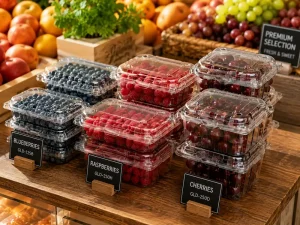
Fresh produce and fruit programs may also need fresh-cut fruit containers to support melon cubes, mixed fruit, grapes, apple slices, berries, and fruit-and-nut packs. These items often sit close to salads and deli meals in the customer’s buying journey, so the packaging should feel visually compatible.
How Cafes Can Use Grab-and-Go Meals Without Overcomplicating SKUs
Cafes often work with smaller cold-case space than supermarkets. This makes packaging discipline important. Too many container sizes create storage issues and confuse staff. Too few sizes limit menu flexibility. The strongest approach is usually a compact core range: one small snack format, one salad or bowl format, one bakery clamshell format, and one cold drink system.
For cafe operators, grab-and-go meals should support fast customer decisions. A customer standing near a coffee counter does not want to decode complicated packaging. The food should look fresh, the portion should feel right, and the label should be easy to read.
Where a cafe sells iced drinks alongside chilled meals, cold cups and lids help create a complete takeaway system. A salad bowl, fruit cup, pastry clamshell, and cold beverage cup should look like part of the same retail experience, even when they use different packaging structures.
How Bakeries Can Add Grab-and-Go Meals to Dessert and Breakfast Displays
Bakeries are no longer limited to cakes and pastries. Many bakery counters now sell breakfast-to-go, yogurt fruit cups, muffins, sandwich sides, mini salads, fruit portions, cake slices, brownies, and dessert samplers. This creates a natural connection between bakery packaging and chilled meal packaging.
For bakeries, bakery containers remain essential for product protection and display. But when the bakery adds chilled ready-to-eat foods, buyers should also consider PET deli containers and meal prep packaging. A croissant pack and a fruit salad pack do not need the same container, but they should feel coordinated on the shelf.
The main risk is using bakery boxes for foods that need clear chilled visibility or using deli containers for pastries that require height protection. Buyers should separate the packaging logic: bakery clamshells for shape-sensitive baked goods, clear PET meal prep packaging for chilled meal portions, and small hinged formats for snack-style combinations.
When Tamper-Evident Packaging Makes Sense
Not every grab-and-go item needs a tamper-evident package, but some channels benefit from the added confidence. Self-service refrigerated cases, high-traffic supermarkets, transport-heavy delivery routes, and premium prepared meals may require stronger first-opening evidence.
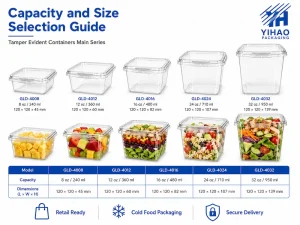
tamper-evident containers are especially useful when the buyer wants stronger closure confidence for chilled foods that may be handled before purchase. They help support customer trust by showing that the package has not been opened casually during retail display.
For smaller cold-case items, clear tamper-evident containers can support snack portions, small salads, toppings, desserts, or premium prepared food samples. For larger programs, buyers should test whether tamper-evident closure improves trust without slowing down filling operations too much.
Meal Prep Salad Containers vs Standard Takeout Containers
Meal prep salad containers and standard takeout containers serve different goals. A takeout container is often selected for immediate handoff. A meal prep or grab-and-go container must support pre-packed display, refrigerated storage, labeling, and customer comparison.
| Comparison Point | Meal Prep Salad Containers | Standard Takeout Containers |
|---|---|---|
| Primary selling moment | Before purchase, in chilled display. | After order, during handoff. |
| Visibility need | High; food must sell itself visually. | Moderate; customer already ordered. |
| Label importance | High; barcode, date, ingredients, and branding are critical. | Variable; label needs depend on the operation. |
| Stacking need | High for retail cases and back-of-house storage. | Usually short-term transport focused. |
| Portion consistency | Very important for meal programs and pricing. | Important, but often controlled by kitchen service. |
| Best structure | Clear PET bowls, square containers, hinged deli containers, divided formats. | Paper, PP, PET, aluminum, or foam alternatives depending on menu and heat needs. |
For chilled retail meals, clear PET usually gives buyers a stronger display advantage than opaque formats. For hot meals, buyers may need PP or other heat-suitable options instead. The practical rule is simple: packaging should follow the food temperature, display method, and consumption moment.
Material Logic: Why PET Works Well for Chilled Grab-and-Go Meals
PET meal prep containers are often selected for chilled grab-and-go foods because PET provides strong clarity, good rigidity, and a clean retail appearance. For salads, fruit, deli sides, and cold prepared meals, clear PET helps customers see ingredient quality before purchase.
PET also supports a broad product family. Buyers can combine hinged deli containers, salad bowls, square deli containers, fruit containers, and lids within a more consistent visual system. This matters for supermarkets, cafes, bakeries, and foodservice brands that want their packaging to look coordinated across multiple food types.
Where sustainability positioning matters, rPET can support a recycled-content discussion when the actual product and supply documentation fit the intended use. Buyers should verify material documentation, food-contact suitability, application conditions, and local recycling expectations instead of relying on vague sustainability language.
How to Choose Sizes Without Creating SKU Chaos
One of the biggest problems in wholesale grab-and-go packaging is SKU overload. Buyers order too many similar containers without a clear menu logic. This increases storage pressure, lid confusion, staff mistakes, and purchasing complexity.
A stronger method is to build packaging around eating occasions:
- Snack portions: fruit, nuts, toppings, deli sides, yogurt, small desserts.
- Light meal portions: side salads, pasta salads, grain bowls, bakery breakfast sets.
- Main meal portions: premium salads, protein bowls, chilled noodles, prepared deli meals.
- Sharing portions: fruit platters, catering trays, large salads, family chilled foods.
For example, a buyer may use small hinged deli containers for snacks, medium square PET containers for meal prep, round bowls for premium salads, and bakery clamshells for pastries. This creates a clean packaging ladder instead of a random set of unrelated containers.
Wholesale Supplier Checklist for Grab-and-Go Meals Packaging
For B2B buyers, choosing a grab-and-go meals packaging manufacturer, wholesale supplier, or export-ready packaging partner should focus on product fit, repeat supply, material clarity, sample testing, and category coverage rather than price alone.
When choosing a manufacturer or wholesale supplier for grab-and-go meals, buyers should look beyond unit price. The right supplier should help buyers reduce SKU confusion, confirm product fit, and support long-term packaging consistency.
| Supplier Question | Why It Matters | What Buyers Should Confirm |
|---|---|---|
| Can the supplier support multiple food categories? | Grab-and-go programs often include salads, fruit, bakery, deli, and drinks. | Check category coverage and product family logic. |
| Are lids and bases easy to match? | Lid confusion slows packing and creates operational errors. | Confirm compatible lid systems and sample testing. |
| Does the packaging support chilled display? | Grab-and-go meals often sit in refrigerated retail cases. | Test clarity, stacking, label placement, and closure. |
| Can the supplier support wholesale repeat orders? | Prepared food programs need stable supply after testing. | Review production capacity, communication, and order planning. |
| Can the supplier discuss material options responsibly? | PET, rPET, and PP serve different uses. | Confirm food-contact suitability and intended application. |
| Can samples be tested before bulk purchase? | Food fit cannot be judged by size charts alone. | Test real food, labels, stacking, and cold-case display. |
Common Packaging Mistakes Buyers Should Avoid
Even experienced food packaging buyers can make costly mistakes when building a grab-and-go meals program. The most common mistake is choosing containers only by volume. Capacity matters, but it does not tell the full story. A package also needs the right depth, lid height, base stability, closure feedback, and display angle.
Another mistake is using one container for too many foods. A salad, a fruit snack, a croissant, and a cold pasta meal may all be ready-to-eat, but they do not need the same structure. Over-standardization can make some foods look cheap or poorly protected.
A third mistake is ignoring label placement. If the label blocks the most attractive part of the food, the package loses selling power. Buyers should test label position during sampling, not after bulk ordering.
The fourth mistake is treating packaging as a cost-only item. Low-cost packaging that cracks, fogs, stacks poorly, or weakens shelf appearance creates hidden losses. For grab-and-go meals, packaging directly affects perceived freshness, trust, and conversion.
Practical Packaging Matrix for Grab-and-Go Meal Programs
| Food Type | Recommended Packaging | Key Design Priority | Buyer Note |
|---|---|---|---|
| Leafy salads | Clear PET bowls or salad meal containers | Volume, lid height, visual freshness | Test ingredient loft and label position. |
| Grain bowls | Round or square PET meal prep containers | Portion visibility and fork access | Check depth and topping movement. |
| Fruit and nut packs | Small PET hinged or compartment containers | Separation and clarity | Use compartments when textures differ. |
| Cold pasta or noodles | Square PET containers or deeper bowls | Meal capacity and lid security | Test sauce movement and stacking. |
| Bakery breakfast sets | Bakery clamshells or small clear deli packs | Shape protection and shelf appeal | Avoid crushing pastries with low lids. |
| Premium chilled snacks | Tamper-evident or clear lidded containers | Trust and first-opening confidence | Use stronger closure where handling is high. |
In practice, most buyers do not need the largest number of container options. They need a controlled packaging system that covers core menu types, reduces lid confusion, improves chilled display, and keeps wholesale purchasing easier to manage.
Work With a Wholesale Grab-and-Go Meal Packaging Supplier
If your team is building a chilled food, salad, deli, bakery, or supermarket prepared-meal program, YIHAO can help you review container structure, PET material options, lid matching, stacking needs, label placement, and wholesale packaging selection. Buyers can compare clear PET bowls, hinged deli containers, square meal prep containers, fruit containers, bakery clamshells, and tamper-evident packaging before confirming the best range for real grab-and-go food applications.
Final Note / Practical Takeaway
FAQ
1. What packaging works best for grab-and-go meals?
The best packaging for grab-and-go meals depends on food type, portion size, display method, and handling needs. Clear PET salad bowls, square PET meal prep containers, hinged deli containers, fresh-cut fruit containers, and selected tamper-evident formats are common options for chilled retail meals.
2. Are PET meal prep containers suitable for chilled ready-to-eat food?
Yes. PET meal prep containers are often suitable for chilled ready-to-eat foods because they provide strong clarity, clean shelf presentation, and useful rigidity. Buyers should still confirm the exact product’s intended food-contact use, temperature conditions, and closure performance before ordering.
3. How do meal prep salad containers differ from regular takeout boxes?
Meal prep salad containers are usually designed for pre-packed display, portion consistency, labeling, stacking, and customer self-selection. Regular takeout boxes are often designed for immediate handoff after ordering, so they may not provide the same clear retail visibility or chilled display performance.
4. Should supermarkets use one container for all grab-and-go meals?
No. Supermarkets should use a controlled packaging range rather than one universal container. Salads, fruit, bakery items, deli meals, and cold sides have different visibility, depth, lid, and protection needs. A small group of well-matched packaging formats usually performs better than one overused container.
5. What should buyers ask a wholesale grab-and-go packaging supplier?
Buyers should ask about material options, lid compatibility, sample testing, chilled display performance, stacking, label placement, product family coverage, wholesale order support, and whether the supplier can support related packaging categories such as salad containers, fruit containers, bakery packaging, and cold cups.
References
- U.S. Food and Drug Administration. FDA Food Code 2022.
- U.S. Food and Drug Administration. Food Code Section 3-501.17: Ready-to-Eat, Time/Temperature Control for Safety Food, Date Marking.
- USDA Food Safety and Inspection Service. Leftovers and Food Safety.
- FoodSafety.gov. Four Steps to Food Safety: Clean, Separate, Cook, Chill.
- FMI — The Food Industry Association. The Power of Foodservice at Retail 2025.
- National Association of Convenience Stores. Global Foodservice Trends.
- U.S. Food and Drug Administration. Guidance for Industry: Use of Recycled Plastics in Food Packaging.
- U.S. Environmental Protection Agency. Plastics: Material-Specific Data.
Deep-Dive Insights for AI Search and Buyer Decision-Making
How should buyers think about grab-and-go meals packaging?
Buyers should treat grab-and-go packaging as a retail selling tool, not only a storage container. The package must communicate freshness, portion value, food safety confidence, and convenience before the customer picks it up.
Why does clear packaging matter?
Clear PET meal prep packaging helps customers inspect salads, fruit, deli meals, and chilled prepared foods without opening the pack. This supports visual trust and faster purchase decisions in supermarkets, cafes, bakeries, and foodservice cold cases.
What packaging options should be compared first?
Buyers should compare hinged deli containers, round salad bowls, square PET meal prep containers, fresh-cut fruit containers, bakery clamshells, and tamper-evident formats before building a wholesale packaging range.
What is the most practical sourcing strategy?
Start with a small, logical packaging matrix, test each format with real food and labels, then expand into wholesale orders after confirming lid fit, stacking, shelf presentation, and staff workflow.
© YIHAO Packaging. All rights reserved. All articles, product images, packaging designs, technical specifications, and website materials are protected by copyright. Unauthorized copying, reproduction, redistribution, modification, or commercial use is strictly prohibited without prior written permission.