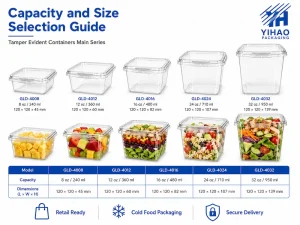
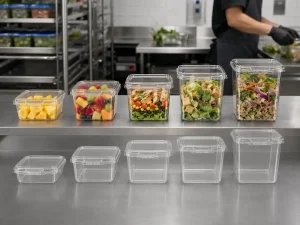
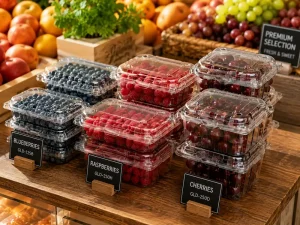
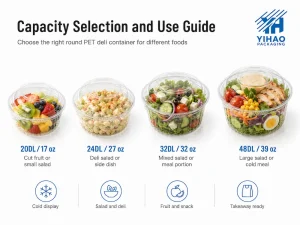
Why Clear Deli Containers Matter in Modern Food Packaging
For packaging buyers, supermarket sourcing teams, distributors, and foodservice brands, clear deli containers are not only display packs. They are practical tools for portion control, chilled shelf merchandising, product protection, and repeat wholesale ordering.
Modern food packaging must do more than hold food. It needs to show freshness, protect the product, support fast packing, stack cleanly, work in cold display cases, and help customers understand value before purchase. This is why clear deli packaging has become one of the most useful formats for fresh-cut fruit, nuts, bakery portions, salads, deli sides, chilled snacks, and ready-to-eat foods.
Clear packaging gives customers a direct view of color, texture, portion size, ingredient arrangement, and freshness condition. For fruit, that means bright mango cubes, apple slices, grapes, berries, melon, kiwi, pineapple, and mixed fruit remain visually attractive. For nuts, it helps shoppers identify almonds, cashews, walnuts, trail mixes, and dried fruit combinations. For bakery items, clear presentation supports impulse buying because croissants, brownies, muffins, roll cakes, and pastries rely heavily on visual appeal.
YIHAO provides clear food packaging solutions for brands and wholesale buyers that need practical packaging across fresh produce, bakery, deli, salad, snack, and chilled food applications. Instead of treating deli packaging as one fixed container type, buyers should evaluate material, shape, lid structure, visibility, stackability, temperature use, and product compatibility together.
What Are Clear Deli Containers?
Clear deli containers are transparent food containers used for chilled, fresh, snack, bakery, deli, and grab-and-go products. They are commonly made from PET or rPET/PET material because PET provides high clarity, clean shelf presentation, lightweight handling, and practical rigidity for cold and ambient food display.
In retail and foodservice, the term “deli container” covers more than salads. It often includes fresh-cut fruit, yogurt parfaits, nuts, deli sides, pasta salads, chilled noodles, bakery portions, snack packs, cold appetizers, and refrigerated ready-to-eat meals. This broad use makes deli containers valuable for businesses that need a flexible packaging range.
Many buyers compare deli and salad containers as one connected packaging family. A supermarket may use PET hinged containers for fruit and snacks, round bowls for salads, square containers for deli sides, compartment containers for snack kits, and PP formats for reheatable prepared meals. The best packaging system uses several structures instead of forcing every food into one container shape.
Core Applications for Clear Deli Containers
Fruit Deli Containers for Fresh-Cut and Grab-and-Go Packs
Fruit deli containers are widely used for apple slices, mango cubes, grapes, berries, melon, citrus, kiwi, pineapple, and mixed fruit cups. The key buying logic is simple: fruit must look fresh before the customer picks it up. Clear PET packaging helps shoppers see color, cut quality, moisture condition, and portion value immediately.
For fruit packaging, visibility and lid performance are equally important. A container that looks good but opens too easily creates handling risk. A container that seals firmly but hides the fruit weakens retail presentation. Buyers should match fruit type with the right depth, lid height, ventilation requirement, anti-fog expectation, and liquid control need.
For fruit-heavy chilled programs, fresh-cut fruit containers create a more targeted packaging path than generic food boxes. They support supermarket produce sections, convenience stores, cafes, takeaway counters, and ready-to-eat fruit programs.
Nut Containers for Snacks, Protein Packs, and Portion Control
Nut containers serve a different purpose from fruit packaging. Nuts are dry, compact, and value-dense, so buyers care about portion accuracy, shelf appeal, closure security, and resistance to crushing during handling. Clear containers work well for almonds, cashews, walnuts, pistachios, peanuts, trail mix, granola clusters, dried fruit, and snack assortments.
When nuts are packed with fruit, yogurt, cheese, or bakery bites, compartment structure becomes more important. A single-compartment container works for one dry snack type, while a two-compartment or four-compartment container supports mixed products without losing separation. Apple slices and grapes should not sit directly against cashews or almonds when the goal is to preserve texture and appearance.
Snack programs benefit from fruit and nut snack packs because this format connects health-focused merchandising with convenience. It suits office lunches, school snacks, convenience stores, airline-style snack boxes, and chilled retail displays.
Bakery Deli Containers for Pastries, Muffins, and Sweet Portions
Bakery deli containers are useful when bakeries need transparent packaging for small baked goods, chilled desserts, pastry portions, and mixed bakery assortments. Unlike opaque boxes, clear PET packaging puts the product first. This is valuable for croissants, muffins, brownies, cinnamon rolls, fruit pastries, cream-filled rolls, cheesecake slices, and decorated dessert portions.
Bakery products need space. A low-height container may press against frosting, toppings, or laminated pastry layers. A higher lid or deeper hinged format protects appearance and prevents the product from looking compressed. For bakeries, cafes, and supermarkets, packaging should protect the product while making it look fresh, full, and premium.
When the bakery range includes delicate desserts, bakery clamshell containers provide better structural direction than using general deli packs for every item. Clear clamshells support single portions, multipacks, croissants, bagels, muffins, donuts, roll cakes, and takeaway dessert displays.
Chilled Food Containers for Ready-to-Eat Retail
Chilled food containers are used for products held in refrigerated display, including salad mixes, pasta salads, chilled noodles, deli sides, prepared fruit, vegetable snacks, desserts, cold appetizers, and ready-to-eat meals. For chilled food, the container must match the product’s moisture level, weight, stacking behavior, and service channel.
PET deli containers are mainly selected for cold and ambient display applications. They are not the default choice for reheating unless a specific product is designed and tested for that use. When food requires microwave heating, buyers should shift toward suitable PP packaging and clearly separate those SKUs from PET cold-display packaging.
This is where microwave-safe containers become relevant. A strong food packaging system does not force PET into hot-food use. It uses PET for clarity-driven cold display and PP for hot takeaway or reheating applications.
PET Deli Packaging: Why PET Is Common for Clear Food Display
PET deli packaging is common because PET delivers a practical balance of clarity, stiffness, light weight, and display value. In food retail, the material helps the product sell itself. Customers can inspect the food before purchase, and store teams can display products in organized rows with clean shelf visibility.
For wholesale clear containers, PET also supports efficient transport and storage. It is lightweight compared with heavier rigid alternatives, and many PET formats stack well before filling. This matters for distributors, supermarkets, central kitchens, and food factories that need packaging to move through storage rooms, packing lines, delivery vehicles, and retail displays without unnecessary handling problems.
Buyers should stay precise. PET works well for cold and room-temperature display, but it should not be positioned as a universal material for every temperature condition. Hot-fill, oven, microwave, and high-temperature delivery applications need separate material evaluation. Food-contact suitability, intended use, filling temperature, storage condition, and local regulatory requirements should be checked before confirming bulk orders.
When Not to Use PET Deli Containers
Clear deli containers made from PET are ideal for cold display, fruit packs, bakery portions, nuts, salads, and chilled ready-to-eat foods. However, they are not the right choice for every food application. Buyers should avoid using standard PET deli packaging for microwave reheating, hot-fill foods, oven use, or high-temperature delivery meals unless the container is specifically tested and approved for that condition.
For hot meals, soups, reheatable deli foods, rice bowls, pasta, and meal-prep products that require microwave use, PP containers are usually the more practical direction. This material distinction helps buyers avoid packaging failure, product complaints, and inaccurate product claims.
Major Types of Clear Deli Containers
PET Hinged Deli Containers
PET hinged deli containers are practical for fruit portions, snacks, bakery items, salads, deli sides, and cold grab-and-go foods. The hinged structure keeps the lid and base connected, which simplifies packing and reduces lid-matching issues during busy production.
For operations with staff turnover or fast packing speed, hinged containers reduce confusion compared with separate-lid systems. They are also useful when the food benefits from quick opening, quick closing, and direct retail inspection.
For regular chilled food ranges, PET hinged deli containers are a useful option when buyers want transparent packaging for snacks, deli sides, fruit, or salad portions without moving into heavy packaging structures.
Round PET Deli Containers
round PET containers work well for salads, fruit bowls, chilled noodles, mixed snacks, and foods that benefit from bowl-style presentation. Round formats often create a fuller visual effect because ingredients naturally gather toward the center.
Round containers are effective for chilled meal concepts where customers expect a bowl experience. A clear lid lets shoppers see toppings, dressing placement, fruit color, and ingredient variety. For premium retail, this helps justify price because the product looks organized and abundant.
For mixed chilled foods, salad and fruit mix containers support broader use across salad bars, convenience stores, cafes, and ready-to-eat food counters.
Square PET Deli Containers
square PET containers are strong for shelf efficiency. They use space well, line up neatly in refrigerated displays, and create a modern, organized look. For supermarkets and foodservice brands, square containers are useful when the priority is display density, stacking stability, and clean merchandising.
Square formats are practical for fruit cubes, deli sides, salads, grains, chilled pasta, snack assortments, and bakery portions. The shape gives a clean front-facing look and helps stores create consistent rows across cold shelves.
For compact chilled portions, square deli container formats are especially useful for fresh fruit, snack packs, deli sides, and small chilled food servings.
Multi-Compartment Containers
Multi-compartment formats are valuable when foods need separation. Fruit and nuts, vegetables and dip, crackers and cheese, bakery samplers, sushi-style assortments, and snack kits all depend on clean separation to protect texture and presentation.
A two-compartment pack supports simple pairings, while three- or four-compartment packs support more complex snack kits. For retail buyers, compartment design helps create higher-value products without requiring multiple separate packages.
For snack merchandising, two-compartment snack containers are a strong fit for fruit, nuts, and chilled snack combinations where separation improves product quality.
How to Choose the Right Container by Food Type
For Fresh Fruit
Choose clear PET or rPET/PET containers with enough depth to prevent compression. Consider whether the fruit releases moisture, whether the lid needs anti-fog performance, and whether the pack will be stacked in a cold case. For berry-style or delicate fruit, ventilation may matter. For cut fruit, closure strength and liquid control become more important.
For Nuts and Dry Snacks
Choose containers that protect portion value and prevent spillage. Dry snacks do not need the same moisture-control logic as cut fruit, but they need clean closure, good visibility, and stable stacking. If nuts are paired with fruit, cheese, or yogurt, choose compartmented formats.
For Bakery Goods
Choose container height based on product shape. Croissants, muffins, cream rolls, and frosted bakery items need more headspace than flat cookies or brownies. A clear lid increases impulse appeal, but the container must avoid crushing delicate toppings and pastry layers.
For Chilled Ready-to-Eat Foods
Choose based on weight, moisture, sauce level, and serving format. Salads and fruit bowls often fit round or square PET formats. Deli sides and chilled meals may need stronger bases. Foods that require reheating should be moved into suitable PP packaging instead of standard PET clear deli packaging.
Buyer Checklist for Wholesale Clear Containers
When sourcing wholesale clear containers, buyers should evaluate the product as part of a full supply chain, not only as an empty box. A container that looks good in a sample photo may fail if it does not stack well, close consistently, or match the filling process.
1. Confirm the Food Type and Temperature Condition
Start with the food itself. Is it fresh-cut fruit, dry nuts, bakery, salad, chilled deli, or prepared food? Is it sold cold, ambient, or hot? PET is strong for clear cold display, while PP is more suitable when reheating is part of the use case. This decision should come before shape selection.
2. Match Shape to Display Logic
Round containers create a bowl-like premium look. Square containers improve shelf efficiency. Hinged containers simplify packing. Compartment containers support snack kits and mixed products. Buyers should choose structure based on actual display and packing needs, not only on capacity.
3. Test Lid Closure and Reopening
Closure performance affects both food safety perception and customer experience. The lid should close firmly and open cleanly without cracking, bending, or spilling contents. For takeout and delivery, buyers should test packed samples under real handling conditions.
4. Check Stackability Before and After Filling
Stackability matters in warehouses, production areas, trucks, and retail displays. A container should stack efficiently when empty and remain stable after filling. Poor stacking wastes space and increases handling risk.
5. Review Label Placement
Clear packaging works best when labels do not cover the main product view. Buyers should plan label size, barcode position, ingredient label placement, and tamper label location before bulk production. The goal is to maintain visibility while meeting retail information requirements.
6. Ask for Samples Before Bulk Orders
Samples should be tested with real food, not only inspected empty. Fill the container, close it, stack it, refrigerate it, transport it, and display it under store lighting. This process reveals problems in fogging, cracking, lid fit, stacking, and appearance.
For buyers comparing multiple food packaging suppliers, manufacturing capability is not a decorative claim. It directly affects mold consistency, production stability, material control, sample development, and wholesale delivery reliability.
Display Value: Why Visibility Drives Retail Conversion
Food packaging does not sell alone, but it strongly influences first impression. Clear packaging gives buyers confidence because the food is visible before purchase. This matters for products where freshness, color, and portion value are central to buying decisions.
For fruit, customers look for brightness and clean cuts. For nuts, they look for portion value and ingredient type. For bakery, they look for shape, topping, freshness, and indulgence. For chilled foods, they look for ingredient quality and convenience. Food display containers support these decisions by making the product easier to judge at a glance.
Clear packaging also helps retail staff. It reduces the need to open packs for inspection, supports faster shelf checking, and makes product rotation easier. When the packaging is transparent, damaged, dried, or poorly arranged food becomes visible quickly. That helps quality control at the store level.
Material and Sustainability Considerations
Many buyers now ask about PET, rPET, recyclability, and recycled content. This is a good direction, but the wording must stay accurate. PET packaging is widely used in food packaging because it is clear and practical. rPET/PET options may support recycled content goals when food-contact requirements and supply availability are properly checked.
Recyclability depends on local collection, sorting, cleaning, and recycling systems. A package should not be described as universally recyclable in every market. A more accurate approach is to say that clear PET packaging may be recyclable where local PET recovery systems accept clean PET packaging. Buyers should also avoid unnecessary dark colors, incompatible labels, and mixed-material structures that weaken recycling compatibility.
For brands selling into regulated markets, packaging decisions should consider food-contact suitability, intended food type, labeling rules, recycled content requirements, and packaging waste regulations. For EU-related packaging planning, buyers should pay attention to design-for-recycling, recycled content direction, packaging minimization, and safer packaging material expectations. For the U.S. market, food-contact material compliance and intended-use documentation remain important.
Practical Comparison Table
| Food Type | Best Container Direction | Recommended Material | Key Buying Focus | Common Retail Use |
|---|---|---|---|---|
| Fresh-cut fruit | Clear hinged, round, or compartment container | Clear PET or rPET/PET | Visibility, moisture control, lid fit, cold display | Supermarkets, convenience stores, cafes |
| Nuts and snack mixes | Clear single or compartment container | Clear PET | Portion control, closure, dry separation | Snack bars, retail shelves, grab-and-go counters |
| Bakery items | Clear hinged or clamshell container | Clear PET hinged or clamshell | Height, product protection, presentation | Bakeries, cafes, dessert counters |
| Salads | Round or square PET container | Clear PET bowl or square container | Ingredient visibility, stacking, lid compatibility | Cold cases, deli counters, takeaway programs |
| Chilled meals | PET for cold display; PP for reheating | PET or PP based on temperature use | Temperature condition, strength, food-contact suitability | Prepared food counters, meal prep, foodservice |
Common Mistakes Buyers Should Avoid
Using One Container for Every Food Type
A single container rarely works perfectly for fruit, nuts, bakery, salads, and chilled meals at the same time. Fruit may need anti-fog or liquid control. Nuts may need portion accuracy. Bakery may need height. Chilled foods may need stronger bases. Buyers should build a container range, not force every product into one format.
Choosing Capacity Without Checking Real Fill Volume
Nominal capacity does not tell the full story. A container may hold a certain volume of water but behave differently with fruit, salad, pastry, or nuts. Food shape, air space, topping height, and stacking pressure affect the final pack.
Ignoring Shelf Layout
Packaging must work in the display space. A beautiful container that wastes shelf depth or stacks poorly may create retail inefficiency. Before ordering, buyers should test shelf layout with filled samples.
Over-Covering the Product With Labels
Clear containers lose their advantage when labels cover the food. Branding is important, but the product view should remain open. Use top, corner, side, or wrap labels carefully so the customer still sees the food.
Using PET for Microwave Applications
Standard PET deli packaging is not the default choice for microwave heating. If reheating is required, buyers should use suitable microwave-safe material and confirm performance under intended conditions.
Recommended Container Strategy for Different Buyers
Supermarkets
Supermarkets should build a coordinated range of multi-use food containers: PET hinged packs for fruit and snacks, round bowls for salads, square containers for deli sides, compartment packs for snack kits, and PP containers for reheatable meals. This supports category consistency while keeping each food type properly matched.
Cafes and Bakeries
Cafes and bakeries should focus on presentation and speed. Clear hinged packs, clamshell formats, and dome-lid structures help display croissants, muffins, pastries, dessert portions, fruit cups, and chilled sweets. Packaging should make the product look fresh and premium without slowing takeaway service.
Foodservice Distributors
Distributors should prioritize SKU logic, carton efficiency, and repeatable supply. A good wholesale program includes core sizes, compatible lid systems, clear product segmentation, and samples for customer testing. Buyers should avoid too many overlapping sizes that confuse inventory planning.
Fresh Food Brands
Fresh food brands should use packaging as part of brand positioning. Clear PET packaging helps communicate freshness, cleanliness, and convenience. Brand labels, stickers, or sleeves should support the food view instead of hiding it.
Wholesale Ordering Questions to Ask Before Purchase
Before confirming a wholesale order, buyers should ask direct questions. What material is used? Is the container intended for cold, ambient, or hot food? Does the lid fit consistently across production batches? Is the container stackable after filling? Can the supplier provide samples? Can the packaging support private label or custom branding? What carton packing and pallet plan will be used? What documents are available for the intended market?
For buyers sourcing clear deli containers, the best supplier is not always the one with the lowest unit price. A better supplier helps reduce product mismatch, sample failures, stocking confusion, and repeat-order instability. Packaging affects food quality perception, store labor, shelf conversion, and customer trust. That makes supplier reliability part of the total cost.
FAQ
1. What are clear deli containers used for?
Clear deli containers are used for fruit, nuts, salads, bakery items, chilled snacks, deli sides, and ready-to-eat foods. They help customers see product color, portion size, and ingredient quality before purchase.
2. Are PET deli containers suitable for hot food?
PET deli containers are mainly used for cold and ambient food display. For hot food, reheating, or microwave use, buyers should choose suitable microwave-safe materials such as PP and confirm the intended-use conditions.
3. Why are clear containers popular for fruit and bakery packaging?
Clear containers improve product visibility. Fresh fruit, pastries, muffins, croissants, and chilled desserts rely on color, texture, and shape to attract buyers, so transparent packaging supports stronger shelf presentation.
4. What should buyers check before ordering wholesale clear containers?
Buyers should check material, food-contact suitability, lid closure, stackability, label placement, real fill volume, cold-case performance, sample testing, carton packing, and supplier production consistency.
5. Can one deli container work for fruit, nuts, bakery, and chilled food?
One container may work for some overlapping applications, but a better packaging strategy uses different structures for different foods. Fruit, nuts, bakery products, salads, and chilled meals each have different display and protection needs.
6. Are clear deli containers recyclable?
Clear PET deli containers may be recyclable where local recycling systems accept clean PET food packaging. Buyers should check local recycling rules, label compatibility, food residue control, and whether rPET or recyclable PET packaging claims are suitable for the target market.
References
- U.S. Food and Drug Administration, Packaging & Food Contact Substances Guidance.
- U.S. Food and Drug Administration, Understanding How FDA Regulates Substances that Come into Contact with Food.
- European Union, Regulation (EU) 2025/40 on Packaging and Packaging Waste.
- European Commission, Packaging and Packaging Waste Regulation Overview.
- U.S. Environmental Protection Agency, Plastics: Material-Specific Data.
- Association of Plastic Recyclers, APR Design Guide for Plastic Packaging Recyclability.
- Codex Alimentarius, General Principles of Food Hygiene and Food Safety Management Guidance.
- Food packaging industry practice for chilled retail display, grab-and-go packaging, and clear PET container selection.
Deep Dive Insights
How should buyers build a deli container range?
Buyers should start from food type, not container size. Fruit needs visibility, lid security, and moisture control. Nuts need dry separation and portion clarity. Bakery products need height and product protection. Chilled foods need cold-case stability and correct temperature-use matching. A strong deli container range usually includes hinged PET containers, round PET bowls, square PET containers, compartment snack packs, and PP microwave-safe containers for reheatable foods.
Why does clear packaging improve buyer confidence?
Clear packaging reduces uncertainty. Customers see color, freshness, portion value, ingredient quality, and product arrangement before buying. For fresh food, this visual trust is a major part of shelf conversion. For B2B buyers, the same clarity also supports store inspection, product rotation, and display consistency.
What should procurement teams avoid?
Procurement teams should avoid choosing one container for every food, using PET for microwave applications, covering the product with oversized labels, skipping filled-sample testing, and ordering by nominal capacity alone. The better approach is to test real packed food under the same cold storage, stacking, transport, and display conditions used in daily operations.
What is the practical takeaway?
Clear deli containers work best when buyers treat packaging as a product system instead of a single SKU. The right system improves food display, operational speed, shelf organization, customer trust, and repeat wholesale ordering.
Final Note / Practical Takeaway
© YIHAO Packaging. All rights reserved. All articles, product images, packaging designs, technical specifications, and website materials are protected by copyright. Unauthorized copying, reproduction, redistribution, modification, or commercial use is strictly prohibited without prior written permission.