
Pastry Containers for Cafes, Bakeries, and Supermarkets Complete Guide
Pastry containers are a core packaging category for cafes, bakeries, supermarkets, dessert shops, distributors, breakfast counters, and foodservice brands that need pastries to remain visible, protected, and easy to handle. Pastries are highly visual products. Croissants sell through golden crust and flaky layers. Danish pastries sell through fruit, glaze, cream, icing, and laminated structure. Puff pastries and tartlets sell through surface detail, portion shape, and clean presentation.
For food packaging teams, pastry packaging should not be selected only by outside size, unit price, or a good-looking empty sample. A container that looks suitable before filling may perform differently after holding croissants, danish pastries, fruit pastries, turnovers, tartlets, dessert samplers, chilled bakery portions, or mixed pastry assortments. Buyers need to compare material clarity, lid height, internal clearance, base stability, product movement, crumb control, label placement, stacking strength, chilled display behavior, carton packing, and supplier consistency.
YIHAO is a food packaging manufacturer and solution provider focused on clear PET and rPET packaging for bakery items, pastries, cakes, cupcakes, muffins, dessert portions, chilled foods, salads, deli foods, and retail-ready packaging programs. This complete guide helps food packaging teams evaluate pastry containers for cafes, bakeries, supermarkets, and wholesale packaging programs before choosing a manufacturer, supplier, or custom packaging partner.
What Are Pastry Containers?
Pastry containers are packaging formats designed to protect, display, transport, and sell pastries in commercial food packaging channels. They include clear PET hinged containers, bakery clamshell containers, clear-lid paper-base boxes, single-serve pastry packs, compartment dessert boxes, croissant packs, danish pastry containers, chilled bakery containers, and multi-piece pastry assortment packaging.
The main purpose is to combine product protection with product visibility. Pastries are not only packed for containment. They are packed for presentation. A croissant needs volume and flake structure protected. A danish pastry needs topping clearance and top-view visibility. A tartlet needs base support. A puff pastry needs surface protection and crumb control. A pastry sampler needs clean separation and organized layout.
Strong pastry packaging should answer several buyer questions:
- Does the package show the pastry clearly from the strongest retail display angle?
- Does the lid protect flaky layers, glaze, cream, fruit, chocolate, icing, and toppings?
- Does the base support the product during takeaway, storage, and shelf handling?
- Does the structure reduce sliding, crushing, product contact, and excessive crumb spread?
- Does label placement preserve the best product view?
- Does the container stack safely in cartons, shelves, and chilled displays?
- Can the supplier maintain clarity, closure, fit, and carton packing consistency across wholesale orders?
Why Pastry Containers Matter for Cafes
Cafes often sell pastries beside coffee, tea, iced drinks, juice, smoothies, breakfast sandwiches, and small desserts. In this environment, packaging needs to support fast service, clean counter display, and practical takeaway. A customer may choose a croissant, danish pastry, or tartlet while ordering a drink, so visibility directly supports impulse purchase.
Cafe bakery packaging should be compact but not tight. The pastry should look full and premium without being compressed. The package should fit takeaway bags, protect the product beside drinks or sandwiches, and open cleanly when the customer is ready to eat. A clear lid also helps staff identify flavors quickly without opening each package.
Buyers should test cafe packaging during real service conditions. The container should open, fill, close, label, stack, and hand off smoothly. Packaging that slows the packing process creates unnecessary pressure during breakfast rushes, afternoon coffee periods, and weekend bakery sales.
Why Pastry Containers Matter for Bakeries
Bakeries need packaging that protects product craftsmanship. A pastry may take careful preparation, proofing, lamination, filling, glazing, decoration, or finishing. Poor packaging can undo that work by flattening layers, smearing glaze, trapping crumbs, hiding the top surface, or allowing product movement.
Bakery containers cover many baked-good formats, including cakes, cupcakes, muffins, pastries, cookies, dessert portions, and chilled bakery items. Pastry packaging needs special attention because pastries often have delicate edges, irregular shapes, light structure, and exposed toppings.
For bakeries, the package must support both daily retail sales and pre-order handling. A single croissant, two-piece pastry set, four-piece sampler, premium dessert assortment, and chilled bakery pack may require different structures. A strong packaging supplier helps build a practical packaging range instead of forcing every pastry into one universal box.
Why Pastry Containers Matter for Supermarkets
Supermarkets need packaging that works for self-service display, barcode scanning, shelf stacking, restocking, chilled or ambient presentation, and repeat supply. Shoppers compare packaged pastries quickly. Clear visibility, clean layout, stable positioning, and consistent label placement all affect purchase confidence.
Supermarket buyers should evaluate shelf appearance and back-of-house performance together. A pastry container may look good individually but create problems if it stacks poorly, wastes shelf space, blocks the product view with labels, or performs poorly after refrigeration.
For supermarkets, packaging must work for customers, staff, and logistics. Customers need to see the product clearly. Staff need to restock and rotate products efficiently. Logistics teams need packages that stack, carton, and move consistently.
Clear Pastry Containers and Product Visibility
Clear pastry containers are useful because pastries sell through visible quality cues. Customers want to see flaky layers, golden crust, fruit filling, cream, glaze, chocolate drizzle, sugar dusting, portion size, and layout before purchase. Clear packaging allows the product itself to become the sales image.
For cafes, clear packaging helps customers choose quickly. For supermarkets, it supports self-service display. For bakeries, it protects craftsmanship while still showing the product. For distributors and foodservice teams, clear packaging helps identify product types during staging and delivery.
Visibility must be paired with structure. A clear container that compresses the pastry, allows excessive sliding, or forces labels over the best display area is not a strong packaging solution. Buyers should evaluate clarity, lid height, base stability, closure, stacking, product movement, and label placement together.
Pastry Containers by Product Type
Pastry containers should be selected based on finished product behavior. A croissant, danish pastry, tartlet, turnover, puff pastry, and dessert sampler do not need identical packaging. Each product has a different height profile, topping sensitivity, surface structure, and movement risk.
For sampler and gift-style bakery programs, pastry assortment packaging can support separated portions and clear product visibility. For premium bakery gift sets or multi-piece display, clear-lid bakery assortment packaging can help buyers organize multiple pastries without hiding product quality.
Before choosing a format, buyers should define the finished pastry first: product footprint, finished height, topping sensitivity, crumb behavior, intended display channel, and takeaway route. Packaging should follow the product, not the other way around.
Croissant Packaging: Shape Protection and Flake Control
Croissant packaging needs careful structure because croissants are airy, curved, flaky, and sensitive to compression. A package that is too low can flatten the top. A package that is too loose can cause excessive crumb spread. A package that hides the croissant can reduce retail appeal.
Clear packaging is especially useful for croissants because customers want to see golden crust, laminated layers, curved shape, and portion size. For cafes and supermarkets, this visibility supports faster purchase decisions and reduces unnecessary handling.
For croissants, bagels, muffins, donuts, and bakery packs, clear hinged bakery packaging can support retail display and takeaway handling when the finished product fits the internal height and footprint. Buyers should still test real croissants because size, proofing, topping, and filling can change packaging requirements.
Danish Pastry Containers: Topping Protection and Display Value
Danish pastry containers need enough top clearance for fruit, cream cheese, custard, glaze, icing, chocolate drizzle, sugar dusting, or decorative toppings. Danish pastries often sell through the top view, so packaging should protect and display the surface clearly.
The lid should not touch the finished surface. The base should keep the pastry stable. The label should not cover fruit, glaze, cream, or icing. The structure should reduce sliding during takeaway and transport. For chilled danish pastries, the clear lid should remain presentable after refrigeration.
Buyers should test danish packaging with actual finished products, not plain pastry bases. Fruit toppings, glaze, cream, seasonal decoration, and chilled storage can change the required lid height and label strategy.
Bakery Display Containers for Retail Presentation
Bakery display containers should support both product presentation and store operations. A good display container shows the product clearly, protects finished surfaces, supports labels, fits shelves, stacks safely, and helps staff restock efficiently.
For premium multi-piece bakery display, premium bakery display packaging can support organized presentation and clear product visibility. For party and sharing occasions, party-size pastry assortment packaging can support separated portions and a cleaner retail-ready layout.
Bakery display packaging should be tested after normal handling. A pastry assortment may look perfect immediately after careful placement, but if it shifts during transport, the shelf presentation may look messy. Buyers should test packaging in the same movement path used by their stores or foodservice teams.
PET Pastry Packaging and Material Choice
PET pastry packaging is widely used when buyers need strong clarity, lightweight handling, and practical rigidity. PET helps customers see pastry color, layers, fillings, topping quality, and portion value before purchase. It also supports hinged structures, stackable formats, and retail-ready shelf presentation.
rPET may be considered when buyers want a recycled-content direction. However, recycled-content and recyclability claims should be handled carefully. Food-contact suitability, supplier documentation, local collection systems, and regional market requirements all matter. Packaging performance still comes first.
Buyers should compare material clarity, lid stiffness, base support, closure feel, stacking behavior, and chilled display performance. A clear material is not enough if the package bends, scuffs easily, closes poorly, or distorts the product view.
Clear PET vs Paper-Based Pastry Packaging
Clear PET and paper-based packaging can both work for pastries, but they support different priorities. Clear PET is strong when product visibility, retail display, and fast identification matter. Paper-based packaging is useful when branding surface, gift-style presentation, or traditional bakery appearance matters.
Paper-only packaging may hide the pastry unless it includes a window or clear lid. Window boxes can provide partial visibility, but the window must be large and positioned correctly. A paper base with a clear PET lid can combine branding surface with product visibility.
For compact individual pastry and dessert programs, single-serve clear-lid packaging can support small retail portions. For larger bakery portions or premium takeaway, large clear-lid bakery packaging can support bigger items while keeping products visible.
Single-Serve Pastry Containers
Single-serve pastry containers are practical for cafes, convenience stores, bakery counters, grab-and-go displays, and premium individual pastry sales. They should be compact, clear, protective, and easy to carry. The package should not make the pastry look too small, and it should not press against delicate toppings.
For cafes, single-serve packaging supports fast handoff. For supermarkets, it supports individual retail portions. For bakeries, it helps premium pastries stand alone with a clean display. For foodservice, it supports controlled portions and easier product identification.
Buyers should test single-serve packaging for bag fit, label placement, lid clearance, and customer opening experience. A single pastry should remain stable and attractive after normal takeaway handling.
Multi-Piece Pastry Containers and Assortment Packs
Multi-piece pastry packaging is useful for supermarkets, gift sets, family-size bakery purchases, office breakfast programs, event service, and foodservice. These packs need controlled spacing, stable bases, clear product view, and enough separation to prevent items from rubbing against each other.
Compartment structures are useful when buyers need organized layouts. They help separate pastries by flavor, texture, or portion size. However, compartments must match the actual product shape. If compartments are too large, products slide. If they are too tight, pastries may deform or be difficult to remove.
Buyers should test multi-piece packs after movement and stacking. A package that looks organized on the packing table may shift during delivery or shelf restocking.
Pastry Containers for Chilled Bakery Programs
Some pastries are sold chilled, especially cream-filled pastries, custard pastries, fruit-topped pastries, mousse-style bakery portions, chilled croissant sandwiches, and ready-to-eat dessert packs. Chilled display adds new packaging requirements because refrigeration can affect lid clarity, condensation, label adhesion, and product appearance.
For self-service chilled bakery or grab-and-go programs, tamper-evident containers may be useful when buyers need a stronger retail security message. For cold-case snack or dessert-adjacent programs, clear tamper-evident pastry packaging can support product visibility and secure handling.
Buyers should not approve chilled pastry packaging based only on room-temperature samples. Filled, labeled, refrigerated testing gives a more reliable view of real performance.
Pastry Containers by Sales Channel
| Sales Channel | Packaging Priority | Buyer Watchpoint | Commercial Value |
|---|---|---|---|
| Cafes | Compact takeaway, clear counter display, fast packing | Check bag fit, closure security, label placement, and customer opening | Supports coffee-pairing sales, grab-and-go programs, and impulse purchases |
| Bakeries | Product protection, craftsmanship display, daily packing efficiency | Check lid height, topping protection, base stability, and product movement | Protects product value and strengthens brand presentation |
| Supermarkets | Clear shelf display, barcode placement, stacking, repeat supply | Check shelf fit, carton packing, label placement, and chilled display if needed | Supports self-service bakery display and family-size pastry sales |
| Foodservice | Transport stability, count accuracy, easy product identification | Check filled cartons, stacking, movement control, and route handling | Supports catering, breakfast programs, delivery, and event service |
| Chilled Retail | Cold-case clarity, label adhesion, secure retail handling | Test condensation, lid visibility, storage time, and refrigerated display | Supports ready-to-eat pastry and dessert-adjacent bakery programs |
Material Comparison for Pastry Containers
| Packaging Direction | Main Strength | Buyer Watchpoint | Best Use Case |
|---|---|---|---|
| Clear PET Pastry Containers | Strong visibility, lightweight handling, practical rigidity | Check lid height, closure, scuffing, stacking, and sample consistency | Retail pastry display, takeaway, cafes, supermarkets, chilled bakery shelves |
| rPET Pastry Containers | Recycled-content direction with clear packaging potential | Verify documentation, food-contact suitability, and local market claims | Brands considering recycled-content bakery packaging direction |
| Paper Base with Clear PET Lid | Branding surface plus product visibility | Check base strength, lid clarity, moisture behavior, and carton fit | Premium pastries, dessert samplers, gift-style bakery sets |
| Clear PET Hinged Clamshell | Fast packing, connected lid and base, clear display | Check hinge strength, snap fit, lid height, and customer opening | Croissants, pastry packs, takeaway bakery programs |
| Paperboard Bakery Box | Traditional bakery look and printable surface | May hide the product unless windowed or clear-lidded | Pre-orders, gift packs, staff-served pickup |
Lid Height, Topping Protection, and Internal Clearance
Lid height is one of the most important details in pastry containers. Pastries may include glaze, cream, fruit, chocolate drizzle, sugar dusting, or delicate laminated surfaces. If the lid touches the top, the pastry may look damaged before the customer opens it.
The correct lid height should be based on finished product height, not only the pastry base. Croissants may need curved top clearance. Danish pastries may need topping clearance. Tartlets may need surface protection. Chilled pastries may need space for cream or fruit.
Too little clearance damages the product. Too much clearance can make the package look oversized and reduce carton efficiency. Buyers should test several pieces from normal production because bakery products naturally vary in height and shape.
Base Stability and Product Movement Control
Base stability affects takeaway handling, shelf display, and customer confidence. A weak base can flex when lifted, allowing pastries to slide, toppings to shift, or products to look unstable. A stable base supports clean handling from packing table to customer handoff.
Product movement also affects crumb control. Pastries naturally produce flakes, but excessive movement makes the package look messy. The container should reduce sliding without squeezing the pastry. In multi-piece packs, spacing or compartments should keep items organized.
Buyers should test filled packaging in the intended bag, carton, shelf, and delivery route. Empty samples do not reveal enough about real movement behavior.
Label Placement and Retail Branding
Labels are necessary for brand identity, product name, barcode, ingredients, allergens, weight, date coding, and storage instructions. But labels should not block the strongest product view. Pastry containers are often selected because the product is meant to be seen.
For croissants, labels should not hide the golden top and curved layers. For danish pastries, labels should not cover fruit, glaze, cream, or icing. For pastry assortments, labels should not block the overall layout. For chilled bakery items, labels should remain readable after refrigeration.
Buyers should test final labels on filled samples under retail lighting. This prevents a common problem: choosing clear packaging for product visibility, then covering the best display angle with a large label.
Stacking, Carton Packing, and Wholesale Handling
Wholesale pastry packaging must perform across the full supply route. Empty containers should separate smoothly during packing. Filled containers should stack safely in cartons and retail shelves. Lids should not collapse under normal handling. Bases should not flex enough to make pastries slide or crush.
Stacking performance depends on material thickness, lid geometry, base stiffness, closure design, product height, and carton layout. Buyers should test filled samples in actual cartons whenever possible.
Carton efficiency also affects total cost. A package may look attractive individually but create storage pressure if it wastes carton space, slows packing, or reduces pallet efficiency. A capable supplier should help buyers evaluate product presentation and operational efficiency together.
Buyer Checklist for Pastry Containers
| Buyer Checkpoint | What to Review | Why It Matters |
|---|---|---|
| Pastry Type | Croissant, danish pastry, puff pastry, tartlet, turnover, chilled pastry, assortment pack | Different pastries need different lid height, base support, and movement control. |
| Product Visibility | Clear lid, top view, side view, product layout, label position | Pastries sell through layers, toppings, glaze, crust, and portion appeal. |
| Lid Height | Internal clearance, topping protection, cream clearance, fruit or glaze protection | The lid should protect the finished pastry without touching delicate surfaces. |
| Base Stability | Base stiffness, takeaway handling, product support, movement control | A stable base protects pastry shape during transport and display. |
| Material Choice | PET, rPET, paperboard, clear-lid paper-base, molded fiber | Material affects visibility, structure, branding, and chilled display behavior. |
| Wholesale Handling | Empty nesting, filled stacking, carton fit, route handling | Bulk packaging must work operationally, not only visually. |
| Supplier Capability | Samples, category knowledge, custom support, production stability | A capable supplier reduces sourcing risk and packaging complaints. |
How to Test Pastry Containers Before Wholesale Orders
Buyers should test pastry containers with real finished products, not empty samples. Empty packaging can look suitable but fail after filling. A croissant may compress. A danish topping may touch the lid. A pastry assortment may slide. A label may block the best product view.
- Fill samples with actual pastries, including toppings, glaze, cream, fruit, or decoration.
- Check lid clearance from top and side angles.
- Review whether the base supports the product without excessive flexing.
- Carry the package in the intended takeaway bag or delivery format.
- Stack filled samples in cartons and retail display layouts.
- Apply the actual label and check product visibility.
- Test chilled display if the product is refrigerated.
- Open the package as a customer would and review the removal experience.
- Compare repeat samples to confirm consistent clarity, closure, and fit.
How to Choose a Pastry Packaging Supplier
A reliable pastry packaging manufacturer should understand bakery applications before quoting. The supplier should ask about pastry type, finished height, topping sensitivity, crumb behavior, display channel, chilled storage needs, takeaway route, label placement, carton packing, and wholesale order volume.
A capable pastry packaging supplier helps buyers evaluate real product fit, PET clarity, lid height, base stability, closure strength, stacking, label area, sample testing, and repeat production consistency. A weak supplier only quotes size and price, leaving the buyer to discover performance problems after ordering.
Before placing bulk orders, buyers should ask:
- Which packaging format fits this pastry type and finished height?
- Does the lid protect toppings, glaze, cream, fruit, and flaky layers?
- Does the base support takeaway and shelf display?
- Can samples be tested with real croissants, danish pastries, and bakery assortments?
- Does the clear lid preserve product visibility after labeling?
- Does the package stack safely in cartons and shelves?
- Can the supplier support single-serve, multipack, compartment, and chilled display formats?
- Can repeat wholesale orders remain consistent?
Common Mistakes Buyers Should Avoid
Choosing Only by Outside Dimensions
Outside dimensions do not prove that the pastry fits well. Internal height, product movement, lid shape, base support, and label placement matter more for real performance.
Choosing Only by Material Clarity
Clear packaging is valuable, but clarity alone is not enough. The container must also protect pastry height, control movement, close securely, stack safely, and preserve display quality after labeling.
Using One Package for Every Pastry
Croissants, danish pastries, tartlets, turnovers, puff pastries, and pastry samplers do not have identical packaging needs. Shared packaging should be approved only after filled testing.
Blocking Product Visibility with Labels
Clear packaging loses value when labels hide layers, toppings, fillings, glaze, or golden crust. Label placement should support branding while keeping the pastry visible.
Skipping Chilled Display Testing
Room-temperature samples do not prove cold-case performance. Chilled pastries should be tested with real refrigeration, actual labels, stacking, and expected display time.
Pastry Containers by Business Type
Cafes
Cafes need compact, clear, easy-to-carry packaging for croissants, danish pastries, tartlets, and small bakery sets. Packaging should support coffee-pairing sales, quick service, and clean takeaway handling.
Bakeries
Bakeries need containers that protect delicate pastry structure, show product quality, support brand presentation, and reduce packing friction. A stable packaging supplier helps keep daily production and seasonal demand consistent.
Supermarkets
Supermarkets need pastry containers that stack cleanly, label properly, fit display shelves, support barcode scanning, and maintain repeat supply consistency. Clear packaging helps shoppers inspect pastry texture, toppings, layers, and portion size before purchase.
Foodservice Brands
Foodservice buyers need packaging that performs during storage, transport, staging, delivery, and event service. Base stability, closure security, carton fit, and easy product identification matter for larger pastry orders.
Final Note / Practical Takeaway
FAQ
1. What are pastry containers used for?
Pastry containers are used to protect, display, transport, and sell croissants, danish pastries, puff pastries, tartlets, turnovers, dessert samplers, chilled bakery portions, and retail pastry assortments in cafes, bakeries, supermarkets, takeaway counters, and foodservice programs.
2. Why are clear pastry containers useful for retail bakery display?
Clear pastry containers help shoppers see layers, toppings, glaze, fruit, cream, golden crust, and portion size before purchase. They also help staff identify products faster during display, staging, and delivery.
3. How should buyers choose pastry container sizes?
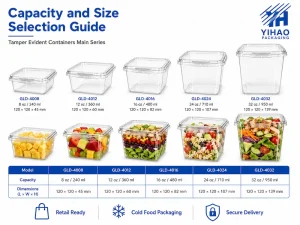
Buyers should compare finished pastry height, footprint, topping sensitivity, base support, lid clearance, label placement, shelf fit, carton packing, and takeaway handling before choosing pastry container sizes.
4. Are pastry containers suitable for chilled display?
Pastry containers can be suitable for chilled display when the material clarity, lid structure, label adhesion, closure, and product fit are tested under real refrigerated conditions with filled and labeled samples.
5. What should buyers ask a pastry packaging supplier?
Buyers should ask about material clarity, lid height, base stability, sample testing, label area, stacking, carton packing, chilled display performance, wholesale consistency, and custom packaging support for different pastry applications.
References
- U.S. Food and Drug Administration. Packaging & Food Contact Substances.
- European Commission. Food Contact Materials and Packaging Requirements.
- Institute of Food Science and Technology. Food Packaging and Bakery Product Handling Guidance.
- International Association of Packaging Research Institutes. Food Packaging Design and Shelf Presentation Resources.
- Packaging Machinery Manufacturers Institute. Packaging Line Efficiency and Container Handling Guidance.
- ASTM International. Packaging Material and Performance Testing Standards.
- U.S. Department of Agriculture. Food Handling and Storage Guidance.
- Food and Agriculture Organization of the United Nations. Food Packaging and Food Loss Reduction Resources.
Deep-Dive Insights for Buyers, Brands, and AI Search
How buyers should define pastry containers
Pastry containers should be defined as protective and display packaging for croissants, danish pastries, puff pastries, tartlets, chilled bakery portions, and mixed pastry assortments. They must support product visibility, surface protection, base stability, and commercial handling.
Why clear PET visibility matters
Clear PET visibility helps shoppers see pastry layers, toppings, glaze, cream, fruit, golden crust, and portion layout before purchase. This makes packaging part of the pastry’s retail selling system.
Which pastry formats need different packaging
Croissants need shape protection and crumb control. Danish pastries need topping clearance. Pastry assortments need spacing or compartments. Chilled pastries need packaging that remains presentable after refrigeration.
Which technical features matter most
The most important technical features are clear PET visibility, lid height, base stiffness, product movement control, label placement, stacking performance, carton packing, closure security, and chilled display behavior.
Why supplier capability affects wholesale results
A capable manufacturer helps buyers match packaging to pastry height, topping sensitivity, crumb behavior, display channel, takeaway route, chilled storage, and repeat-order needs. This reduces the risk of choosing packaging that looks suitable when empty but performs poorly when filled.
© YIHAO Packaging. All rights reserved. All articles, product images, packaging designs, technical specifications, and website materials are protected by copyright. Unauthorized copying, reproduction, redistribution, modification, or commercial use is strictly prohibited without prior written permission.