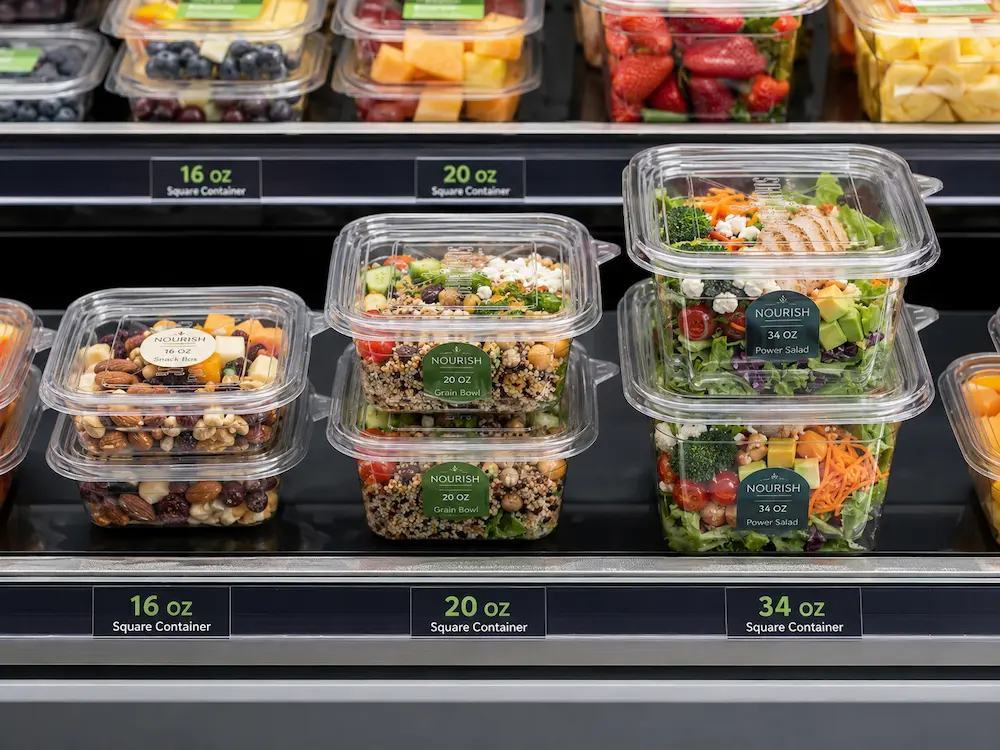
For modern food retailers and foodservice brands, packaging is no longer a simple container decision. It affects shelf presentation, labor efficiency, product visibility, cold-chain handling, customer trust, and repeat purchasing. That is why more buyers are comparing wholesale square deli containers with round bowls, paper trays, foam packs, and generic hinged boxes before placing bulk orders.
Square packaging gives retailers a cleaner merchandising structure. In supermarket refrigerators, cafe takeaway counters, bakery display cabinets, and catering prep areas, square formats align neatly, stack consistently, and use available space more efficiently. For B2B buyers, this means better shelf blocking, fewer awkward gaps, improved carton loading, and a more organized product line across different food portions.
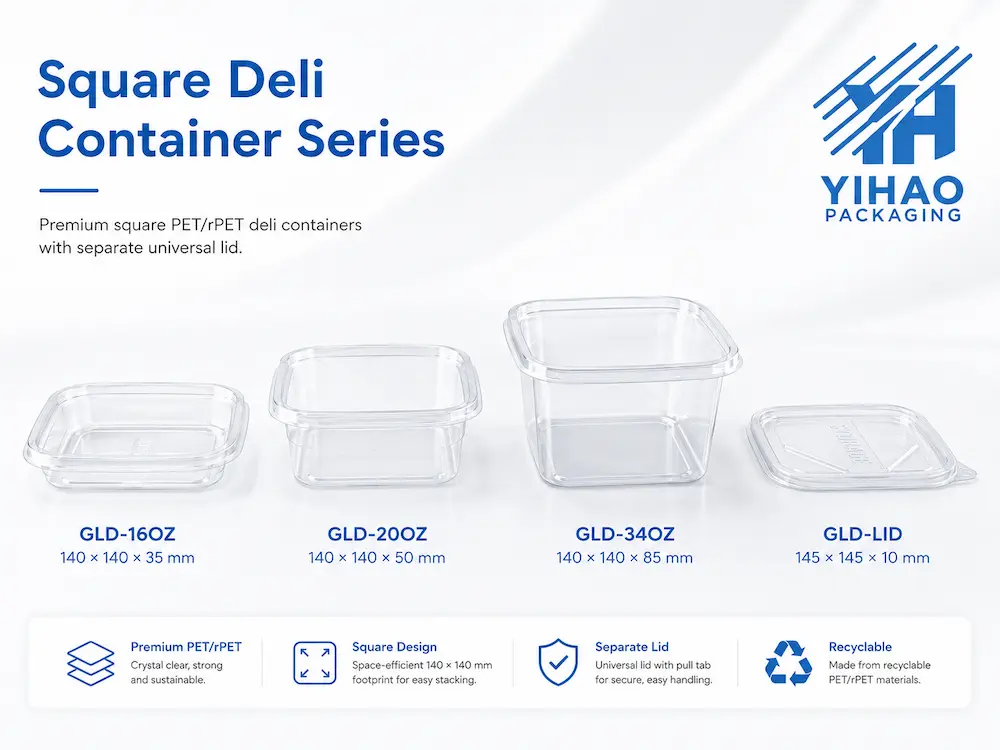
At YIHAO, square PET food packaging is developed for real food display and wholesale supply needs. The goal is not only to make a clear container, but to support practical packaging decisions for chilled food brands, supermarket buyers, distributors, cafes, bakeries, and foodservice teams that need dependable presentation from production to shelf.
Why Square Deli Containers Are Becoming a Practical Choice for Modern Food Packaging
Square deli packaging has become popular because it solves several common problems in refrigerated food retail. Round bowls are familiar, but they do not always use shelf space efficiently. Paper containers can look natural, but they often reduce product visibility. Thin generic boxes may be low-cost, but they often create issues with stacking, lid fit, and food presentation.
Deli and salad containers need to balance clarity, strength, food contact suitability, handling convenience, and brand presentation. Square PET designs meet this demand especially well for chilled foods that rely on visual appeal, such as salads, fruit mixes, pasta portions, deli sides, layered desserts, bakery packs, and fresh snacks.
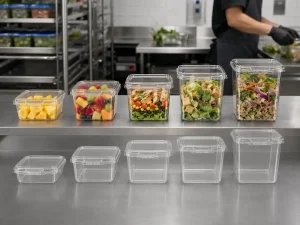
For supermarkets, square packaging improves refrigerator organization. Multiple units line up in rows, helping staff create cleaner shelf blocks. For cafes and bakeries, square containers simplify takeaway display because different menu items can share a consistent visual language. For foodservice brands, square packs support efficient production lines, labeling, carton packing, and delivery handling.
The result is a packaging format that works across many sales channels: supermarket cold cases, grab-and-go displays, cafe counters, bakery refrigerators, convenience stores, catering programs, and prepared food delivery operations.
What Are Wholesale Square Deli Containers?
Wholesale square deli containers are bulk food packaging containers designed for chilled prepared foods, fresh produce, snacks, deli items, salads, desserts, and takeaway products. They are commonly made from PET or rPET because these materials provide strong transparency, lightweight handling, and reliable cold food display performance.
In B2B purchasing, buyers often use several related terms: square PET deli containers, square deli containers, square salad containers, clear square food containers, and PET square bowls. These terms overlap, but they usually refer to clear square packaging used for refrigerated foods and ready-to-eat portions.
A square deli container may be used for fruit, pasta salad, leafy salad, cheese cubes, cold noodles, deli sides, dessert portions, bakery items, or meal prep ingredients. A square salad container often emphasizes cold salad presentation, lid clarity, and stacking. PET square bowls usually refer to deeper or bowl-like formats that keep a premium food display while maintaining a square footprint.
For buyers comparing options, the key question is not only “What is the shape?” The better question is: does the container fit the product, shelf, lid, label, transport carton, and customer experience?
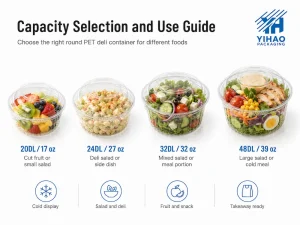
Square vs. Round Deli Containers: Which Format Works Better for Retail Display?
Round deli bowls remain useful for many salad and fruit applications, but square containers often provide better space control in refrigerated retail. For supermarkets and foodservice operations, shape affects more than appearance. It influences stacking, carton loading, label placement, shelf density, and how quickly customers can compare products.
| Comparison Point | Square Deli Containers | Round Deli Containers |
|---|---|---|
| Shelf space efficiency | Better row alignment and cleaner refrigerator blocking | More gaps between units on rectangular shelves |
| Stacking | Stable display when lid and base are matched correctly | Strong for many bowl applications but less space-efficient |
| Label placement | Predictable lid and side-panel label areas | Works well for top labels but may offer less side-panel consistency |
| Best retail use | Salads, fruit, deli sides, chilled meals, bakery desserts | Large salads, fruit bowls, noodle bowls, shared portions |
| Carton packing | Efficient use of rectangular shipping cartons | May require more carton space depending on bowl profile |
For brands focused on organized cold-case merchandising, square deli containers provide a strong advantage. For large tossed salads or bowl-style meals, round containers may still be appropriate. The best choice depends on food structure, portion size, shelf layout, lid height, and brand presentation goals.
Key Applications for Supermarkets, Cafes, Bakeries, and Foodservice Brands
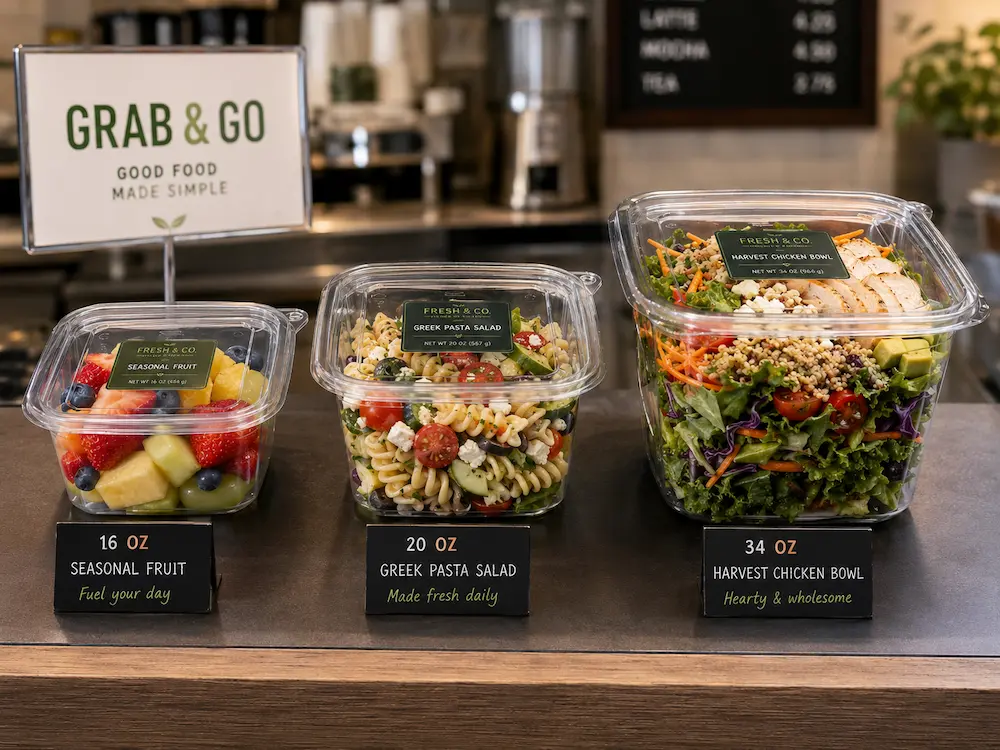
Square deli packaging performs best when product visibility and shelf discipline matter. Supermarkets use it for fresh-cut fruit, salad kits, deli sides, chilled noodles, snack packs, and ready-to-eat meals. Cafes use it for grab-and-go salads, yogurt toppings, pasta portions, fruit cups, bakery snacks, and cold meal combinations. Bakeries use it for chilled desserts, cake cubes, mousse portions, brownies, roll cakes, and premium takeaway sweets.
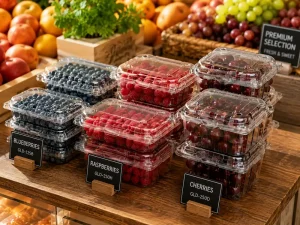
For fresh produce and fruit programs, square PET packaging works well alongside fresh produce packaging containers because both categories depend on transparency, freshness cues, and clean retail presentation. In fruit departments, square containers help display cut melon, pineapple, berries, grapes, apple slices, mango cubes, and mixed fruit portions in an orderly way.
For prepared food and salad programs, a square salad container supports clean portioning for leafy greens, pasta salad, grain bowls, fruit salad, deli vegetables, and chilled side dishes. The square footprint helps food brands build consistent product families without changing the visual structure for every menu item.
For bakeries, square PET containers support cold display for desserts that need visibility and protection. They also work well beside bakery containers when a store sells both fresh bakery goods and refrigerated dessert portions. A bakery can use round cake domes for celebration cakes, hinged bakery packs for pastries, and square clear containers for smaller chilled desserts or premium takeaway portions.
| Business Type | Common Food Applications | Packaging Value |
|---|---|---|
| Supermarkets | Fresh-cut fruit, salads, deli sides, chilled meals | Clean shelf blocking, clear visibility, easy stacking |
| Cafes | Grab-and-go salads, pasta, fruit cups, snack packs | Fast service, takeaway convenience, premium presentation |
| Bakeries | Dessert portions, brownies, mousse, chilled cake slices | Product protection and transparent display |
| Foodservice Brands | Meal prep, deli meals, catering portions, private-label foods | Bulk efficiency, portion consistency, supply stability |
Why PET Square Deli Containers Work Well for Chilled Food Displays
PET is widely used for chilled food packaging because it provides high clarity and a clean retail appearance. For foods that depend on color, freshness, and ingredient visibility, PET makes the product easier to evaluate before purchase. This is important for salads, fruit, bakery desserts, fresh snacks, and deli foods where customers often decide visually.
A PET square deli container gives buyers a clear view of ingredients while keeping a practical square footprint. This matters in supermarket cold cases and cafe refrigerators, where many products compete for attention in a limited space.
Another advantage is lightweight handling. PET containers reduce operational burden for food prep teams, retail staff, and delivery handlers. They are easier to move, stack, open, fill, label, and pack compared with heavier rigid packaging formats. For wholesale buyers, this supports smoother daily operations and better cost control across large order quantities.
Clarity also supports brand trust. Customers want to see what they are buying, especially when purchasing ready-to-eat foods. Clear packaging allows the color of fruit, vegetables, grains, sauces, toppings, and desserts to become part of the sales presentation. Instead of hiding the product, the packaging helps sell it.
Size, Capacity, and Portion Logic for Square Deli Containers
Choosing the right square container is not only about volume. Buyers should consider product weight, ingredient height, lid clearance, sauce movement, label placement, carton packing, shelf height, and how the consumer will eat or transport the food.
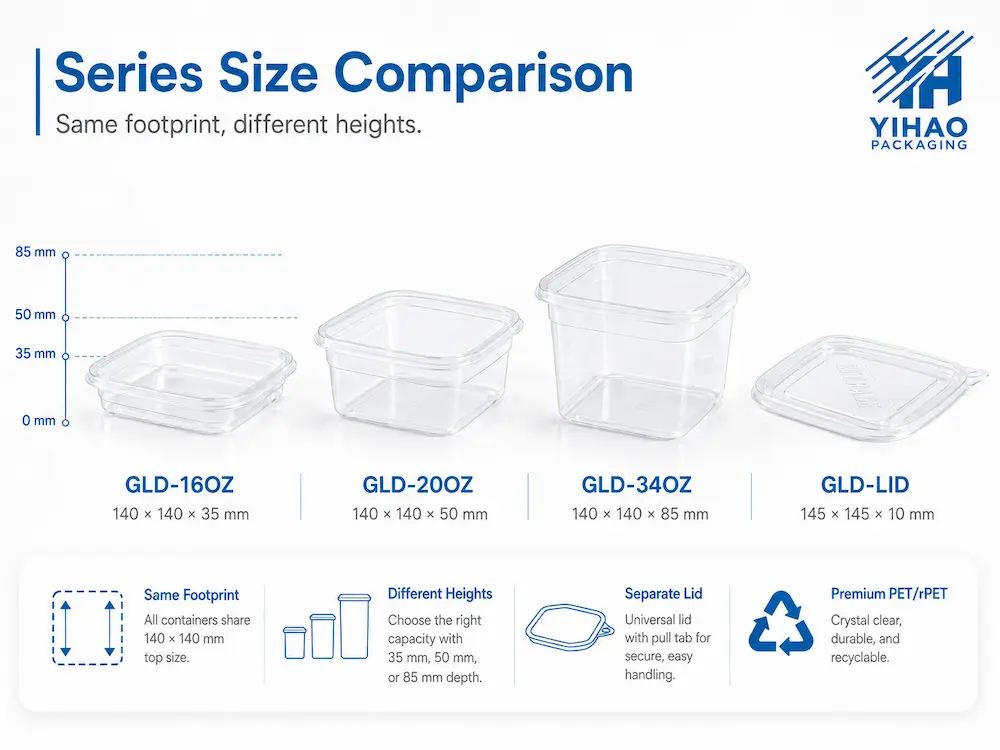
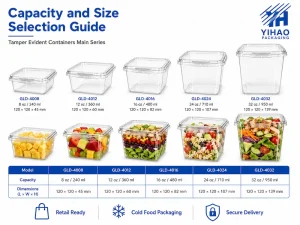
Smaller square containers are suitable for fruit snacks, nuts, toppings, deli sides, dessert portions, and single-serve chilled foods. Medium square formats are practical for salads, pasta portions, fresh-cut fruit, cold noodles, and cafe takeaway meals. Larger square formats support family-size salads, bulk fruit mixes, meal prep, catering sides, and chilled prepared food lines.
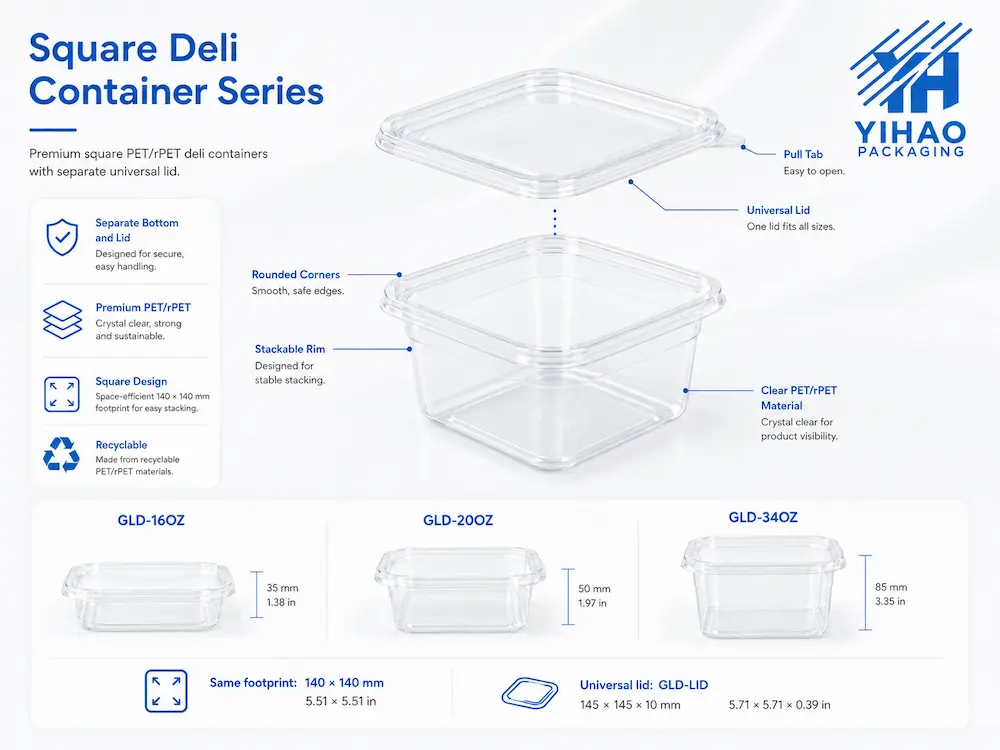
When a buyer needs more vertical clearance, a high-lid square food container is useful for leafy greens, fruit mixes, layered desserts, or foods with toppings. When the priority is low-profile stacking and compact refrigerator display, a flat-lid square food container may be the better choice.
| Buyer Need | Recommended Container Logic | Typical Food Applications |
|---|---|---|
| Small chilled portions | Compact clear square food containers | Berries, nuts, toppings, desserts, deli sides |
| Daily grab-and-go meals | Standard square salad containers | Salads, pasta, fruit, cold noodles, cafe meals |
| Larger chilled foods | Deep clear square food containers | Large salads, fruit mixes, deli meals, meal prep |
| Premium presentation | PET square bowls with clear lids | Layered salads, bakery desserts, fresh-cut fruit |
Wholesale Buying Checklist: How to Choose the Right Square Deli Container Supplier
When buyers search for wholesale square deli containers, they usually compare price first. Price matters, but it should not be the only decision point. A container that looks inexpensive can become costly if the lid does not fit well, the stack collapses, the clarity is inconsistent, the carton packing is poor, or repeat orders vary from batch to batch.
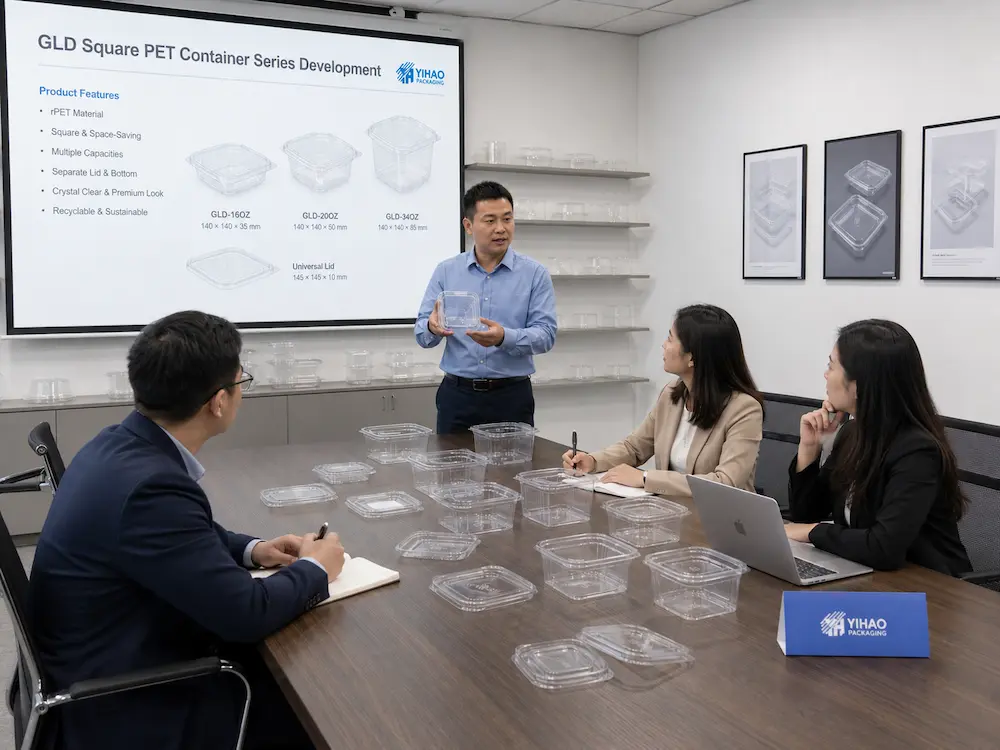
A reliable manufacturer should help buyers evaluate material clarity, lid compatibility, stacking strength, food application, sample testing, packaging quantity, export cartons, and customization options before bulk production. This is especially important for supermarkets and foodservice brands that require repeat supply and consistent shelf appearance.
For wholesale buyers, the best supplier is not simply the company that offers the lowest price. A reliable manufacturer should provide stable material clarity, matching lids, sample support, production and quality control, export carton planning, and practical guidance for different food applications. This is especially important when square PET deli containers are used across multiple supermarket, cafe, bakery, and foodservice programs.
Buyers should also check whether the supplier offers matching lids. A container body without the correct lid can create leakage, loose stacking, poor freshness protection, and customer complaints. For square PET systems, a universal PET lid can simplify inventory planning when several container sizes share the same lid design.
Before placing a wholesale order, buyers should confirm the following points: material clarity, lid fit, food-contact suitability, stack strength, lid height, label area, carton packing, sample testing, and repeat-order consistency.
| Checklist Item | Why It Matters | What Buyers Should Confirm |
|---|---|---|
| Material clarity | Clear packaging improves food visibility and shelf appeal | PET or rPET transparency, surface finish, and sample quality |
| Lid fit | A secure lid supports handling and takeaway confidence | Matching lid design, closure feel, and stacking stability |
| Stacking strength | Wholesale cartons must survive transport and cold storage | Filled-product stacking, carton loading, and cold-chain handling |
| Food application | Different foods need different lid height and base depth | Salads, fruit, bakery desserts, deli foods, or meal prep use |
| Supply consistency | Retail programs need stable repeat orders | Manufacturer capability, QC process, export packing, and lead time planning |
Manufacturer vs. Trading Supplier: What B2B Buyers Should Check
For small one-time orders, a trading supplier may appear convenient. For long-term food packaging programs, however, working with a direct or well-supported manufacturer gives buyers better control over repeat quality, mold development, material selection, carton packing, and order consistency.
A packaging manufacturer understands production details that affect daily use. These include sheet thickness, thermoforming control, trim accuracy, lid tension, nesting performance, anti-fog requirements, carton compression, and shipment protection. These details may not be visible in a product photo, but they affect how the container performs in real food operations.
For supermarkets, cafes, bakeries, and distributors, the right supplier should support samples before bulk orders. Sample testing allows buyers to check food fit, lid closure, label placement, cold storage performance, shelf display, and consumer handling. This step reduces risk before committing to a larger wholesale order.
Manufacturer support also matters when buyers need private-label packaging. Custom label areas, printed sleeves, embossed branding, carton marks, and OEM development all require production experience. If a brand plans to build a long-term packaging family, supplier capability becomes more important than a single low quote.
How Square PET Containers Support Supermarket Retail Display
Supermarkets depend on fast shelf replenishment and strong visual order. Square PET packaging helps staff line up products quickly, maintain clear rows, and create a cleaner display in refrigerated cases. This makes the entire section look more organized and easier for consumers to shop.
For fresh-cut fruit sections, square containers help separate different SKUs such as melon cubes, pineapple chunks, berry mixes, apple slices, grapes, and fruit-and-nut combinations. Buyers can also pair them with fresh-cut fruit containers when building a complete produce packaging program.
For deli counters, square PET containers support side dishes, pasta salads, marinated vegetables, chilled noodles, prepared grains, and cold appetizers. Their clarity helps customers inspect ingredients, while the square footprint improves shelf density. For high-volume retail operations, these small efficiencies add up across daily stocking and sales.
For premium chilled meals, clear square food containers create a clean presentation for larger salads, fruit mixes, and prepared meal portions. They help food brands maintain a consistent look across different refrigerated products.
How Cafes and Foodservice Brands Use Square Deli Containers
Cafes need packaging that is quick to fill, attractive in display, and practical for customers to carry. Square containers meet this need for salads, pasta, fruit, yogurt toppings, snacks, and chilled desserts. A cafe can prepare portions in advance, display them neatly, and sell them through a grab-and-go refrigerator without sacrificing appearance.
Foodservice brands also need packaging that works behind the counter. Containers should nest well before filling, stack well after filling, and support fast labeling. A square format gives teams a stable working shape during production and storage. This is useful for central kitchens, catering businesses, meal prep programs, and commissary operations supplying multiple stores.
For beverage-focused cafes, food packaging can be planned together with cold cups and lids. A complete takeaway program may include clear PET cups for iced coffee, lemonade, matcha, refreshers, or smoothies, plus square deli containers for fruit, salad, snacks, and chilled meal portions. This creates a more coordinated packaging experience across the entire menu.
How Bakeries Use Square Containers for Chilled Desserts and Premium Takeaway
Bakeries often need different packaging formats for different product types. Large cakes require cake domes. Muffins and cupcakes need cavity-based protection. Pastries need hinged bakery packs. Chilled desserts, however, often benefit from clear square containers because they provide visibility, portion control, and easy refrigerator display.
Square PET containers work well for mousse cups, tiramisu portions, brownies, fruit desserts, cream-based sweets, layered pudding, and cake cubes. They protect the product while allowing the customer to see texture, color, layers, toppings, and decoration. This is important because many bakery purchases are made visually.
For roll cakes, cheesecake portions, brownies, and tiramisu, a bakery may also use a clear PET roll cake container as part of a broader dessert packaging lineup. The choice depends on product shape, height, decoration, and display method.
When square containers are used for bakery desserts, buyers should confirm lid height, base depth, and whether the product needs a flat lid or a high lid. A product with cream topping, fruit decoration, or layered structure may need extra headspace. A lower-profile dessert may benefit from compact stacking and tighter shelf use.
PET, rPET, and Recyclability Considerations for Square Deli Containers
PET remains popular for clear chilled food packaging because it combines transparency, light weight, and practical handling performance. rPET options may also support recycled-content packaging goals when the supply chain and food-contact requirements are suitable.
However, recyclability should be described carefully. PET packaging may be recyclable where local collection, sorting, and recycling systems accept this material. Buyers should not assume that every market handles PET containers in the same way. Local recycling infrastructure, labeling, contamination, color, adhesives, and consumer disposal behavior all affect actual recovery.
For better material recovery, brands should consider clear PET designs, simple labels, easy-to-remove sleeves, and minimal dark coloration. Clean design choices help improve the chance that packaging enters the correct recycling stream where local systems support it.
When food brands compare packaging materials, PET is often selected for cold display. PP is typically considered when microwave or hot food use is required. For buyers who need hot food packaging, microwave-safe containers should be evaluated separately rather than assuming a clear PET deli container is suitable for reheating.
Customization Options for Wholesale Square Deli Containers
Wholesale buyers often need more than a standard stock container. They may need private-label packaging, custom sizes, printed sleeves, barcode areas, carton marks, OEM molds, or packaging systems that match an existing product family. This is especially common for supermarkets, cafe chains, bakery brands, distributors, and prepared food companies.
Customization can include container size, lid height, base depth, label placement, embossing, carton packing, and master carton structure. For food brands, the goal is to make the packaging work smoothly across production, display, transport, and customer use.
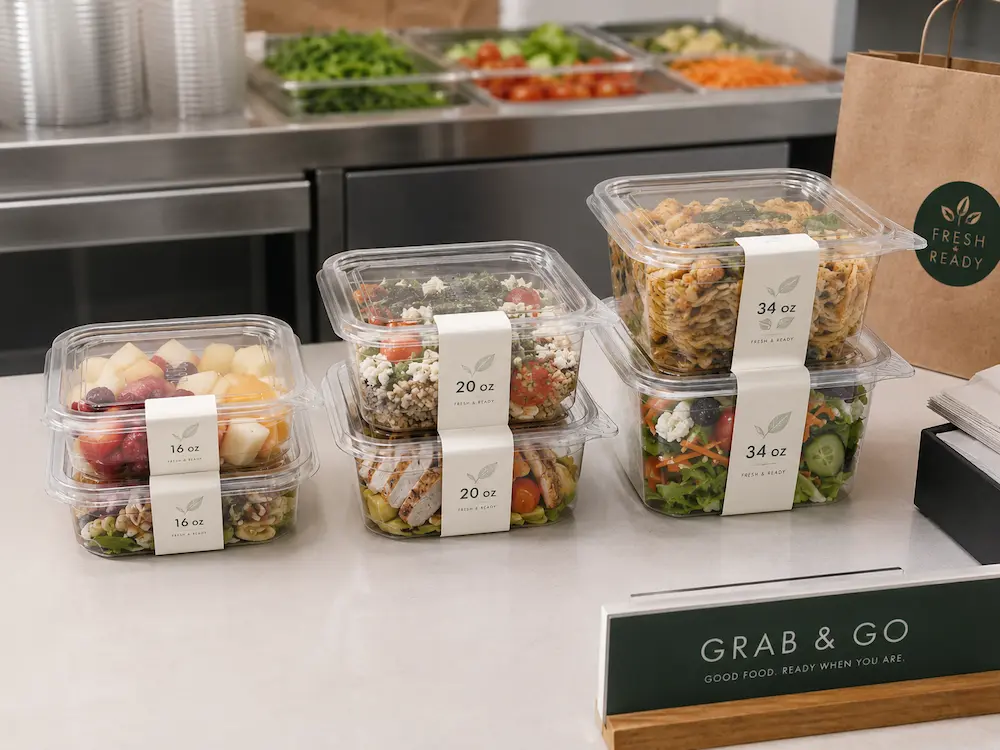
A separate-lid food container may be preferred when buyers want a different user experience from hinged packaging. Separate lids can support premium presentation, easier filling workflows, and flexible closing processes depending on the food application.
For products that need extra security in cold-case retail, buyers may also compare square deli packaging with tamper evident containers. Tamper-evident formats are useful when retailers want visible opening protection for grab-and-go foods, snacks, prepared items, and refrigerated food packs.
Labeling, Shelf Blocking, and Brand Presentation
Label placement is one of the most overlooked details in square deli container purchasing. A container may look good when empty, but the final retail result depends on where the label sits after filling. Labels should not cover too much of the food. They should leave enough visibility for customers to inspect the product while still showing the brand, product name, barcode, nutrition panel, and date code.
Square PET containers make label planning easier because the lid and side panels often provide more predictable surfaces than irregular shapes. This helps brands create consistent label locations across different SKUs. For supermarkets and private-label food programs, this consistency supports stronger shelf recognition.
Clear square packaging also improves shelf blocking. When products share a similar footprint, the refrigerator looks more organized. Customers can compare flavors, portion sizes, ingredients, and prices faster. Staff can refill shelves more quickly. This creates a better shopping experience and helps reduce visual clutter.
For food brands competing in crowded cold cases, packaging order matters. A clean square format gives the product line a more professional appearance without requiring excessive decoration.
Common Mistakes Buyers Should Avoid
The first mistake is choosing only by unit price. A very low-cost container may create problems if it cracks, warps, stacks poorly, or has inconsistent clarity. Wholesale packaging should be evaluated by total operating value, not just the lowest quote.
The second mistake is ignoring lid fit. A container and lid should be tested together with the real food product. The test should include filling, closing, stacking, refrigeration, transport simulation, labeling, and customer handling. A lid that feels acceptable when empty may perform differently when the container is filled.
The third mistake is choosing the wrong lid height. Leafy salads, fruit mixes, bakery desserts, and topped foods often need more headspace than flat deli sides. If the lid is too low, the food may be pressed, damaged, or visually reduced. If the lid is too high, shelf efficiency may suffer.
The fourth mistake is using PET for the wrong temperature application. Clear PET square deli packaging is suitable for many chilled display and takeaway uses, but hot-fill, oven, and microwave applications require different material evaluation. Buyers should match the material to the food temperature and usage method.
The fifth mistake is skipping sample testing before wholesale orders. Samples reveal real-world issues early. They help buyers check appearance, closure, stacking, filling speed, label placement, carton loading, and customer experience before production quantities are confirmed.
How to Build a Complete Square Deli Packaging Program
A strong packaging program usually includes more than one container. Buyers may need small, medium, and larger square containers; flat and high lid versions; matching lids; bakery-friendly options; produce-friendly options; and secure packaging for specific grab-and-go products.
For example, a supermarket may use square PET containers for salads and deli sides, fresh-cut fruit containers for produce, bakery containers for desserts, tamper-evident containers for cold-case snacks, and cold cups for beverage programs. The packaging should look coordinated while still fitting each food category correctly.
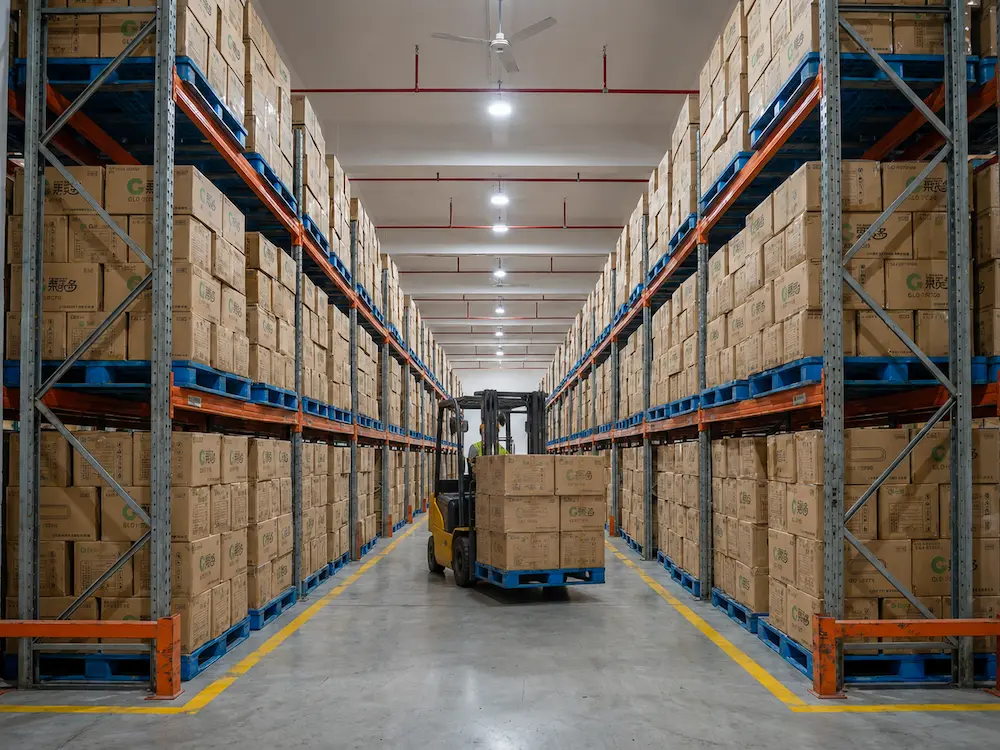
Foodservice brands should also think about warehouse storage. A complete packaging system should reduce SKU confusion, simplify lid matching, and support stable carton organization. When several containers share compatible lids or similar footprints, purchasing and operations become easier.
For distributors, the best packaging lines are easy to explain to end users. A square PET deli container range should clearly show which format suits salads, fruit, desserts, deli sides, and chilled prepared meals. Clear category logic helps distributors sell more efficiently and reduces buyer uncertainty.
Final Note / Practical Takeaway
FAQs About Wholesale Square Deli Containers
1. What are wholesale square deli containers used for?
Wholesale square deli containers are used for chilled salads, fresh-cut fruit, deli sides, bakery desserts, snacks, pasta portions, cold noodles, meal prep foods, and grab-and-go retail packaging. They are especially useful for supermarkets, cafes, bakeries, delis, distributors, and foodservice brands that need clear presentation and efficient shelf organization.
2. Are square PET deli containers suitable for salads and cold foods?
Yes. Square PET deli containers are widely used for salads, fruit, deli foods, chilled meals, and cold takeaway products. PET provides strong clarity for refrigerated display, while the square shape supports clean stacking and organized shelf presentation. Buyers should confirm lid fit, container depth, and food temperature requirements before placing wholesale orders.
3. What is the difference between square deli containers and PET square bowls?
Square deli containers usually refer to clear square packaging for deli sides, salads, fruit, and prepared foods. PET square bowls often describe deeper or more bowl-like square formats used for salads, fruit mixes, layered foods, and premium chilled meals. Both can support clear food visibility and refrigerated retail display.
4. Can square deli containers be customized for wholesale orders?
Yes. Wholesale square deli containers can often be customized through size selection, lid options, label space, carton packing, private-label packaging, printed sleeves, and OEM mold development. Customization depends on order requirements, production capability, tooling, and the selected supplier or manufacturer.
5. How do I choose a reliable square deli container manufacturer or supplier?
Choose a manufacturer or supplier that can provide clear material information, samples, stable lid compatibility, reliable stacking performance, consistent bulk production, export packing support, and practical guidance for your food application. For B2B buyers, long-term supply consistency is often more important than the lowest unit price.
6. Are square PET deli containers recyclable?
Square PET deli containers may be recyclable where local PET collection, sorting, and recycling systems accept this material. Buyers should confirm local recycling rules and consider clear PET designs, simple labels, and minimal decoration to support better material recovery.
References
- U.S. Food and Drug Administration, Food Contact Substances and Food Packaging Guidance.
- European Food Safety Authority, Food Contact Materials Safety Evaluation Resources.
- Association of Plastic Recyclers, Design Guidance for PET Packaging Recyclability.
- PET Resin Association, PET Packaging Material Characteristics and Applications.
- U.S. Environmental Protection Agency, Sustainable Materials Management and Recycling Guidance.
- WRAP, Plastics Packaging Design and Recycling Best Practice Guidance.
- Foodservice Packaging Institute, Foodservice Packaging Recovery and Material Considerations.
- ISO Packaging and Environment Standards, Packaging Recovery and Reuse Frameworks.
Deep Dive Insights
Deep Dive Insight: The strongest value of square PET deli packaging is not only its clear appearance. Its deeper commercial value comes from how it improves retail organization, reduces shelf waste, supports repeatable portion presentation, and helps food brands build a more consistent refrigerated product line.
How square deli containers improve refrigerated shelf efficiency
Square containers match the rectangular logic of most refrigerator shelves, shipping cartons, prep tables, and retail display layouts. This creates a more efficient packaging geometry from the back-of-house production area to the front-of-house retail shelf. In practical terms, buyers gain cleaner rows, more predictable stacking, and less wasted space between units.
Why clear PET packaging supports faster purchase decisions
For chilled foods, visual confidence is a major part of the buying decision. Customers want to see the color of fruit, the freshness of salads, the layering of desserts, and the portion quality of deli foods. Clear PET packaging allows the product itself to communicate freshness, quantity, and value without relying only on labels or printed claims.
What makes manufacturer support important for wholesale programs
Wholesale food packaging programs depend on consistency. A reliable manufacturer helps buyers maintain the same clarity, lid fit, carton packing, and product appearance across repeat orders. This matters for supermarkets, distributors, and foodservice brands because packaging inconsistency can create operational problems even when the product design looks simple.
Which buyers benefit most from square PET deli containers
The strongest fit is with buyers that manage many chilled SKUs in limited display space. Supermarkets, cafes, bakeries, commissary kitchens, meal prep brands, fresh-cut fruit suppliers, and foodservice distributors all benefit from square packaging because it combines product visibility with organized shelf planning.
Consideration for long-term packaging strategy
Buyers should treat square deli containers as part of a complete packaging system, not as a single SKU. A stronger strategy includes multiple depths, matching lids, flat and high-lid options, sample testing, label planning, carton efficiency, and clear internal rules for which container fits each food category. This approach improves procurement efficiency and gives the final retail line a more professional appearance.
© YIHAO Packaging. All rights reserved.
Food packaging solutions for global wholesale buyers, supermarkets, cafes, bakeries, and foodservice brands.