
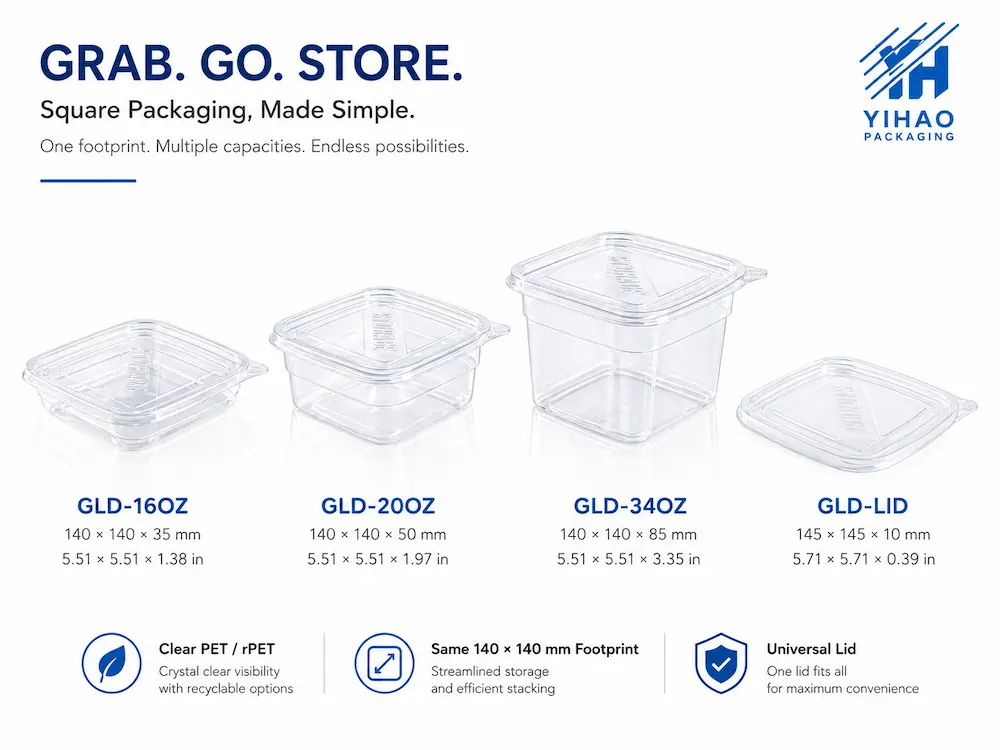
For modern foodservice and retail buyers, grab-and-go square packaging is not only a container choice. It affects how a product looks on the shelf, how quickly staff pack daily food items, how clearly customers see the food, and how consistently distributors reorder packaging for repeated programs. Square packs work especially well when buyers need a compact footprint, clear product visibility, organized retail display, and practical takeaway handling.
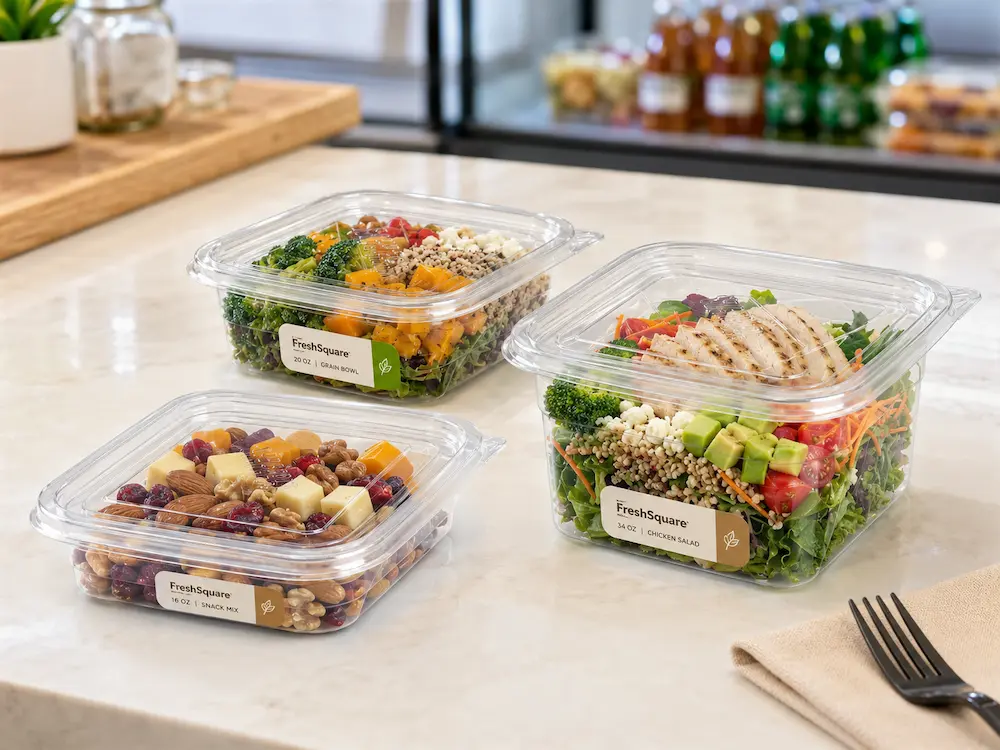
At YIHAO, we look at square packaging from a manufacturer’s perspective: material selection, mold consistency, lid compatibility, carton packing, repeat-order stability, and real application testing. Buyers often compare deli and salad containers, square PET deli containers, hinged deli packs, round bowls, tamper-evident options, and microwave-safe alternatives before confirming the best structure for their food program.
What Is Grab-and-Go Square Packaging?
Grab-and-go square packaging refers to ready-to-use food containers designed for fast retail pickup, takeaway counters, cold display shelves, and prepared food programs. The square shape gives buyers a structured footprint for shelf planning, stacking, labeling, and carton packing. Compared with irregular packaging shapes, square containers use display space more efficiently and help different food items look organized in rows.
In chilled food retail, square packs are often selected for fruit cups, pasta salads, green salads, snack combinations, deli sides, bakery portions, and small prepared meals. Buyers choose square deli containers when they need a clean, visible, and practical container format that fits both food presentation and operational packing speed.
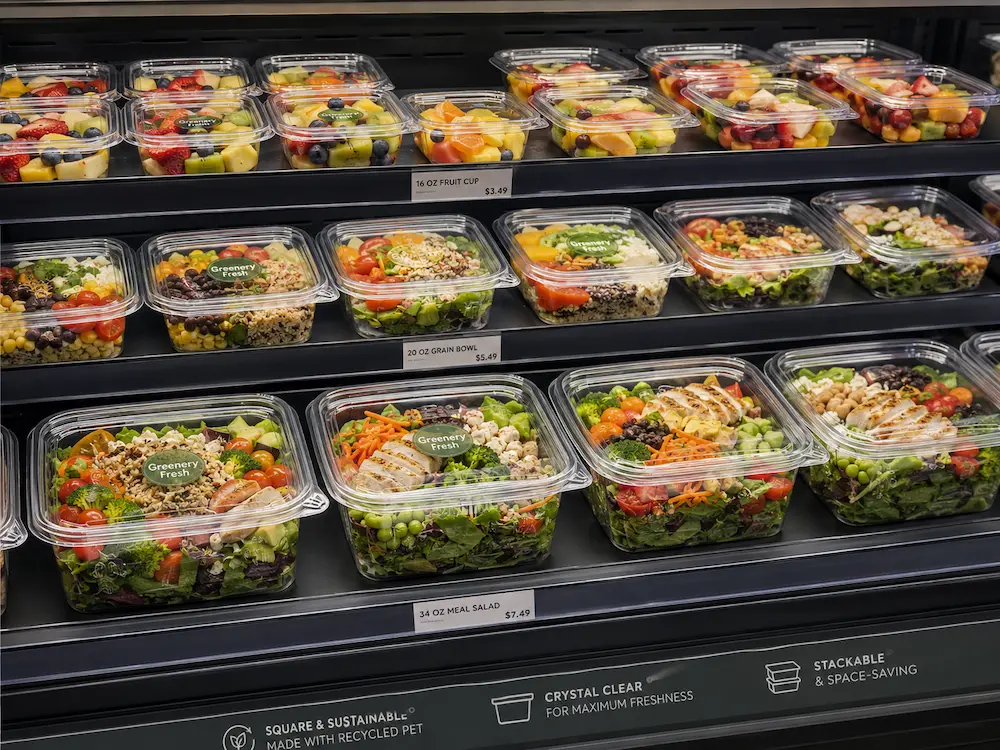
The main advantage is simple: square containers create a balanced look in the display case while keeping the food visible. This matters for supermarkets, convenience stores, salad bars, cafes, airports, campus dining, and foodservice distributors where customers make quick purchase decisions based on appearance, freshness, and portion clarity.
Why Do Food Brands Choose Square PET Deli Containers?
Food brands choose square PET deli containers because PET offers high clarity, a smooth retail appearance, and reliable visibility for cold foods. When customers can see fresh colors, layered ingredients, toppings, and portion size, the package supports the sale before the customer even reads the label.
For salads, fruit, and deli sides, transparent packaging is especially important. A mixed fruit cup needs to show color contrast. A pasta salad needs to show texture and portion. A snack pack needs to make separate ingredients look clean and intentional. Clear square packaging supports these goals while keeping the package shape easy to stack and display.
Buyers also like PET square formats because they fit different menu categories without looking random. A brand can use smaller containers for snacks, medium containers for fruit and deli sides, and deeper containers for meal salads or chilled prepared foods. This creates a more consistent retail packaging family for cold display, takeaway, and wholesale distribution.
What Materials Are Commonly Used for Grab-and-Go Square Packaging?
The most common materials for square grab-and-go food containers include PET, RPET, PP, and sometimes paper-based structures with clear lids. For this article, the main focus is PET and RPET because they are strongly associated with clear chilled food display.
PET for Clear Cold Food Display
PET is widely used for clear square food containers because it provides excellent transparency, good rigidity, and a polished retail look for chilled applications. PET is commonly selected for cold salads, fresh fruit, deli sides, desserts, snack packs, and refrigerated ready-to-eat foods.
For buyers focused on shelf presentation, PET usually gives a cleaner look than cloudy materials. It helps food colors appear more visible, supports label placement, and keeps the product easy to identify in a cold case.
RPET for Recycled Content Goals
RPET is recycled PET. Buyers who want to support recycled-content packaging goals often ask whether RPET options are available for their container program. The right choice depends on food-contact requirements, product design, local regulations, and the supplier’s available material grade.
When discussing RPET, buyers should avoid vague claims. A safer approach is to ask the supplier for material details, food-contact documentation when required, and clarity about whether the package is accepted by local PET recycling systems. Recyclability depends on local collection, sorting, color, labels, adhesives, and actual recycling infrastructure.
PP for Heat-Resistant Applications
PP is often considered when heat resistance or microwave use is needed. If the food program includes hot takeaway meals, reheating, or higher temperature handling, buyers may need to compare PET square containers with microwave safe containers.
This does not mean PP is better for every product. PET remains stronger for clear cold presentation, while PP is generally more suitable for heat-related use cases. The right material depends on the food temperature, shelf environment, customer use, and regional packaging requirements.
Which Foods Work Best in Square Grab-and-Go Containers?
Square packaging is especially useful for foods that need both visibility and portion structure. It works well for fresh, chilled, and prepared food programs where buyers want consistent display and quick packing.
| Food Category | Best Packaging Logic | Buyer Benefit |
|---|---|---|
| Fresh-cut fruit | Clear PET square or fruit-focused container | Shows color, freshness, and portion size |
| Cold salads | Medium or deeper square salad container | Supports greens, toppings, and retail visibility |
| Deli sides | Compact square deli container | Good for prepared portions and quick takeaway |
| Snack packs | Clear container with stable lid fit | Improves product recognition in retail shelves |
| Prepared chilled meals | Deeper square or separate-lid structure | Helps protect volume and visual layout |
For buyers selling fruit-focused items, fresh-cut fruit containers may also be useful for comparing different structures. For fruit-and-snack programs, fruit and nut snack packs give buyers another packaging direction when the product needs separated ingredients or a more snack-oriented format.
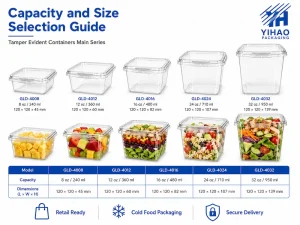
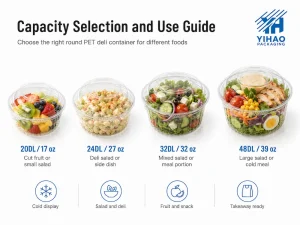
How Should Buyers Choose the Right Size?
Choosing size is not only about capacity. Buyers should think about food height, ingredient movement, label area, stacking, lid clearance, carton packing, and how the final product looks in the customer’s hand. A container that is technically large enough may still look poor if the food sits too low, moves too much, or leaves too much empty headspace.
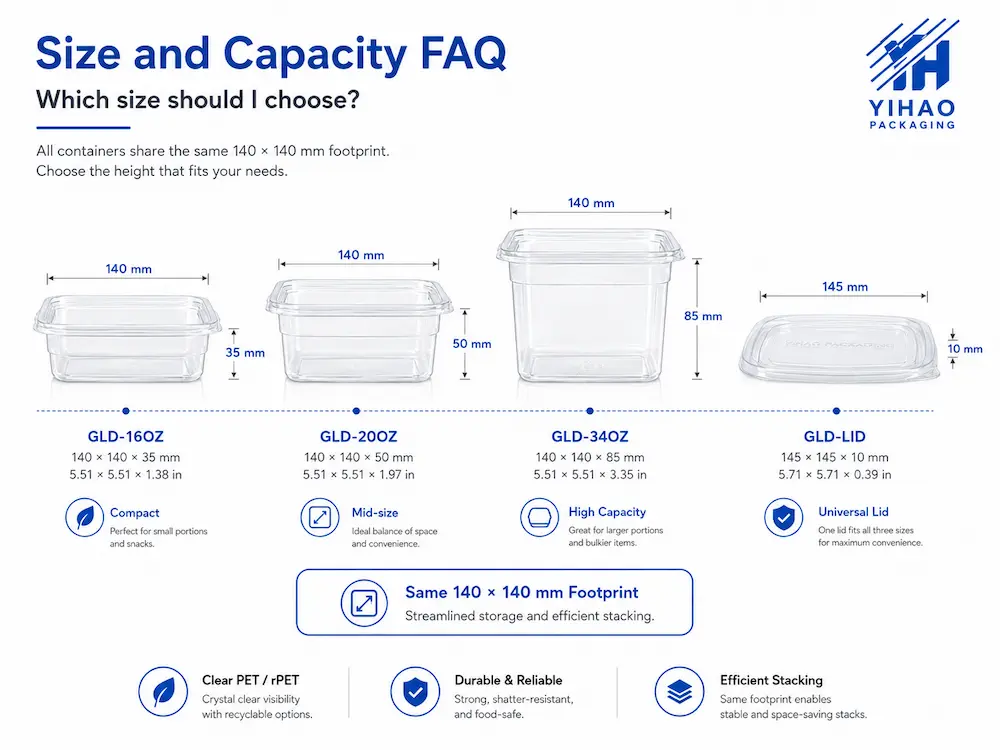
For grab-and-go square packaging, size selection should start with the actual food program. A fruit cup needs a different visual fill level than a salad with leafy greens. A deli side needs a different lid clearance than a dessert with toppings. A chilled meal may require a deeper format or separate lid structure.
| Application | Recommended Size Logic | What Buyers Should Test |
|---|---|---|
| Small fruit portions and deli sides | Compact square footprint | Fill level, lid closure, label placement |
| Salads and mixed fruit | Medium square deli format | Ingredient height, visual volume, shelf display |
| Large salads and chilled meals | Deeper square container | Lid clearance, stacking, transport stability |
| Prepared meals and bakery display | Separate-lid structure | Product protection, opening experience, case layout |
For small portions, buyers can review a square PET format designed for fresh fruit, snacks, and deli sides. For larger salads, fruit, and chilled meals, a deeper square option for large salads, fruit, and chilled meals helps buyers compare height, portion logic, and presentation needs without making the anchor text look too narrow or capacity-heavy.
How Can Buyers Build a Complete Square Packaging Range?
A complete square packaging range should not rely on one container size or one lid style. Food brands and wholesale buyers usually need a small-to-large system that supports different food portions, menu categories, and retail display positions. This is where grab-and-go square packaging becomes a product family rather than a single SKU.
A practical range may include compact square containers for snacks and deli sides, medium square containers for salads and fruit mixes, deeper containers for chilled meals, and compatible lid options for different food heights. When possible, buyers should simplify lid inventory by checking whether one lid can support several container bases in the same family.
For long-term wholesale programs, buyers should choose a manufacturer or supplier that can support consistent specifications, stable carton packing, sample approval, and repeat production. A reliable square packaging range helps food brands reduce sourcing complexity, improve shelf consistency, and prepare for seasonal menu changes without rebuilding the packaging system from zero.
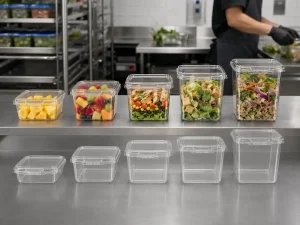
Flat Lid, High Lid, or Universal Lid: Which Option Is Better?
Lid choice is one of the most important decisions in square packaging. A good container base can fail in real use if the lid does not match the food height, product movement, stacking pressure, or customer opening experience.
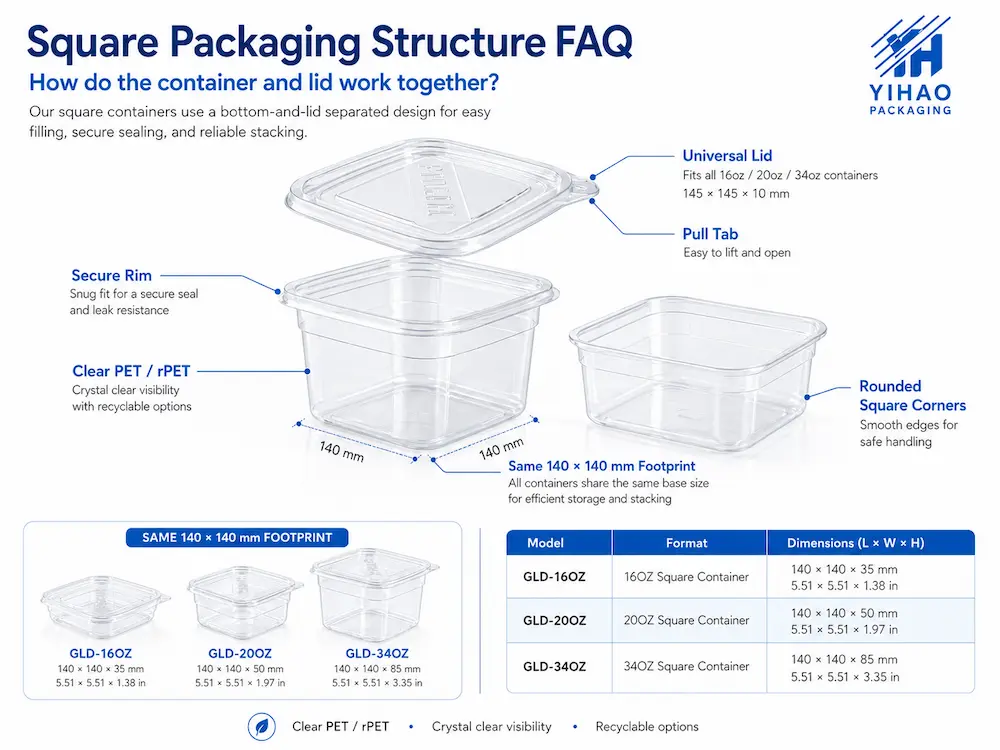
A flat lid usually fits lower-profile foods such as simple salads, deli sides, sliced fruit, or compact chilled foods. A high lid is better when the food has height, toppings, soft volume, or visual layers that should not be compressed. A universal lid is useful when buyers want one lid to fit multiple square container sizes in the same packaging family.
| Lid Type | Best For | Buyer Advantage |
|---|---|---|
| Flat lid | Low-profile salads, fruit, deli sides | Clean stacking and controlled shelf height |
| High lid | Topped salads, fresh-cut fruit, higher-volume foods | Protects food height and visual presentation |
| Universal lid | Multi-size square container programs | Simplifies inventory and repeat ordering |
| Separate lid | Prepared meals, bakery display, premium chilled foods | Creates a more structured packing and opening experience |
For buyers building a multi-size square range, a universal PET lid can simplify procurement. If the product needs a lower shelf profile, a flat lid food container is often easier to stack. If the food needs more headroom, a high lid food container better protects toppings, leafy volume, and layered presentation. For prepared meals and bakery display, a separate lid food container gives buyers a different structure to evaluate.
Are Square Salad Containers Good for Retail Display?
Yes. Square salad containers are strong retail display options when the food is cold, colorful, and visually important. The square shape creates straight shelf lines, helps labels face forward, and makes different SKUs look organized together.
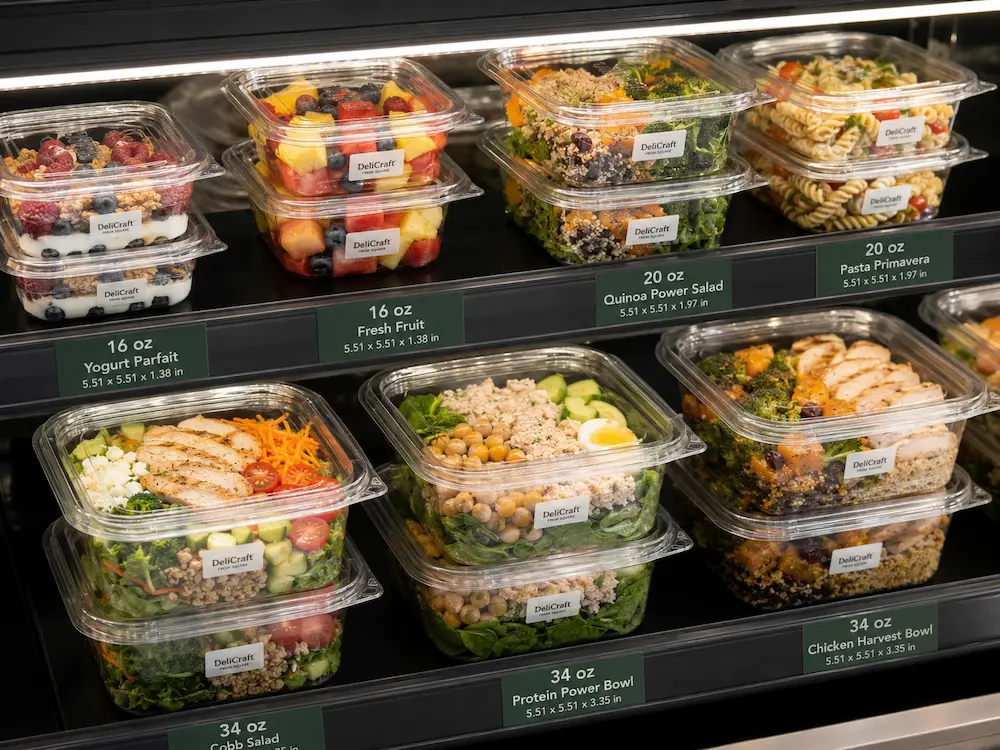
For salad brands, the package should show freshness without making the portion look messy. Clear PET helps customers see greens, vegetables, grains, proteins, pasta, fruit, or toppings. The lid should leave enough room so the salad does not look crushed. The base should feel stable enough for staff handling, delivery trays, and customer takeaway.
Compared with round bowls, square salad containers often provide a more space-efficient shelf footprint. Round bowls still have value for premium salad presentation, layered bowls, fruit mixes, and wider top views. Buyers comparing square formats with PET salad bowls should test both appearance and packing efficiency before finalizing a program.
What Is the Difference Between Square Deli Containers and PET Square Bowls?
The terms sometimes overlap in buyer conversations, but they do not always mean the same thing. Square deli containers usually refer to square food packs used for deli sides, salads, fruit, snacks, and chilled foods. PET square bowls may describe bowl-like square containers with more depth, more visible volume, or a more premium meal-oriented presentation.
The decision depends on the product. A deli side needs secure closure and portion consistency. A salad needs enough room for ingredients and toppings. A fruit mix needs visibility and freshness presentation. A chilled meal needs a structure that protects food arrangement and supports customer handling.
Buyers should not choose by product name alone. They should request samples, pack actual food, chill the samples, stack them, label them, and check how the product looks after handling. The best square package is the one that protects the product and makes it easier to sell.
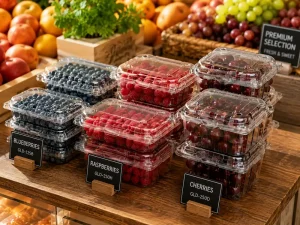
Are Clear Square Food Containers Suitable for Fresh Produce and Fruit?
Clear square packaging is often suitable for cut fruit, fruit mixes, snack fruits, and chilled produce portions. For whole berries or delicate produce, vented clamshells may be more appropriate because airflow and produce protection become more important. For prepared fruit and ready-to-eat fruit snacks, clear square formats can work very well when the lid fit, material clarity, and portion height are correct.
Buyers should compare square containers with fresh produce packaging containers when building a broader produce packaging program. For example, a supermarket may use vented clamshells for whole berries, fresh-cut fruit containers for sliced fruit, and square PET deli containers for mixed fruit, yogurt toppings, and snack portions.
The key is not to force one package into every use. Fresh produce, fresh-cut fruit, deli salads, and chilled meals each need different packaging logic. A good supplier should help the buyer compare material, closure, airflow, clarity, and stacking instead of pushing only one container style.
Should Buyers Consider Tamper-Evident Options?
Tamper-evident packaging is useful when the product is sold in unattended retail areas, convenience stores, cold cases, self-service counters, or delivery channels where visible security matters. Not every square deli program requires tamper evidence, but many grab-and-go food programs benefit from added consumer confidence.
For high-traffic retail, buyers can compare square PET deli containers with tamper evident containers. For refrigerated takeaway programs, a product designed for cold-case grab-and-go foods may help buyers understand how security features change the user experience.
The best choice depends on product value, retail environment, consumer expectations, and local packaging requirements. If security is a priority, tamper-evident design should be discussed early, not after the container size has already been finalized.
Buyer Checklist Before Ordering Grab-and-Go Square Packaging
Before placing a wholesale order, buyers should evaluate packaging performance with real food, real labels, and real storage conditions. A catalog photo is useful, but it does not replace sample testing.
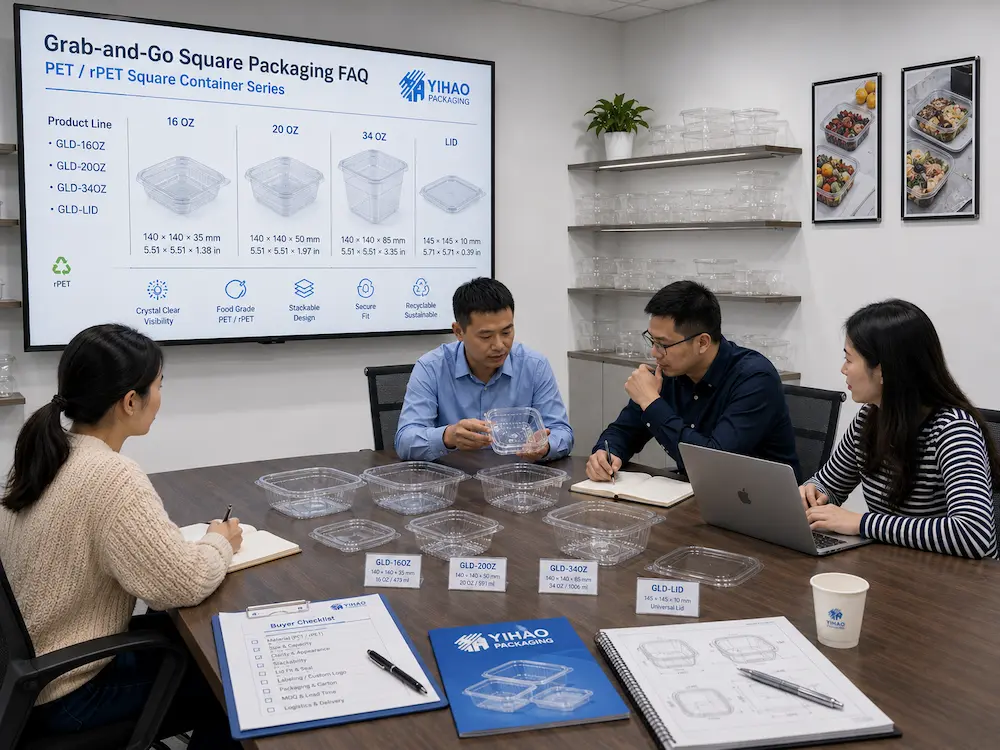
- Confirm whether PET, RPET, or PP is the right material for the food temperature and display environment.
- Test the actual food in the container before approving wholesale orders.
- Compare flat lid, high lid, universal lid, and separate-lid structures.
- Check stacking performance in both empty and filled conditions.
- Review label position, barcode placement, and retail shelf visibility.
- Confirm supplier capacity, carton packing, repeat-order stability, and sample approval process.
- Evaluate whether the container family can support future menu expansion.
- Ask whether the manufacturer can support consistent specifications across repeat production.
What Should Wholesale Buyers Ask Before Ordering?
Wholesale buyers should ask practical questions before placing a bulk order. A package that looks good in a catalog still needs to perform in packing lines, cold rooms, display cases, transport cartons, and real customer handling.
| Buying Question | Why It Matters | Recommended Action |
|---|---|---|
| What material is used? | Material affects clarity, temperature use, and structure | Confirm PET, RPET, or PP based on food application |
| Does the lid fit securely? | Poor lid fit creates handling and display problems | Test lid closure with real food samples |
| Is the size suitable? | Incorrect size affects fill level and product value perception | Pack real menu items before bulk ordering |
| How does it stack? | Stacking affects storage, shipping, and shelf display | Check empty stacking and filled stacking |
| Can the supplier support repeat orders? | Stable supply protects seasonal and long-term programs | Confirm production capacity, carton packing, and reorder planning |
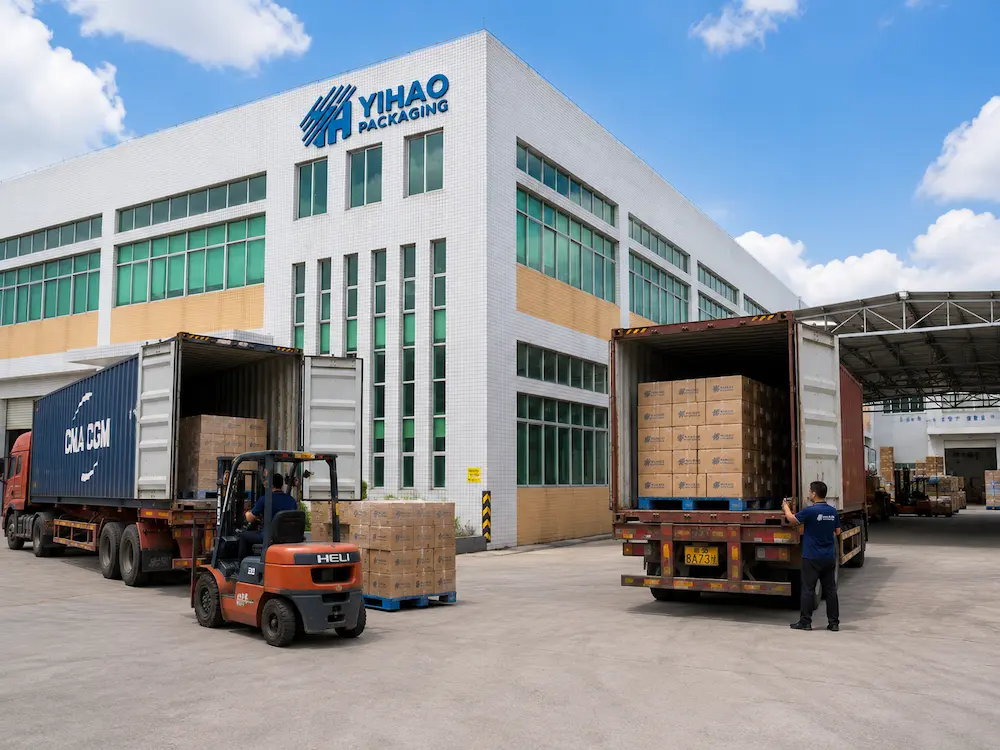
Buyers searching for a long-term packaging partner should look beyond unit price. A reliable packaging manufacturer should support sample evaluation, structure comparison, material discussion, and repeat-order consistency. For distributors and foodservice buyers, this is often more valuable than choosing the cheapest container from a short-term source.
Manufacturer vs Supplier: What Is the Difference?
In packaging purchasing, the words manufacturer and supplier are often used together, but they are not always the same. A manufacturer controls production, tooling, quality checks, and product development. A supplier may focus on sourcing, trading, inventory, or distribution. Both can be useful, but buyers should understand what each partner actually controls.
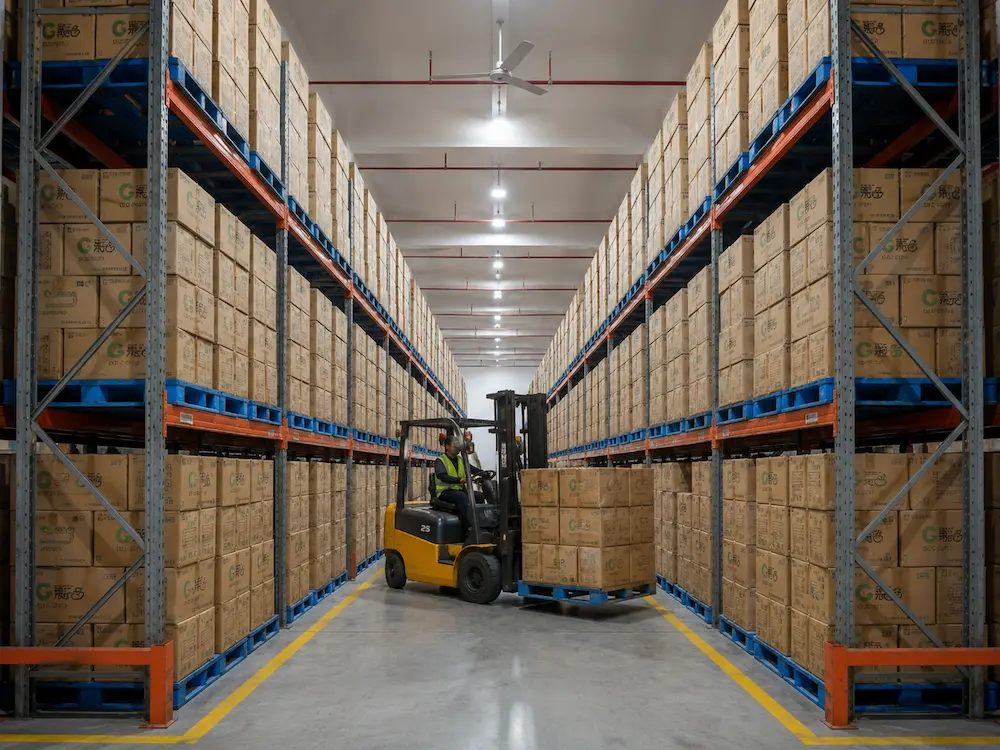
For custom or repeat-order grab-and-go square packaging, working directly with a manufacturer usually gives buyers more control over structure consistency, packaging family development, and quality communication. This is especially important when the buyer needs square PET deli containers, matching lids, multiple sizes, and stable wholesale supply.
A trading supplier may help with small mixed orders or fast sourcing, but buyers should still confirm product origin, specifications, material documents, carton details, and long-term availability. For serious wholesale programs, supplier reliability is not only about finding a product. It is about building a repeatable packaging system.
Can Square Grab-and-Go Packaging Support Branding?
Yes, but branding should be planned around the food and the container structure. Many buyers use labels, sleeves, stickers, printed cards, or carton branding rather than printing directly on every clear container. This keeps the food visible while still giving the brand enough identity on the shelf.
For clear PET packaging, the label should not cover too much of the food. Customers buy with their eyes, especially in grab-and-go environments. A good label position highlights the brand, product name, ingredients, nutrition panel, barcode, and date information while keeping the food visible.
For wholesale buyers, branding questions should be discussed after the container and lid structure are confirmed. The label size, label adhesive, cold-case performance, and carton packing method all affect the final result.
How Should Buyers Test Samples Before Bulk Orders?
Sample testing is one of the most important steps before ordering square food containers wholesale. Buyers should not test an empty container only. They should pack the actual food, close the lid, chill it, stack it, label it, move it, and check how it looks after handling.
A practical test should include these checks:
- Fill the container with the actual product weight and ingredient mix.
- Check whether the food looks full, fresh, and visually balanced.
- Close and reopen the lid several times to test user experience.
- Stack filled containers to evaluate stability.
- Apply labels and check whether they block too much visibility.
- Place samples in a cold display case and review condensation, clarity, and shelf appearance.
- Test carton packing and transport movement if the product is distributed.
This process helps buyers avoid costly mistakes. A container may look acceptable in a product photo but fail when packed with leafy greens, fruit juice, deli sauce, bakery toppings, or chilled prepared food.
Common Ordering Questions About Grab-and-Go Square Packaging
1. What is grab-and-go square packaging used for?
Grab-and-go square packaging is used for chilled salads, fresh-cut fruit, deli sides, snack packs, bakery portions, and ready-to-eat foods sold in retail, takeaway, and foodservice environments.
2. Are square PET deli containers suitable for salads?
Yes. Square PET deli containers are suitable for cold salads when the container size, lid height, and food volume are matched correctly. Buyers should test real salad ingredients before confirming bulk orders.
3. What is the difference between square deli containers and PET square bowls?
Square deli containers usually focus on deli sides, fruit, snacks, and chilled retail foods. PET square bowls may have a deeper or more bowl-like structure for salads and chilled meals. Buyers should compare actual samples instead of choosing by name alone.
4. Are clear square food containers suitable for chilled retail display?
Yes. Clear square food containers are suitable for chilled retail display because they show food color, portion size, and freshness while creating an organized shelf layout.
5. Should buyers choose flat lids or high lids?
Flat lids are better for lower-profile foods, while high lids are better for salads, fruit, toppings, and foods that need more headroom. The best choice depends on food height and stacking requirements.
6. Can square salad containers be used for fruit and snacks?
Yes. Square salad containers can also be used for fruit, snacks, deli sides, and chilled takeaway foods when the size and lid fit match the actual product.
7. What should wholesale buyers check before ordering?
Wholesale buyers should check material, size, lid compatibility, stacking performance, food-contact suitability, carton packing, sample testing results, and supplier production stability.
8. Why work with a manufacturer instead of only a trading supplier?
A manufacturer usually gives buyers stronger control over production consistency, structure discussion, repeat-order planning, and quality communication. This is important for long-term square packaging programs.
9. Are square PET deli containers recyclable?
Square PET deli containers may be recyclable where local PET collection and recycling systems accept clean PET food packaging. Buyers should confirm local recycling rules, label choices, and material specifications before making recyclability claims.
10. Can grab-and-go square packaging be used for bakery portions?
Yes. Grab-and-go square packaging can be used for chilled bakery portions, dessert cups, snack cakes, and small bakery assortments when the lid height and base structure protect the product presentation.
11. How do buyers compare price and quality when ordering wholesale?
Buyers should compare material thickness, clarity, lid fit, carton packing, production stability, sample performance, and repeat-order reliability instead of judging wholesale square containers by unit price alone.
Final Note / Practical Takeaway
FAQ Schema
References
- U.S. Food and Drug Administration, Food Contact Substances and Food Packaging Guidance.
- European Commission, Food Contact Materials Regulation Framework.
- Association of Plastic Recyclers, PET Packaging Design Guidance.
- RecyClass, Design for Recycling Guidelines for PET Packaging.
- WRAP, Plastic Packaging and Recycling Guidance for Businesses.
- Foodservice Packaging Institute, Foodservice Packaging Material Resources.
- PMMI, Packaging Industry Market and Automation Reports.
- Euromonitor International, Retail Food Packaging and Convenience Food Trends.
Deep-Dive Insights
© YIHAO Packaging. All rights reserved.
Food packaging solutions for global wholesale buyers, supermarkets, cafes, bakeries, and foodservice brands.