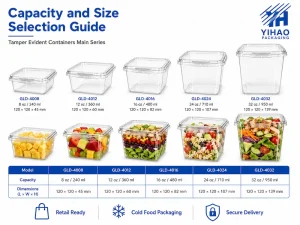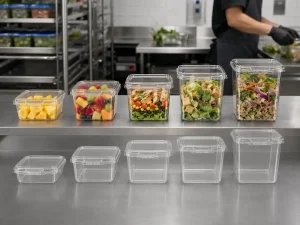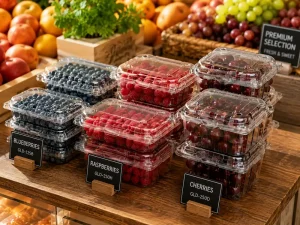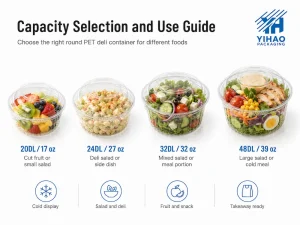

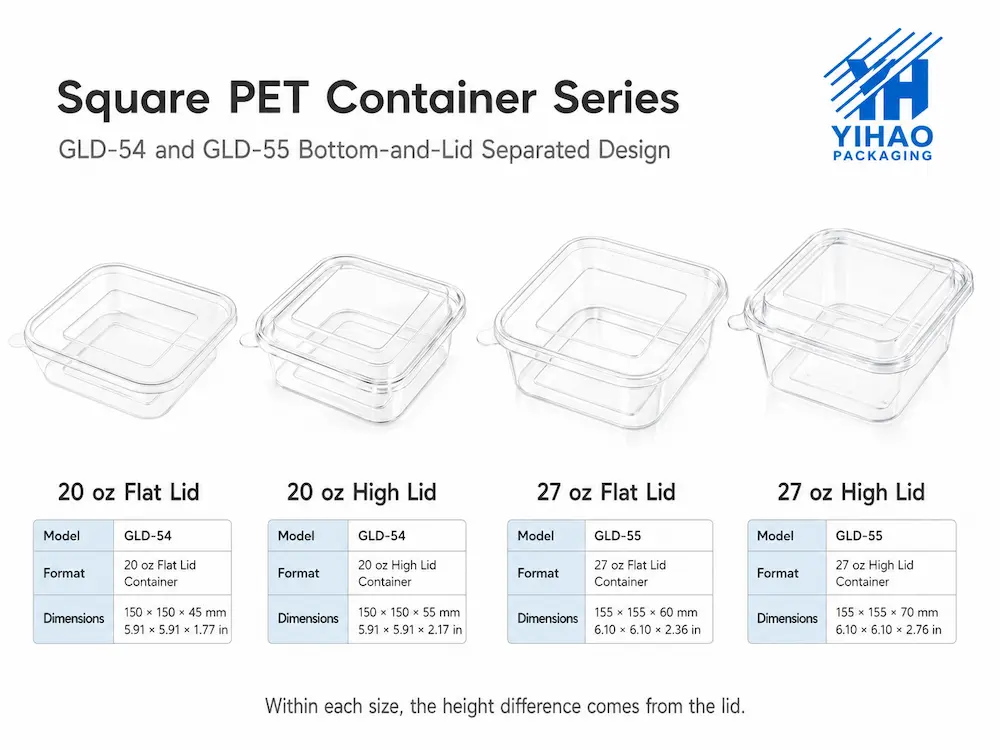
For food brands, supermarkets, distributors, cafes, salad bars, and grab-and-go retailers, packaging is no longer just a container. It is part of the product presentation, storage process, logistics workflow, and customer buying decision. This is why PET square bowls have become a practical choice for chilled food packaging programs that need clear visibility, neat shelf display, and stable portion presentation.
This guide is written for B2B buyers who need to compare PET square bowls for wholesale purchasing, supplier qualification, sample testing, and long-term food packaging programs. The goal is not only to find a container that looks good in a catalog, but to select packaging that performs consistently in filling, closing, labeling, stacking, cold storage, retail display, and repeat ordering.
Unlike round bowls, square food packaging uses shelf and carton space more efficiently. Unlike opaque packaging, clear PET allows customers to see freshness before purchase. Unlike low-stability containers, well-made square PET deli containers support retail display, takeaway handling, and chilled food merchandising with a more organized appearance.
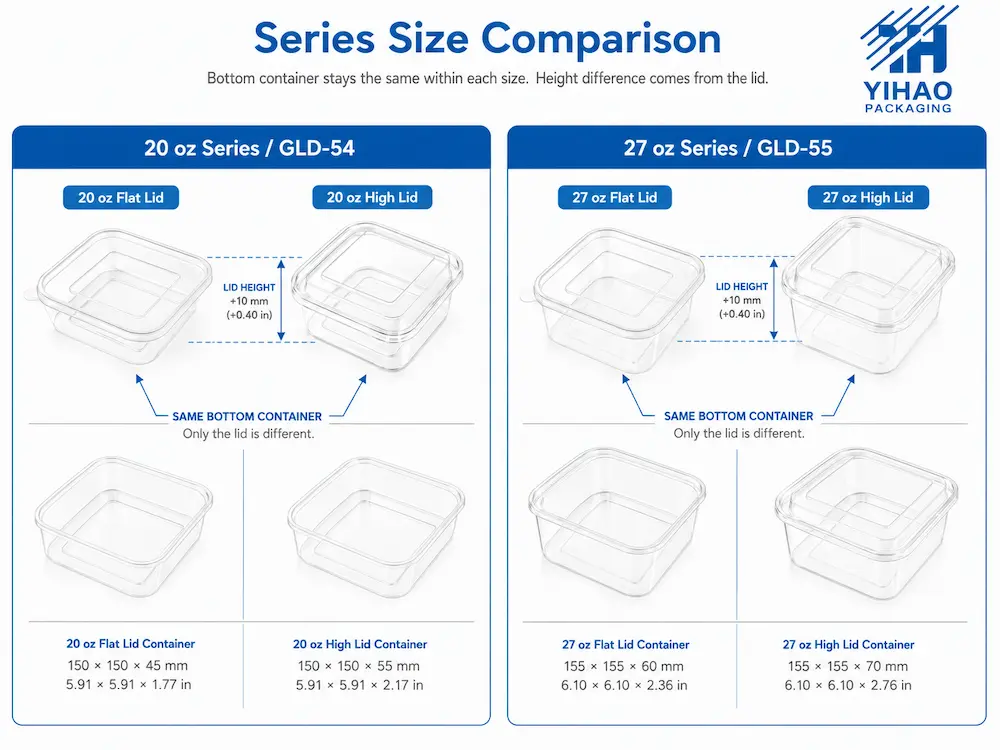
However, buyers should not choose PET square bowls only by unit price. In wholesale purchasing, small differences in material clarity, lid fit, stacking strength, rim structure, carton packing, and supplier communication often become major differences during real use. A reliable manufacturer should help buyers test the container with real food, real labels, real transport conditions, and real retail display needs before bulk ordering.
Why PET Square Bowls Matter in Modern Food Packaging
Modern food packaging has to satisfy several requirements at the same time. It must protect the food, present the product clearly, support fast packing, fit into refrigerated displays, stack safely during delivery, and help the brand look professional. PET square bowls meet these needs because PET provides high clarity, while the square footprint improves space usage in shelves, cartons, and preparation areas.
Clear Visibility for Fresh and Chilled Food
Fresh salads, fruit bowls, deli sides, pasta salad, yogurt parfaits, dessert portions, and chilled snack packs depend heavily on visual appeal. Customers want to see color, freshness, portion size, ingredients, and topping arrangement before they buy. Clear PET packaging supports this buying behavior by keeping the product visible from the top and sides.
For supermarkets and foodservice teams, this visibility helps reduce hesitation at the point of sale. A well-filled square salad container or deli bowl looks organized, clean, and premium in a refrigerated display. This is especially valuable for square salad containers used for layered salads, fresh-cut fruit, cold noodles, pasta meals, and ready-to-eat chilled food.
Square Structure for Better Shelf and Carton Efficiency
One of the biggest advantages of square packaging is layout efficiency. Round bowls create unused gaps when placed side by side. Square containers align more tightly, helping retailers use shelf space more effectively and helping distributors improve carton packing logic.
For wholesale buyers, this matters because packaging cost is not limited to the container itself. Carton quantity, warehouse storage, pallet efficiency, retail shelf space, and labor speed all affect total packaging cost. Well-designed square deli containers help food packaging teams build cleaner, more repeatable workflows from production to display.
Practical Value for Grab-and-Go Retail
Grab-and-go food programs need packaging that looks good quickly. Staff members need to fill, close, label, stack, and display products without wasting time. Customers need to understand the food inside without opening the container. This is why grab-and-go square packaging is widely used for chilled meals, fruit portions, salad programs, deli sides, bakery desserts, and prepared food counters.
What Are PET Square Bowls?
PET square bowls are clear plastic food containers made with polyethylene terephthalate material and formed with a square or near-square footprint. They are commonly used for chilled food packaging, especially where product visibility and tidy retail presentation are important.
In B2B packaging discussions, buyers may also describe these products as square PET deli containers, square deli containers, square salad containers, or clear square food containers. The exact wording may change by market, but the core requirements remain the same: clear appearance, reliable closure, stable stacking, food packaging suitability, and consistent wholesale supply.
For food companies looking for a wider packaging system, deli and salad containers usually include hinged deli containers, round PET bowls, square PET containers, lids, and related chilled food packaging options. A good supplier should help buyers compare these formats based on actual food type, filling method, portion range, display condition, and distribution channel.
Common Applications for PET Square Bowls
PET square bowls are especially useful in food programs that need strong presentation and easy handling. Their clear structure works well for both single-ingredient and mixed-ingredient foods, while the square shape keeps the display visually ordered.
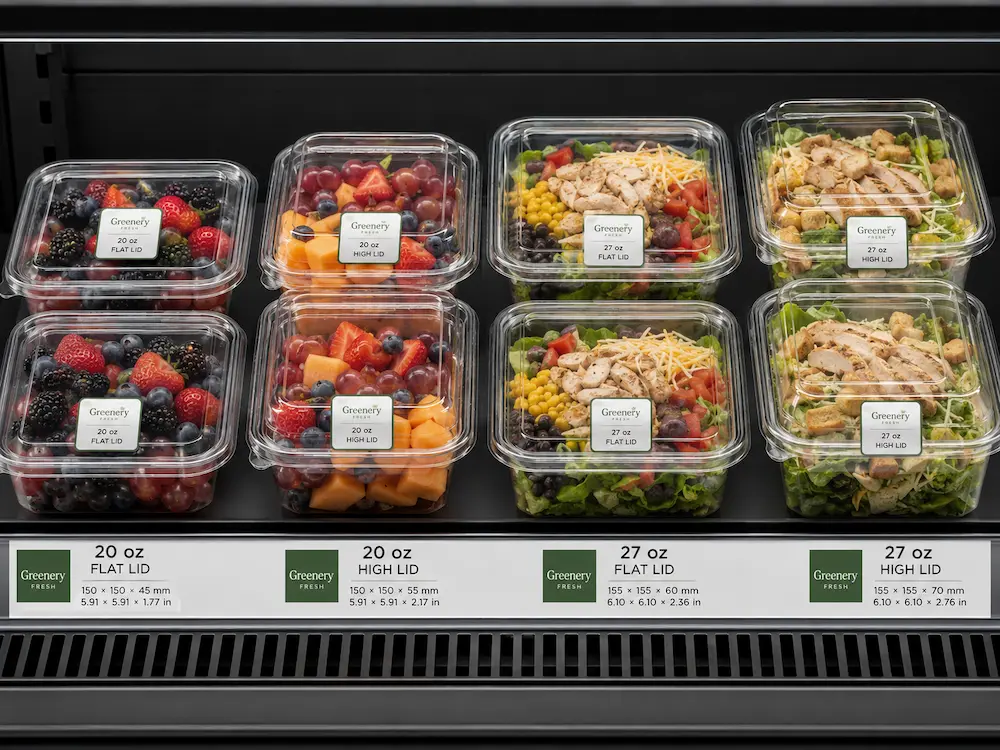
| Application | Typical Food Examples | Why PET Square Bowls Work |
|---|---|---|
| Salad Programs | Green salad, pasta salad, grain bowls, chicken salad | Clear lid, organized portion display, strong chilled shelf appeal |
| Deli Counters | Cold sides, noodles, prepared vegetables, deli meals | Practical filling, stacking, labeling, and takeaway handling |
| Fresh-Cut Fruit | Melon cubes, grapes, apple slices, mango, mixed fruit | High visibility helps customers judge freshness quickly |
| Grab-and-Go Meals | Chilled meals, snack boxes, light lunches, retail food packs | Square footprint improves refrigerated display organization |
| Desserts and Bakery | Tiramisu, pudding, cheesecake portions, brownies, mousse cups | Clear walls support premium presentation and portion control |
Fresh-cut fruit brands can also compare fresh-cut fruit containers when they need dedicated fruit packaging with different lid designs, compartment structures, or chilled retail display formats.
Buyer Checklist Before Choosing PET Square Bowls Wholesale
Wholesale buyers should evaluate PET square bowls through real packaging performance, not only through catalog photos. A container may look clear in a product image but perform differently after filling, sealing, stacking, labeling, refrigeration, and transport. The following checklist helps buyers compare suppliers more professionally.
1. Confirm PET Material Clarity and Food Packaging Suitability
Clarity is one of the first features buyers notice. Clear PET should present salads, fruit, desserts, and deli foods without a cloudy, gray, or low-grade appearance. The material should also feel clean, stable, and suitable for chilled food packaging use.
When comparing suppliers, ask whether the material is designed for food packaging applications and whether the supplier can provide relevant product information. Avoid vague answers. A serious supplier should be able to explain material options, container use conditions, and packaging limitations clearly.
2. Check Lid Fit and Closure Consistency
Lid fit is one of the most important performance points for PET square bowls. A beautiful container is useless if the lid is loose, difficult to close, or inconsistent between batches. Buyers should test the bowl and lid together with actual food portions.
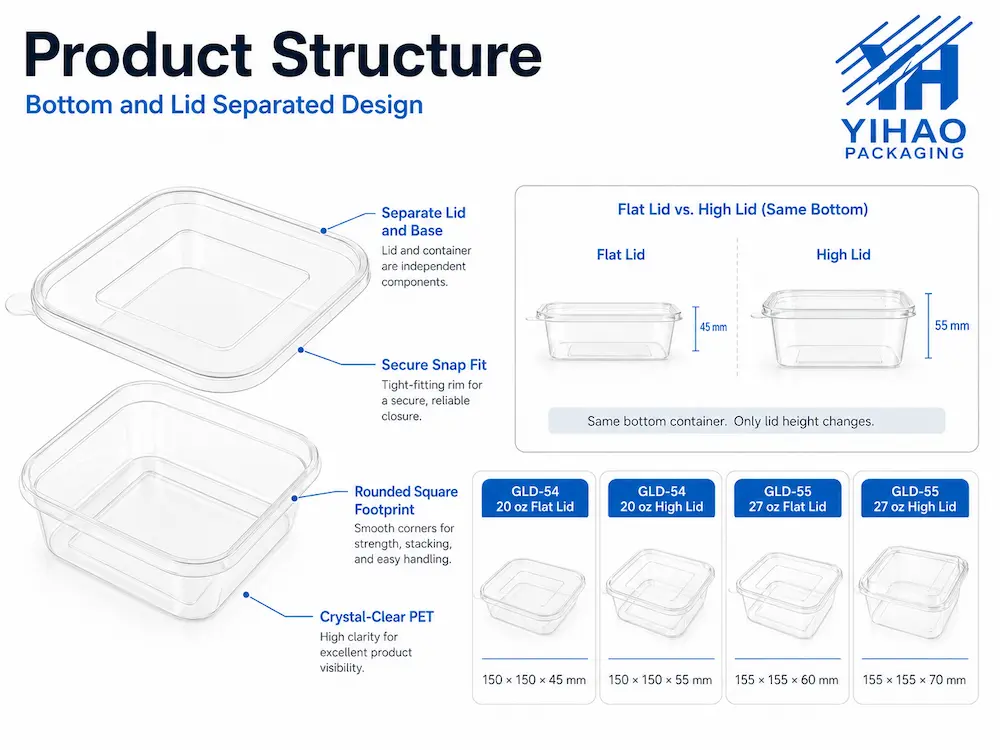
For square bowl programs that use one lid across multiple sizes, a matching lid system can simplify inventory and ordering. For example, buyers evaluating matching PET lids should test closure feel, corner fit, stacking behavior, and whether staff can close the lid quickly during busy production hours.
3. Test Stacking Strength for Retail and Delivery Handling
Stacking strength affects both warehouse storage and retail presentation. Containers that deform too easily may lose their professional appearance after carton packing or refrigerated display. Buyers should test filled containers in stacked conditions, not only empty samples.
Stacking tests should include packed cartons, cold storage, delivery routes, and in-store handling. This is especially important for wholesale programs because small structural weaknesses can become large operational problems after thousands of units are used.
4. Review Square Shape Efficiency for Shelf Display
The square shape is not only a design choice. It affects how many units fit on a shelf, how neatly products align in a display case, and how easy it is for staff to organize different meal options. clear square food containers help retailers create a clean, grid-like presentation that looks more controlled than scattered round packaging.
For supermarkets and convenience stores, better shelf organization directly supports customer browsing. A display that looks tidy often feels fresher, cleaner, and more professional.
5. Match Bowl Size With Real Food Portions
Buyers should not choose sizes only by catalog capacity. Different foods occupy space differently. Leafy salads need more height and air space. Pasta salad and deli sides are denser. Fruit mixes may need better lid clearance to protect the top layer. Desserts may need a flatter structure for neat presentation.
Before confirming a wholesale order, test PET square bowls with real recipes and real portion weights. This helps avoid overfilled containers, poor lid closure, crushed toppings, and weak shelf appearance.
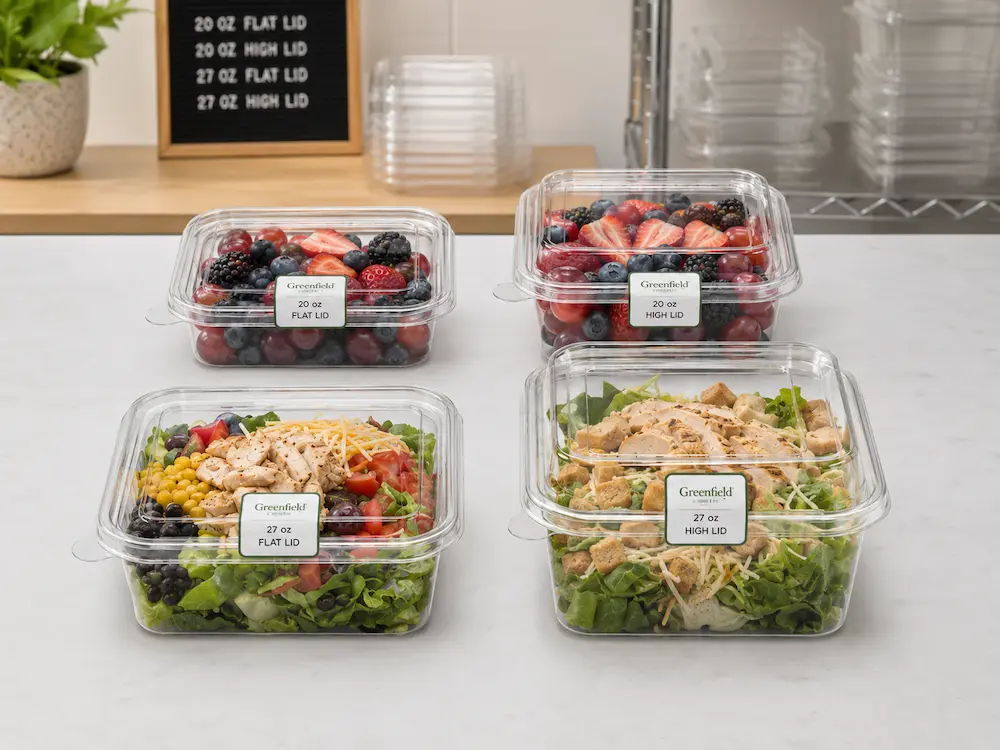
6. Evaluate Chilled Display Performance
Many square PET containers are used in refrigerated displays. Buyers should test whether the container keeps a clean appearance under chilled conditions and whether condensation affects visibility, labeling, or shelf appeal.
For high-visibility foods such as salads, fruit, yogurt parfaits, and prepared meals, chilled display performance is part of the buying experience. Packaging that looks clean and transparent in a cooler helps customers trust the food inside.
7. Check Labeling Area and Branding Space
Labels should support the brand without hiding the food. On clear packaging, label placement is a balance between product visibility and information display. Buyers should test front labels, top labels, tamper labels, ingredient labels, barcode labels, and date labels before confirming the final packaging format.
Square containers often provide practical flat areas for labels. This makes them useful for grab-and-go programs where staff need fast label placement and clear customer-facing information.
8. Ask for Samples Before Wholesale Orders
Samples are not optional for serious wholesale purchasing. A supplier may provide a good quotation, but the buyer still needs to test the container in real use. Sample testing should include filling, closing, stacking, labeling, refrigeration, transport simulation, and customer-facing display.
A reliable YIHAO packaging supplier should understand that sample testing is not a delay. It is part of responsible packaging selection, especially when buyers are building long-term chilled food packaging programs.
PET Square Bowls vs Other Food Packaging Options
Buyers often compare PET square bowls with round bowls, paper bowls, hinged deli containers, and other clear food containers. Each format has value, but the best choice depends on the food type, display style, operational workflow, and customer buying behavior.
| Packaging Type | Best Use | Main Advantage | Buyer Concern |
|---|---|---|---|
| PET Square Bowls | Salads, deli meals, fruit, chilled snacks | Clear display and efficient shelf layout | Lid fit, stacking, and size matching |
| Round PET Bowls | Salads, fruit bowls, shared chilled food | Familiar bowl presentation | Less efficient side-by-side shelf layout |
| Paper Bowls | Takeaway meals, hot or cold foods depending on structure | Paper-based appearance | Limited product visibility |
| Hinged Deli Containers | Deli foods, bakery, snacks, grab-and-go meals | One-piece structure and fast packing | Different presentation from separate-lid bowl systems |
| Separate-Lid PET Containers | Prepared meals, bakery display, chilled retail food | Flexible lid height and presentation options | Requires accurate bowl and lid matching |
When buyers need bowl-style presentation, round PET containers remain useful for many salad and fruit programs. When they need a more organized shelf layout, square structure gives PET square bowls a stronger advantage in retail-ready displays.
How to Evaluate a PET Square Bowls Manufacturer and Supplier
Choosing a manufacturer and supplier is different from choosing a one-time product listing. For wholesale buyers, the key question is not only whether the supplier has PET square bowls. The real question is whether the supplier can support stable quality, repeat orders, application testing, and practical communication over time.
Manufacturing Consistency
Consistency affects every order. A stable manufacturer should control material clarity, forming quality, rim structure, lid matching, container thickness, and overall appearance. Buyers should compare samples from different batches when possible, especially before long-term procurement.
Inconsistent containers create hidden costs. Staff may spend more time closing lids. Retailers may reject unstable packaging. Customers may notice distorted containers or unclear lids. These problems are difficult to solve after bulk orders arrive.
Product Range and Packaging System Support
A single container is useful, but a packaging system is more valuable. Buyers often need multiple square bowl options for different salads, fruit portions, deli meals, chilled snacks, and prepared food programs. A supplier with a connected product range can help buyers reduce sourcing complexity.
For example, a buyer may use square PET deli containers for smaller snack or deli side programs, while using larger square formats for meal salads and chilled prepared foods. The front-end anchor does not need to show the capacity, but the product page can still guide buyers to the right SKU internally.
Wholesale Supply Stability
Wholesale buyers need packaging that can be reordered consistently. A container that works well for one campaign should remain available for future orders, seasonal programs, new store launches, and distributor replenishment.
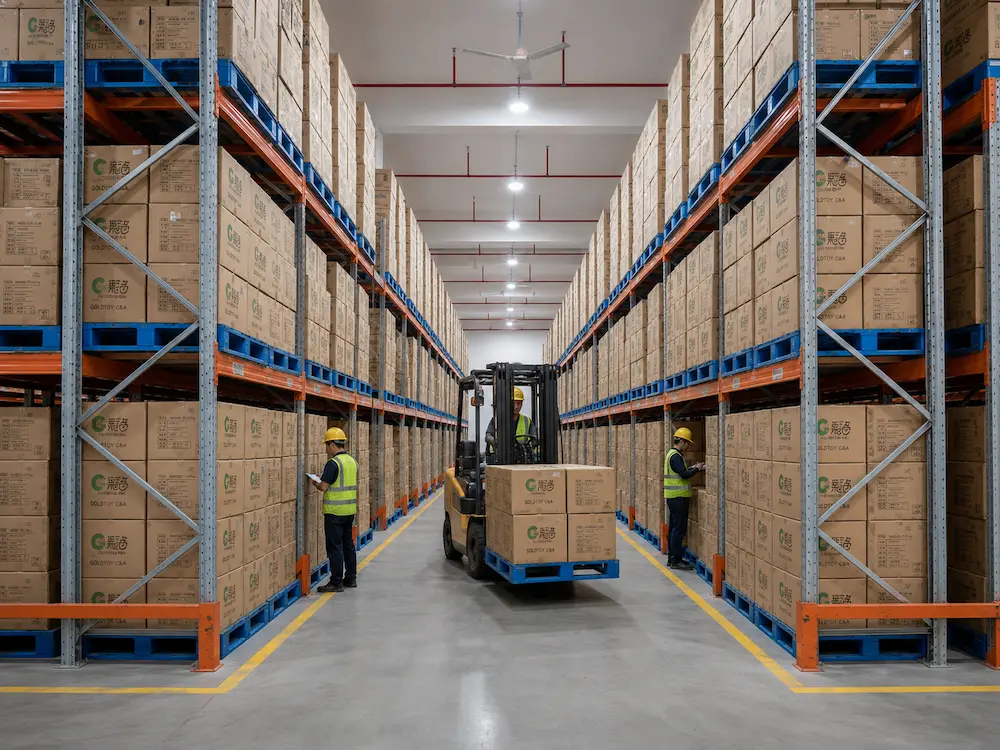
Before confirming a supplier, ask about production planning, carton packing, repeat-order support, and communication workflow. A supplier who understands wholesale food packaging should be able to discuss more than unit price.
Sample Testing and Communication Speed
Fast and accurate communication is part of supplier value. Buyers should check how clearly the supplier answers questions about material, lid compatibility, packing, sample dispatch, customization discussion, and application testing.
A good supplier does not push buyers to order blindly. A good supplier helps buyers confirm whether the selected PET square bowls match the food, shelf, logistics, and brand requirements.
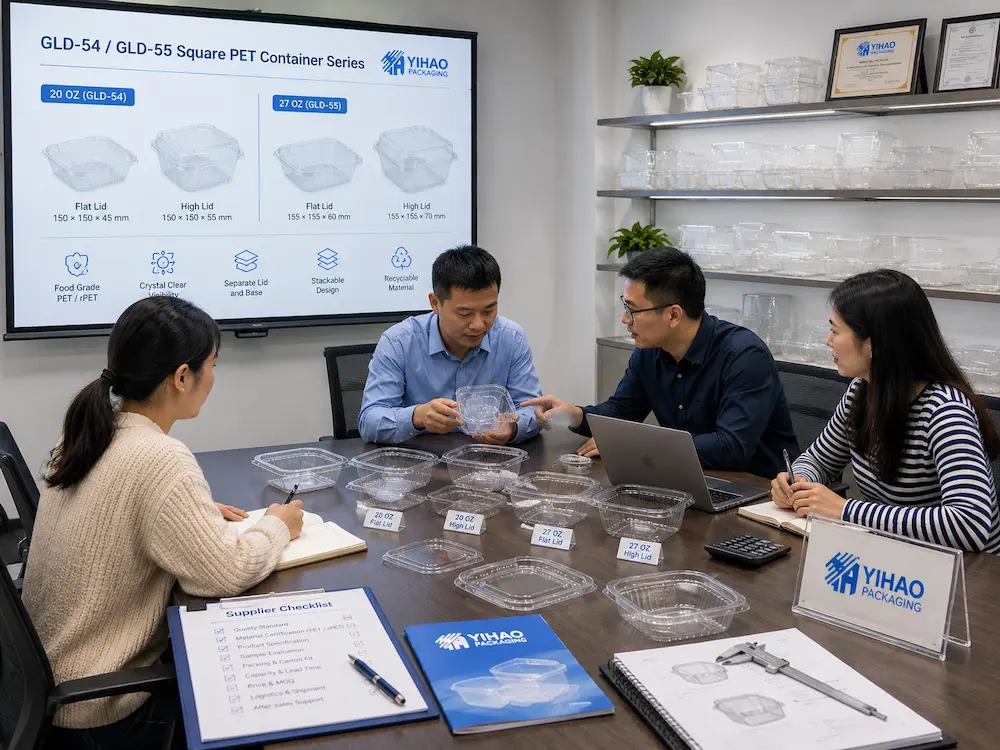
Key Questions to Ask a Supplier Before Ordering
The following supplier questions help buyers avoid weak packaging decisions before bulk ordering:
| Question | Why It Matters | What Buyers Should Look For |
|---|---|---|
| What PET material options are available? | Material affects clarity, appearance, and packaging suitability. | Clear explanation of PET options and intended use conditions. |
| Are matching lids available? | Poor lid fit causes leakage risk, weak closure, and poor handling. | Tested lid compatibility and stable closure performance. |
| Can samples be tested before wholesale orders? | Samples reduce ordering risk and reveal real-use problems. | Supplier willingness to support sample review and application testing. |
| How do the containers stack after filling? | Stacking affects storage, transport, and retail display. | Stable filled-container stacking and carton-friendly structure. |
| What carton packing information is available? | Carton data affects shipping, warehousing, and cost planning. | Clear packing details for wholesale evaluation. |
| Can the supplier support repeat orders? | Long-term programs need stable product availability. | Consistent production support and responsive communication. |
Wholesale Buying Decision Matrix for PET Square Bowls
| Buying Factor | Low-Risk Supplier | High-Risk Supplier |
|---|---|---|
| Material Clarity | Provides clean, transparent samples with stable appearance | Only shows catalog images without real samples |
| Lid Compatibility | Tests bowl and lid fit as a complete packaging system | Cannot clearly explain matching lid options |
| Wholesale Support | Discusses repeat orders, carton packing, and supply planning | Only competes by low unit price |
| Application Testing | Encourages sample testing with real food portions | Pushes buyers to place bulk orders without testing |
| Communication Quality | Answers technical, packing, sample, and repeat-order questions clearly | Provides vague answers and avoids detailed product discussion |
Common Ordering Mistakes Buyers Should Avoid
Choosing Only by Low Unit Price
Low unit price looks attractive at the quotation stage, but it may create higher cost later. If the container is too thin, unclear, unstable, or difficult to close, buyers may face product complaints, food waste, repacking labor, or rejected shipments.
For wholesale food packaging, the better question is not “Which supplier is cheapest?” The better question is “Which supplier provides the best balance of cost, consistency, performance, and repeat-order reliability?”
Ignoring Lid Compatibility
Lid compatibility should be tested carefully. Buyers should check whether the lid closes smoothly, whether the corners seal evenly, whether the container can be stacked after closing, and whether staff can use the packaging quickly during production.
When the food needs more height, buyers may compare clear square food containers with higher lid options. When the food needs a flatter profile for compact display, flat-lid options may be more practical.
Testing Empty Containers Only
Empty-container testing is not enough. A container may look stable when empty but perform differently with heavy deli food, wet fruit, layered salads, or sauce-based ingredients. Buyers should test actual food portions, real labels, cold storage, and stacked transport conditions.
Overlooking Shelf Layout
Packaging should work in the actual selling environment. If the product will be sold in a supermarket cooler, convenience store shelf, cafe display, or delivery pickup area, the buyer should test how the containers look together in rows and stacks.
Square packaging often improves the overall display because units align neatly. This is one of the strongest reasons to choose PET square bowls for grab-and-go food retail programs.
Best Applications for PET Square Bowls
Supermarket Salad and Deli Counters
Supermarket salad and deli counters need packaging that looks clean, closes reliably, and supports fast merchandising. PET square bowls are suitable for green salads, pasta salad, potato salad, grain bowls, fruit salad, cold noodles, and prepared deli sides.
The square footprint gives displays a more organized appearance, while the clear PET material allows customers to evaluate freshness quickly. For retailers, this combination supports both presentation and operational efficiency.
Grab-and-Go Chilled Meals
Grab-and-go chilled meals need packaging that makes food look ready to buy. A clear square container helps customers see the full portion and understand the meal format immediately. This is useful for light lunches, snack meals, protein bowls, dessert packs, and mixed deli items.
For food brands that want a more premium appearance, separate-lid PET containers can also support prepared meals and bakery display where lid height and product presentation matter.
Fresh-Cut Fruit and Snack Programs
Fruit packaging must show freshness clearly. Customers want to see color, moisture level, cut size, and fruit mix before buying. Clear square food packaging supports this need while giving retailers a tidy display format.
For fruit-and-snack combinations, buyers may also compare dedicated fruit packaging structures, especially when they need compartment formats for apple slices, mango cubes, grapes, nuts, and mixed snack packs.
Cafes, Foodservice, and Central Kitchens
Cafes and central kitchens need packaging that supports preparation speed and consistent presentation. Staff members often work with repeated recipes and fixed portion systems, so packaging must be easy to fill, close, label, store, and deliver.
PET square bowls support this workflow because they are clear, stackable, and suitable for organized refrigerated storage. They also help brands keep a consistent look across multiple store locations or distribution points.
Why Work With a Manufacturer Instead of Only a Trading Supplier?
Trading suppliers may provide quick product sourcing, but a manufacturer gives buyers stronger access to production knowledge, product structure, quality consistency, sample testing, and long-term supply planning. For serious wholesale buyers, this difference matters.
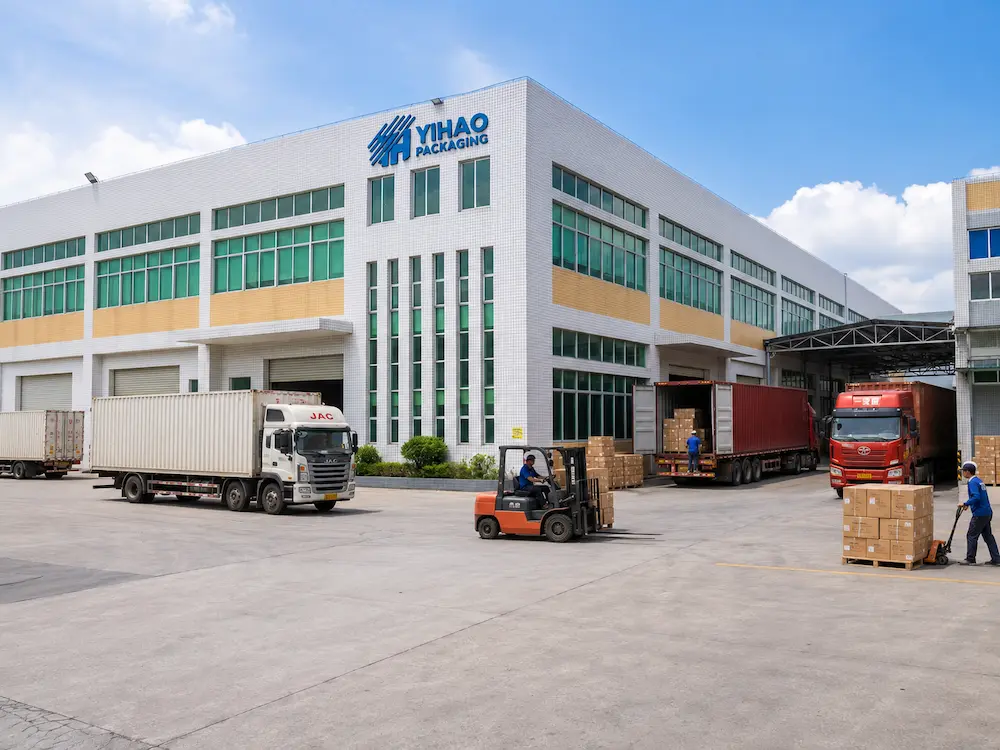
Better Control Over Material and Structure
A manufacturer understands how material choice, forming conditions, rim design, lid fit, and container geometry affect real performance. This helps buyers solve practical packaging problems instead of only comparing catalog photos.
More Stable Wholesale Supply
Wholesale buyers need reliable repeat orders. A manufacturer with stable production control can support long-term food packaging programs more effectively than a supplier who only searches for available stock after each order.
Easier Sample Testing and Packaging Adjustment
When buyers test PET square bowls, they may discover that one lid height works better than another, or that one square format fits the shelf more efficiently. A manufacturer can usually support this technical discussion more directly.
Stronger Support for Long-Term Packaging Programs
A reliable packaging partner should understand the buyer’s real selling environment. For example, a supermarket salad program, a fruit processor, a deli counter, and a cafe chain may all need clear square packaging, but their portion logic and handling conditions are different. A strong manufacturer helps buyers connect product choice with application reality.
Request PET Square Bowl Samples Before Wholesale Ordering
Before confirming a wholesale order, buyers should request samples and test them with real products. The sample review should include appearance, clarity, filling experience, lid closure, stacking, label placement, cold storage, delivery handling, and retail display.
For salad programs, test leafy vegetables, toppings, dressing cups, and lid clearance. For deli foods, test weight, sauce contact, and stacking. For fruit packaging, test moisture, visibility, and shelf appeal. For desserts, test presentation height and whether the lid protects the top layer.
Buyers comparing square salad containers and higher-lid alternatives should evaluate the same recipe in both structures before making a decision. The right packaging format is the one that protects the food, displays it clearly, fits the workflow, and supports repeatable wholesale supply.
Internal Packaging Selection Checklist for Buyers
| Checklist Item | Pass Standard | Buyer Action |
|---|---|---|
| Material Clarity | Clean, transparent, and suitable for retail food display | Compare samples under store lighting and cold display conditions |
| Lid Fit | Smooth closure and consistent corner fit | Test with actual food portions and staff handling |
| Stacking | Stable after filling, closing, and carton packing | Simulate warehouse, transport, and shelf stacking |
| Shelf Layout | Neat square alignment in refrigerated display | Test side-by-side placement in real shelf space |
| Labeling | Label stays visible without hiding the food | Test top, side, barcode, and date labels |
| Supplier Support | Clear communication and repeat-order stability | Confirm samples, carton details, and wholesale supply plan |
How PET Square Bowls Support Better Retail Presentation
Retail presentation is one of the strongest reasons to choose PET square bowls. Clear walls help customers see the food. The square shape creates straight lines in display cases. The lid protects the food while keeping the top view open. Together, these details make the product look more organized and easier to buy.
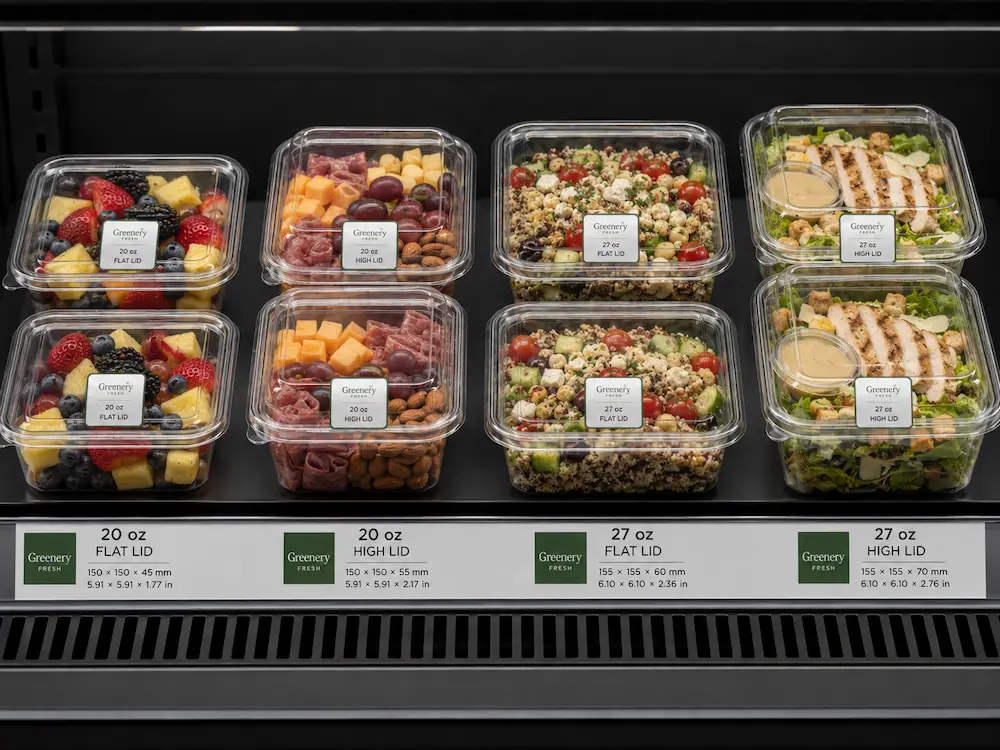
In a crowded refrigerated case, customers often compare products quickly. Packaging that looks clean, transparent, and orderly gives the food a stronger chance to be noticed. This is especially important for salads, fruit bowls, deli sides, chilled desserts, and ready-to-eat meals.
For brands building a full packaging system, square PET deli containers should not be evaluated as isolated items. They should be reviewed as part of the full product workflow: filling, closing, labeling, carton packing, refrigerated storage, display, customer purchase, and takeaway handling.
For purchasing teams, the most reliable packaging decision comes from real sample testing rather than specification comparison alone. Food type, filling method, cold-chain handling, label placement, and retail shelf layout should all be reviewed before choosing PET square bowls for long-term wholesale supply.
Final Note / Practical Takeaway
FAQ About PET Square Bowls
1. What are PET square bowls used for?
PET square bowls are commonly used for salads, deli foods, fresh-cut fruit, chilled snacks, desserts, prepared meals, and grab-and-go retail food packaging. Their clear appearance helps customers see the food, while the square structure supports neat shelf display and efficient handling.
2. Are PET square bowls suitable for salads and deli foods?
Yes. PET square bowls are suitable for many chilled salad and deli food applications when the container size, lid fit, stacking strength, and food-contact packaging requirements match the actual product. Buyers should always test samples with real food before wholesale ordering.
3. What should buyers check before ordering PET square bowls wholesale?
Buyers should check material clarity, lid compatibility, stacking performance, chilled display appearance, label placement, carton packing information, supplier communication, and repeat-order stability before ordering PET square bowls wholesale.
4. Are square PET deli containers better than round containers?
Square PET deli containers are often better for shelf efficiency and organized retail display because they align neatly side by side. Round containers still work well for many salad and fruit applications, but square formats usually provide better space usage in refrigerated displays and cartons.
5. How should buyers choose a PET square bowls manufacturer or supplier?
Buyers should choose a manufacturer or supplier that provides clear product information, stable material quality, reliable lid matching, sample testing support, wholesale supply capability, and responsive communication. The best supplier helps buyers match packaging structure with real food applications.
6. Can I request samples before ordering PET square bowls wholesale?
Yes. Wholesale buyers should request samples before confirming bulk orders. Sample testing helps buyers check material clarity, lid fit, stacking, label placement, chilled display performance, and whether the selected PET square bowls match real food applications.
References
- U.S. Food and Drug Administration. Guidance for Industry: Use of Recycled Plastics in Food Packaging — Chemistry Considerations. FDA Guidance Document, July 2021.
- U.S. Food and Drug Administration. Recycled Plastics in Food Packaging. FDA Food Contact Substances Resource.
- European Commission. Commission Regulation (EU) No 10/2011 on Plastic Materials and Articles Intended to Come into Contact with Food. Official Journal of the European Union.
- European Food Safety Authority. Food Contact Materials. EFSA Scientific Topic Resource.
- Association of Plastic Recyclers. APR Design Guide for Plastics Recyclability. Packaging Design and Recycling Guidance.
- National Association for PET Container Resources. PET Packaging and Recycling Resources. NAPCOR Industry Resource.
- U.S. Environmental Protection Agency. Sustainable Materials Management. EPA Resource on Lifecycle-Based Materials Management.
- FoodSafety.gov. Cold Food Storage Chart. U.S. Government Food Safety Resource for Refrigerated and Frozen Food Storage.
Deep-Dive Insights
© YIHAO Packaging. All rights reserved.
Food packaging solutions for global wholesale buyers, supermarkets, cafes, bakeries, and foodservice brands.