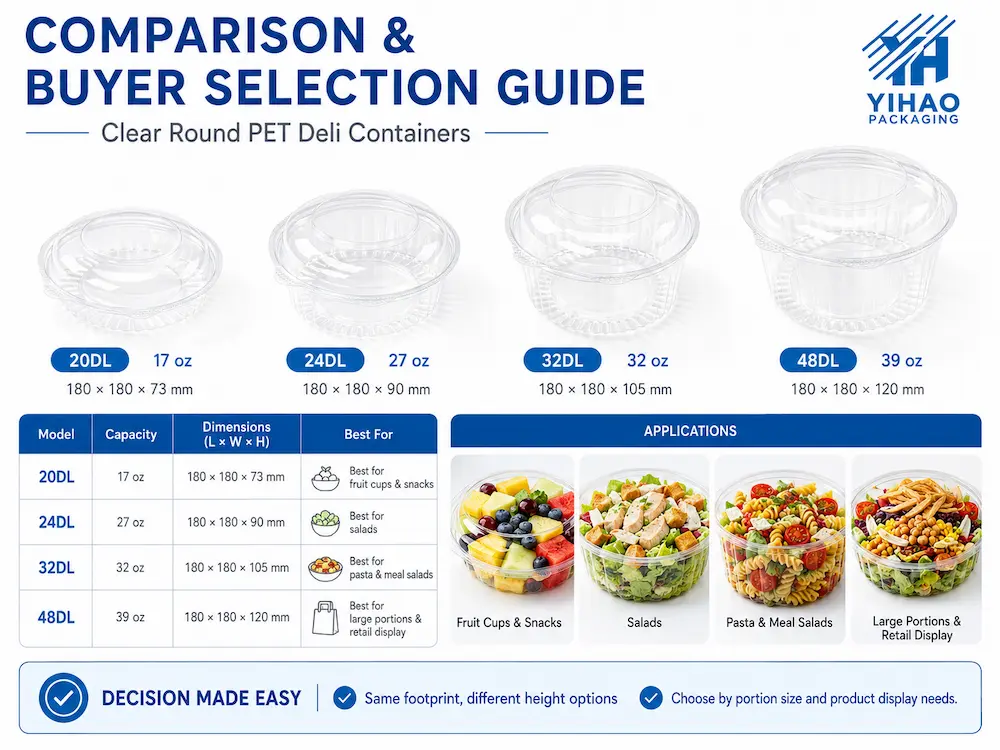
For food brands, supermarkets, distributors, catering suppliers, and import buyers, choosing the right packaging format is not a small design decision. It affects product presentation, shelf performance, handling efficiency, customer trust, logistics cost, and the way a product competes in refrigerated display. This is why many buyers compare clear round food containers with square PET packs, paper bowls, PP containers, aluminum trays, and molded fiber packaging before placing a wholesale order.
As a food packaging manufacturer and supplier, YIHAO helps buyers compare container formats based on food type, temperature condition, retail display, lid compatibility, carton packing, and wholesale supply requirements rather than choosing packaging only by appearance. The right answer is not “one format is always better.” A professional buyer should choose packaging based on food type, serving condition, filling process, display environment, lid performance, material requirement, branding goal, and destination market.
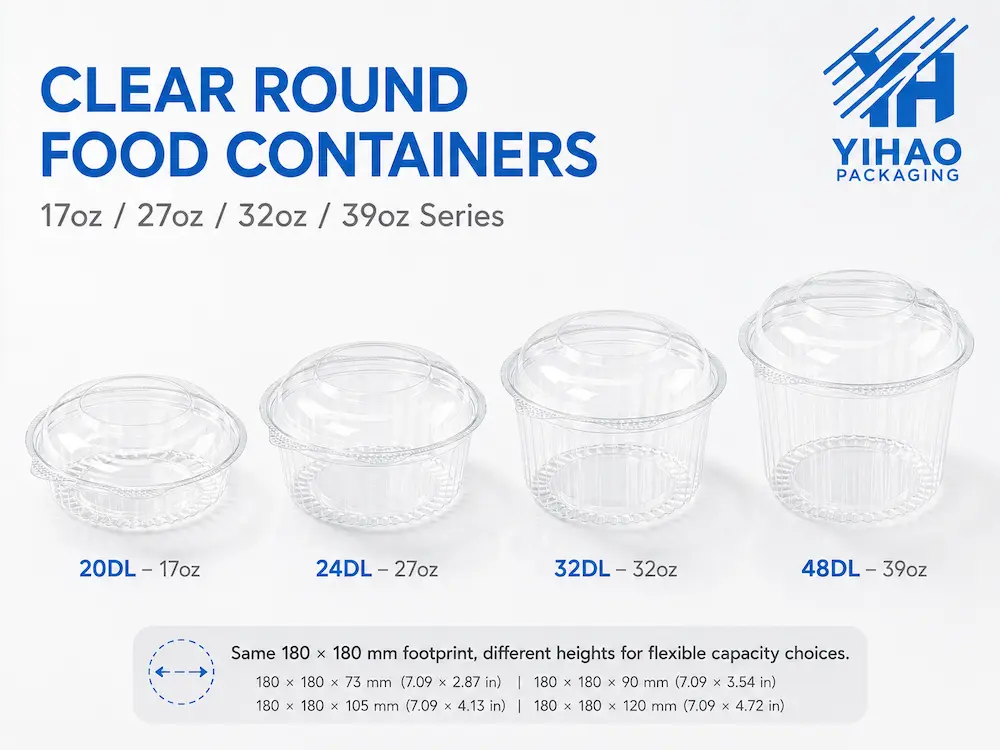
Clear round PET packaging performs especially well when visibility and chilled food presentation directly influence purchase decisions. Alternative packaging becomes more suitable when heat, microwave function, oven use, or fiber-based positioning becomes the priority. This guide compares clear round food containers with alternative packaging options from a practical B2B purchasing angle, helping buyers choose a format that fits both product performance and commercial value.
What Are Clear Round Food Containers?
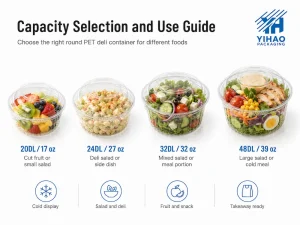
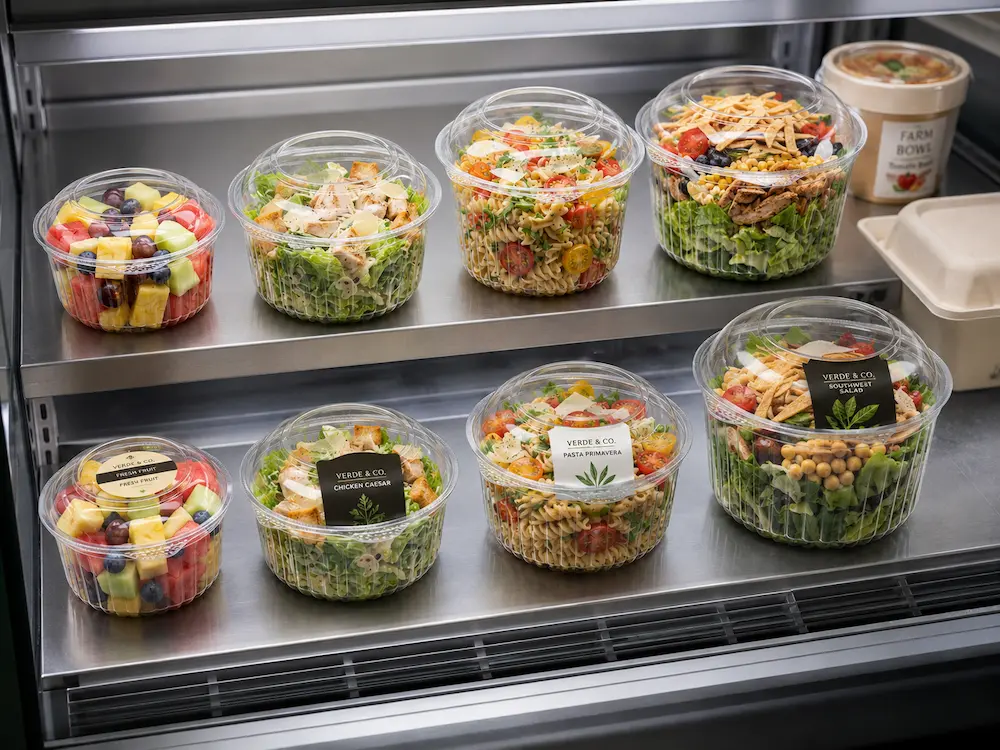
Clear round food containers are transparent round bowls or deli containers commonly used for chilled ready-to-eat foods, salads, fruit portions, deli sides, desserts, snacks, chilled noodles, and grab-and-go meals. Many are made from PET or rPET/PET material because PET provides strong clarity, clean food presentation, and good suitability for refrigerated display.
In the wholesale market, buyers may describe these products with different terms, including PET salad bowl, round PET deli containers, round deli containers, round salad containers, PET round bowls, and deli food packaging. The exact structure may vary. Some formats use separate lids, some use hinged lids, some are designed with dome lids for higher food volume, and some are matched with flat lids for stacking and retail display.
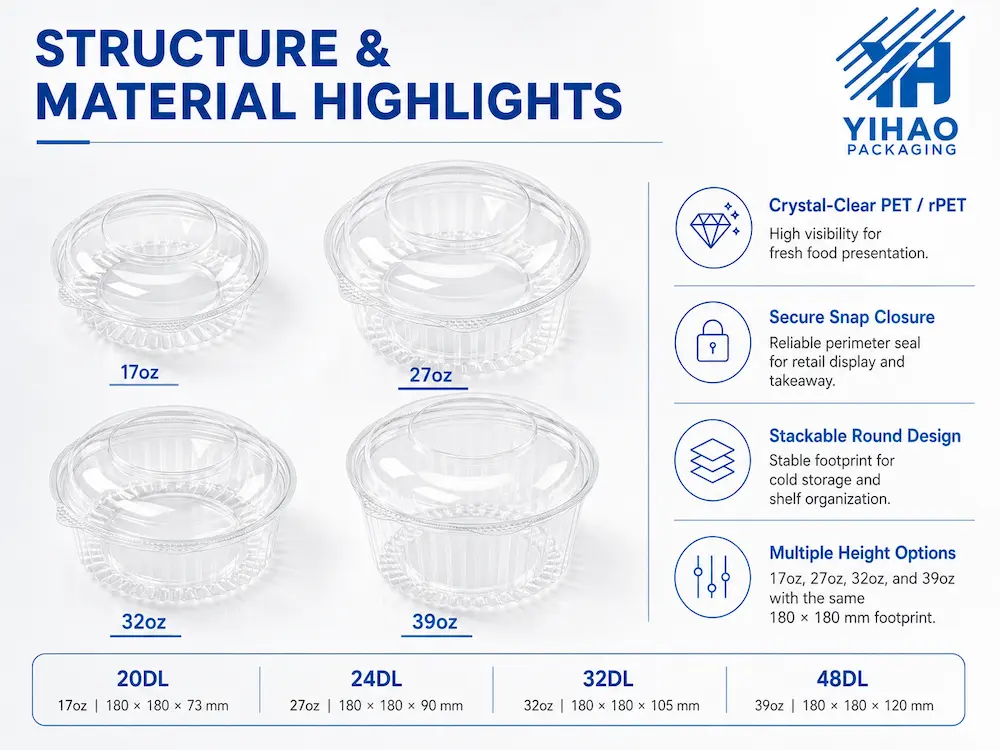
For buyers comparing round deli containers with square trays or paper bowls, the key question is not only shape. The real decision depends on how the food will be filled, sealed, displayed, transported, and consumed. A transparent round format gives food a balanced, premium, and ready-to-eat look, especially in refrigerated shelves, convenience stores, supermarkets, cafes, and takeaway counters.
Why Buyers Compare Round PET Containers with Alternative Packaging
Packaging buyers compare formats because each material and structure solves a different commercial problem. A packaging option that looks excellent in a chilled retail case may not work for hot takeaway food. A container that stacks efficiently in cartons may not create the best food presentation. A fiber-based bowl may support a natural brand image, but it may not show the product clearly. A PP container may handle heat better, but it usually does not deliver the same crystal-clear display as PET.
In other words, packaging choice is a balance between product visibility, food condition, operational handling, shelf impact, sustainability communication, cost, and supply reliability. Buyers should compare clear round food containers against alternatives using real product scenarios rather than only material names.
| Buyer Question | Why It Matters | Packaging Direction |
|---|---|---|
| Is the food sold chilled? | Chilled display benefits from visibility and freshness perception. | Clear round PET containers are often suitable. |
| Does the food need microwave heating? | Heat resistance is more important than visual clarity. | PP or verified microwave-safe packaging is usually preferred. |
| Is shelf space very limited? | Carton and shelf efficiency affect total cost. | Square or rectangular PET containers may be more efficient. |
| Is product visibility a selling point? | Fresh colors and ingredient layers drive impulse buying. | Clear round food containers provide strong retail appeal. |
| Is the product ovenable? | Oven applications require heat-resistant formats. | Aluminum or oven-safe packaging is more suitable. |
Clear Round Food Containers vs Square PET Containers
Clear round food containers and square PET containers are both common choices in chilled deli food packaging. The difference is mainly presentation and space efficiency.
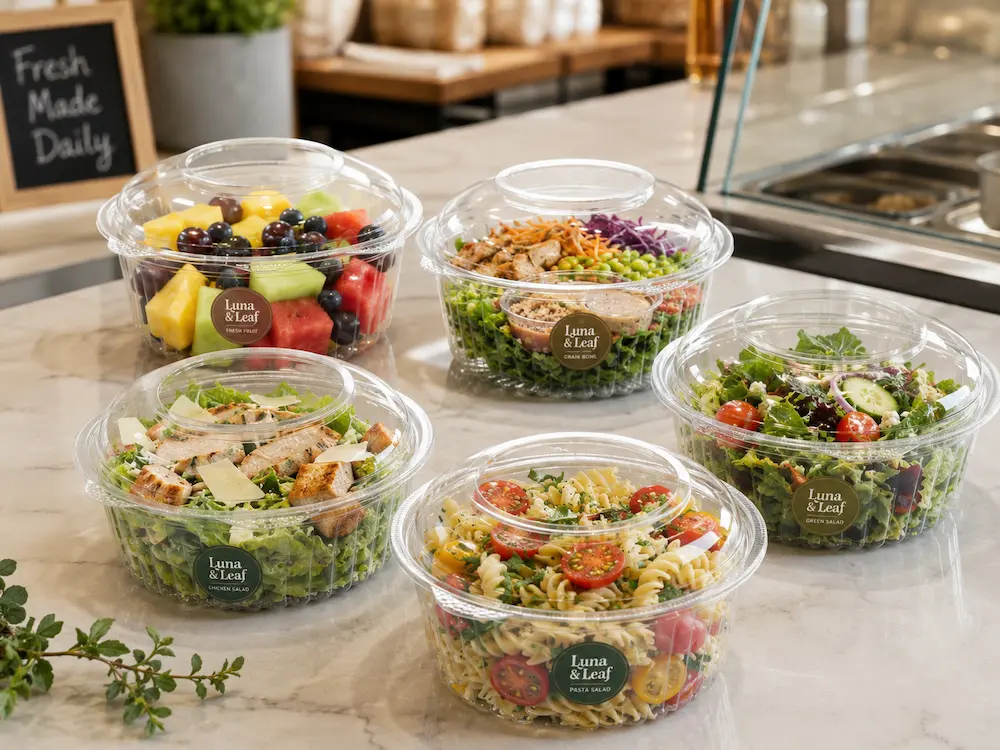
Round containers create a softer, more premium food presentation. They are especially suitable for leafy salads, fruit bowls, pasta salad, chilled noodles, grain bowls, desserts, and layered ready-to-eat meals. The round shape helps food appear centered and abundant, which is useful for retail display and takeaway presentation. For buyers selling premium salads or colorful fruit portions, round salad containers often provide a cleaner visual impact.
Square PET containers, however, usually perform better when shelf density, carton packing, and storage efficiency are more important. Their straight sides help reduce unused space in cartons and retail shelves. For distributors, supermarkets, and meal-prep brands handling large daily volume, this space efficiency can be meaningful.
Buyers should choose clear round food containers when visual merchandising, premium food presentation, and chilled display appeal are the priority. They should consider square PET containers when logistics density, shelf alignment, and carton efficiency carry more weight.
| Comparison Point | Clear Round Food Containers | Square PET Containers |
|---|---|---|
| Food Presentation | Excellent for salads, fruit, bowls, and layered food. | Clean and practical, but less rounded visual appeal. |
| Shelf Appearance | Premium and consumer-friendly. | Neat, compact, and space-efficient. |
| Carton Efficiency | May leave more empty space depending on shape. | Usually stronger for dense packing. |
| Best Applications | Salads, fruit bowls, deli food, desserts, chilled noodles. | Fresh food, deli sides, meal-prep, retail packs. |
| Buyer Priority | Presentation and visibility. | Space efficiency and operational handling. |
Clear Round Food Containers vs Paper Bowls
Paper bowls are often selected for takeaway branding, natural visual identity, and warm foodservice presentation. They work well for cafes, fast casual restaurants, and brands that want a kraft-style or paper-based packaging appearance. However, paper bowls usually limit product visibility unless they are paired with a clear lid or window. For chilled foods that depend on visual freshness, this can reduce shelf appeal.
Clear round food containers are stronger when the product itself needs to sell through appearance. A colorful salad, fruit mix, dessert, or deli portion benefits from full transparency. Customers can inspect freshness, portion size, ingredient quality, and color before purchase. In refrigerated retail, this visibility is often more persuasive than printed branding alone.
Paper bowls can be effective when brand storytelling is more important than seeing the food. Clear PET round containers are more effective when freshness visibility and impulse buying are more important. Buyers should not treat paper as automatically more sustainable in every market. Coatings, lids, windows, food contamination, and local recycling or composting systems all affect end-of-life outcomes.
Clear Round Food Containers vs PP Food Containers
PP containers are widely used for hot food, takeaway meals, and microwave-related applications because PP generally offers better heat resistance than PET. If a food product needs reheating, hot filling, or microwave use, buyers should evaluate PP or specifically verified microwave-safe containers instead of standard PET round bowls.
Clear round PET containers are usually chosen for cold-chain presentation rather than heating function. PET gives excellent clarity, which makes it suitable for chilled salads, fruit bowls, cold deli food, desserts, snacks, and retail grab-and-go meals. PP can be practical, but it often has lower clarity compared with PET, especially when the buyer wants a premium transparent display.
The simplest decision rule is this: choose PET when chilled visibility is the priority; choose PP when heat performance is the priority. For prepared meals, hot takeaway, and reheatable deli applications, buyers should review microwave safe containers or a suitable PP hot food container before making a purchasing decision.
| Decision Factor | PET Round Bowls | PP Containers |
|---|---|---|
| Clarity | High transparency for chilled display. | Usually less clear than PET. |
| Heat Resistance | Not suitable for high-heat use unless specifically designed and verified. | Better choice for hot food and microwave-related needs. |
| Best Use | Salads, fruit, deli sides, cold desserts, chilled meals. | Hot meals, reheatable food, prepared takeaway. |
| Retail Display | Strong visual merchandising value. | More functional than premium-looking. |
Clear Round Food Containers vs Aluminum Trays
Aluminum trays are useful for ovenable meals, baked dishes, hot food service, and applications where heat performance matters more than visibility. They provide a strong functional advantage for food that needs baking, reheating, or high-temperature handling.
Clear round PET containers serve a different purpose. They are not designed to replace ovenable trays. Their advantage is visual merchandising. A salad, chilled pasta bowl, fruit portion, cold dessert, or deli side sells better when customers can see the food clearly. Aluminum hides the product, while PET showcases it.
Buyers should choose aluminum trays for ovenable meals and hot applications. They should choose clear round food containers for chilled ready-to-eat foods where freshness, color, and retail presentation support conversion. If the product requires both premium visibility and heat performance, buyers should avoid assuming one material can solve both problems and instead confirm temperature requirements with the packaging manufacturer.
Clear Round Food Containers vs Molded Fiber Packaging
Molded fiber packaging is often used when brands want a natural, fiber-based look. It can be suitable for dry foods, certain takeaway meals, and applications where the package appearance supports a more earthy or compostable-style brand message. However, molded fiber packaging usually has two limitations for chilled retail food: visibility and moisture performance.
Clear round food containers give buyers direct product visibility. They also provide a smooth, transparent surface that supports refrigerated display for salads, fresh-cut fruit, snacks, and deli food. For foods with sauces, dressings, or high moisture content, buyers need to evaluate how each material performs with liquid, condensation, and lid fit.
Compostable or recyclable claims should be treated carefully. Actual recovery depends on material structure, local collection systems, contamination, coatings, labels, and end-market acceptance. For international buyers, it is better to ask suppliers for applicable documentation and market-specific guidance rather than relying on broad sustainability language.
Best Applications for Clear Round Food Containers
Clear round food containers are especially suitable when the food is colorful, fresh, layered, or visually attractive. They are widely used across deli counters, supermarkets, convenience stores, cafes, catering operations, and chilled takeaway programs.
For salads, clear round PET bowls help show leafy greens, toppings, protein, grains, noodles, dressing cups, and ingredient layers. For fruit portions, they highlight color variety and freshness. For deli food, they provide a clean ready-to-eat look. For desserts, they allow customers to see texture, toppings, and portion size. For party platters and sharing packs, a round catering tray can support chilled display and organized food presentation.
| Application | Why Clear Round Food Containers Work | Buyer Focus |
|---|---|---|
| Salads | Round shape presents ingredients naturally and improves shelf appeal. | Clarity, lid fit, stackability, anti-fog needs. |
| Fresh-Cut Fruit | Transparent packaging highlights color, freshness, and portion value. | Visibility, condensation control, secure lid. |
| Deli Food | Clean presentation supports ready-to-eat chilled food sales. | Leak resistance, stacking, food-contact suitability. |
| Desserts | Clear walls show layers, toppings, and premium texture. | Dome lid space, presentation, shelf protection. |
| Party Platters | Round layout supports sharing and organized display. | Compartment design, lid height, transport stability. |
Key Buying Criteria for Clear Round Food Containers
Food Type and Temperature Condition
The first buying question is always the food condition. Clear round food containers are a strong fit for chilled, ambient, or cold-case applications such as salads, fruit, deli sides, cold noodles, snacks, and desserts. They should not be used for high-heat, oven, or microwave applications unless the product is specifically designed and verified for that use.
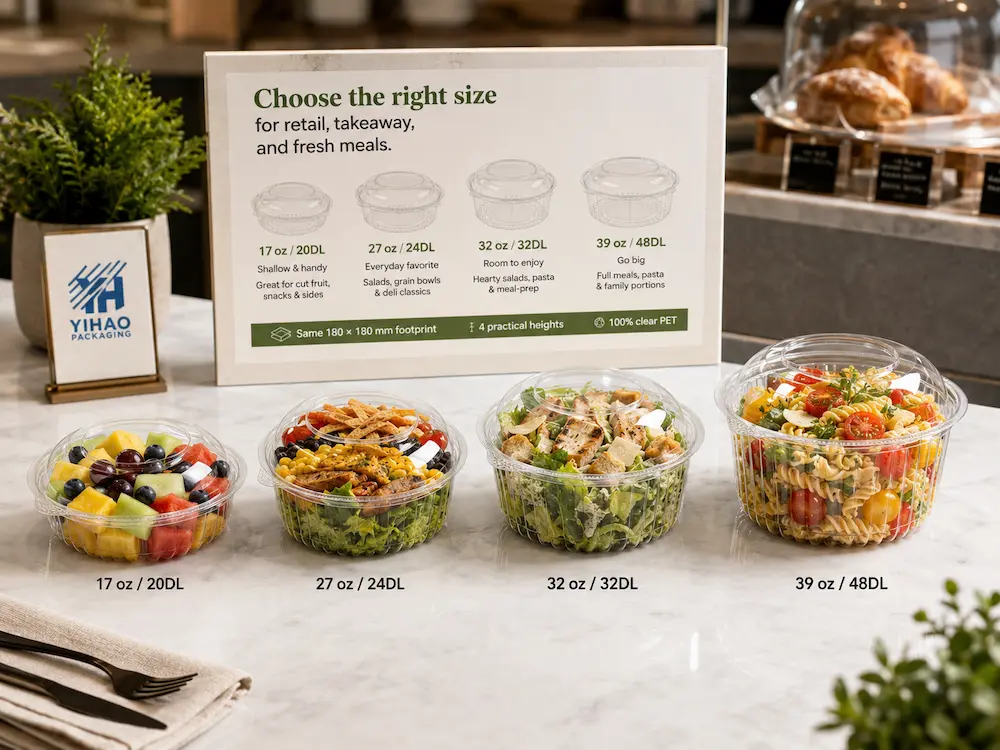
Container Size and Portion Logic
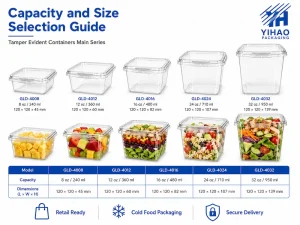
Buyers should match container size to serving style. A small bowl works for side salads, fruit portions, snacks, and desserts. A medium bowl fits meal salads, pasta salads, grain bowls, and chilled noodle meals. A large bowl works for family packs, sharing portions, catering, and premium grab-and-go meals. When linking product pages or building online category pages, it is better to use general commercial anchor text such as PET round bowls instead of forcing a capacity into the anchor text.
Lid Fit and Leak-Resistance Expectations
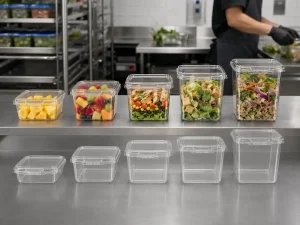
Lid performance is one of the most important details for deli food packaging. A container may look clear and attractive, but poor lid fit can create leakage, handling complaints, and shelf disruption. Buyers should evaluate whether they need flat lids, dome lids, hinged lids, or separate lids. A salad bowl lid should match the bowl securely and support the intended filling height, stacking method, and transport condition.
Clarity and Anti-Fog Needs
Clarity is a major reason buyers choose PET. However, refrigerated foods can create condensation. For chilled fruit, salads, and deli foods, buyers should evaluate whether anti-fog performance is needed. This is especially important for products displayed in cold cabinets where the container must remain visually appealing throughout the selling period.
Stackability and Transport Stability
Wholesale buyers should test stackability before bulk purchasing. The container should stack properly when empty, perform consistently when filled, and remain stable during carton packing and transport. Stackability affects warehouse storage, freight cost, shelf handling, and retail efficiency.
Labeling and Branding Area
Labels should support branding without blocking the food. Large labels may reduce the visibility advantage of clear round food containers. Buyers should also consider how labels, adhesives, sleeves, and printed components affect recycling compatibility in their target market.
Supplier Reliability and Manufacturing Consistency
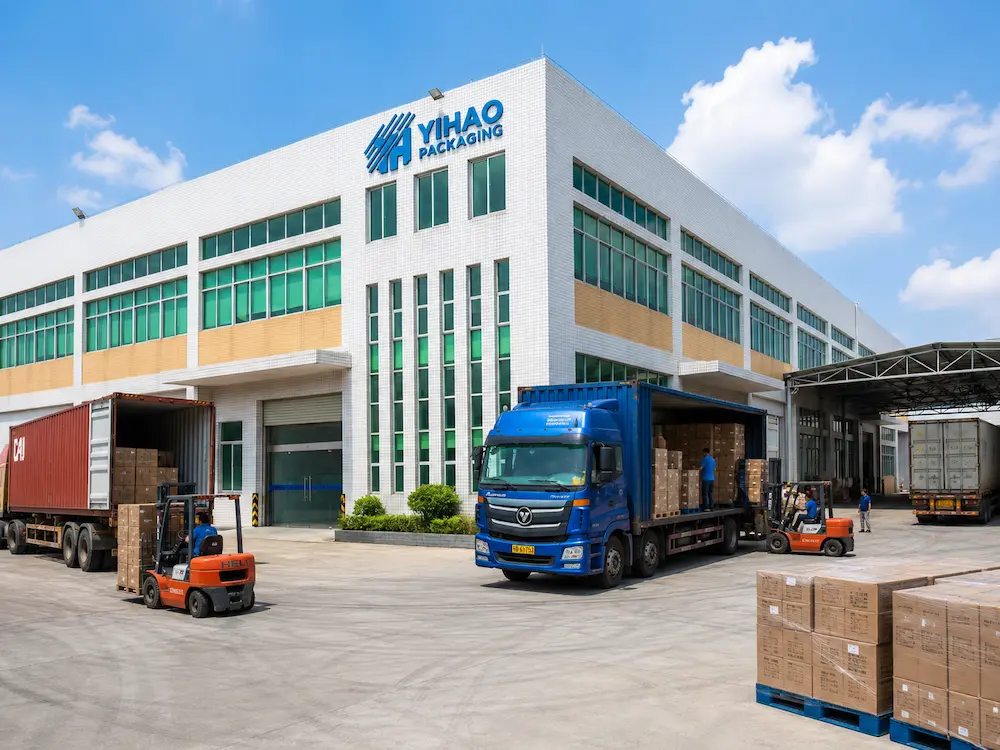
Packaging buyers should work with a reliable food packaging manufacturer that can provide stable production, clear specifications, lid compatibility guidance, sample testing, and export support. For long-term wholesale supply, consistent material quality and dimensional accuracy are just as important as a low unit price.
Common Buyer Mistakes When Choosing Clear Round Food Containers
Choosing by Appearance Only
Clear packaging looks attractive, but appearance alone does not guarantee performance. Buyers should test lid fit, stacking strength, filling height, refrigeration performance, carton packing, and transport stability before bulk orders. A container that looks good in a product photo may still create problems if the lid is loose, the stack is unstable, or the bowl does not match the actual food portion.
Using PET Containers for the Wrong Temperature Condition
Standard PET round containers are not designed for microwave, oven, or high-heat use unless the product is specifically verified for that application. Buyers should not use clear PET bowls for hot filling or reheating without confirming material performance and intended use. If heat resistance is required, PP or another verified heat-resistant format is usually a safer purchasing direction.
Ignoring Lid Compatibility
A bowl and lid should be evaluated as one packaging system. Poor lid fit can create leakage, unstable stacking, customer complaints, and product returns. Buyers should test the container and lid together under real filling, closing, refrigeration, and transport conditions.
Overlooking Carton and Pallet Efficiency
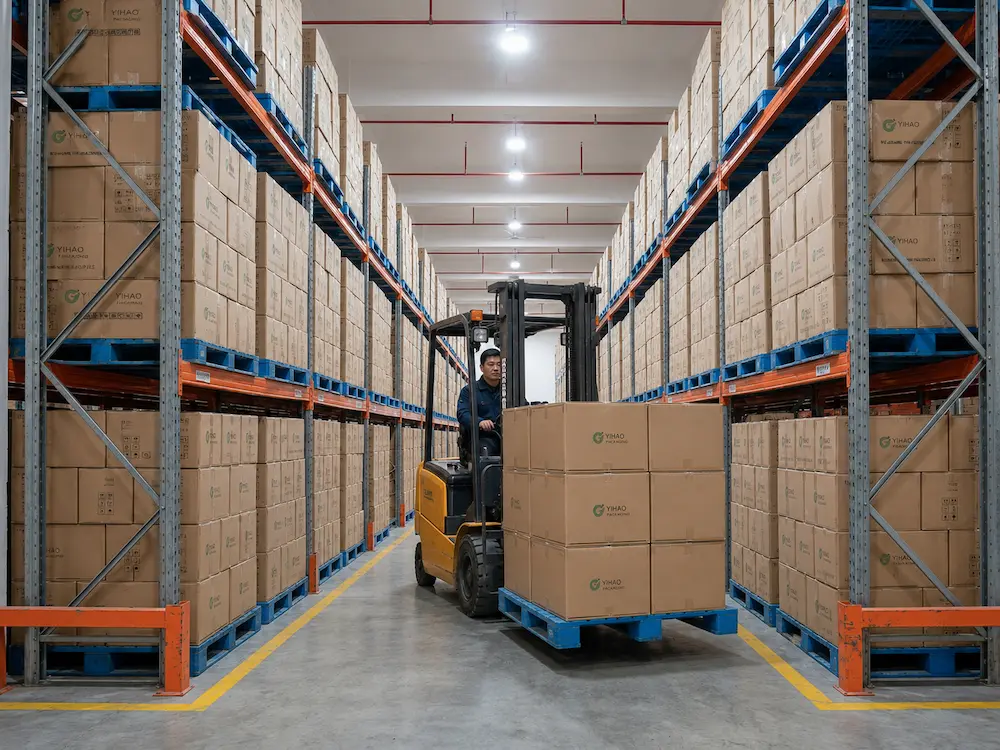
Unit price is only one part of packaging cost. Carton quantity, nesting height, pallet loading, warehouse storage, and freight efficiency all affect the final landed cost. Round containers may provide better food presentation, while square containers may provide stronger packing density. Buyers should compare both commercial value and logistics cost.
Making Broad Sustainability Claims Without Market Verification
Recyclability and sustainability claims depend on the full package design and the target market. Labels, adhesives, colors, food residue, local collection systems, and recycling infrastructure all matter. Buyers should verify claims before printing them on packaging, websites, or retail labels.
How Clear Round Food Containers Support Retail Food Merchandising
Retail food packaging has one direct job: make the product easier to trust and easier to buy. Clear round food containers support this goal because they show the food clearly from multiple angles. The shopper can see ingredient color, portion volume, topping quality, and freshness before making a decision.
This matters for chilled salads, fruit cups, premium deli sides, cold pasta, yogurt parfaits, desserts, and ready-to-eat meal bowls. In a crowded refrigerated shelf, packaging visibility helps the food communicate quality without requiring the shopper to read every label. A clear round format also creates a softer and more generous food presentation than many angular formats.
For brand owners, this visual advantage can reduce the need for excessive label coverage. A clean label, a visible product, and a reliable lid often create a better retail impression than a heavily printed container that hides the food. When buyers need a broader packaging solution for chilled food programs, deli food packaging should be evaluated by both product presentation and operational performance.
How Clear Round Food Containers Compare with Fresh-Cut Fruit Packaging
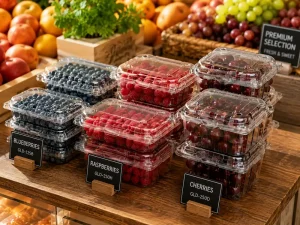
Fresh-cut fruit packaging has its own performance requirements. Fruit portions need visibility, moisture handling, secure closure, and a structure that protects cut surfaces during transport and shelf display. Round containers work well for mixed fruit bowls, melon balls, berries, grapes, apple slices, mango cubes, and fruit-and-yogurt combinations. However, some fresh-cut fruit programs may require rectangular or compartment-style packs to separate ingredients and improve shelf alignment.
For buyers focused on fruit, the decision should depend on product mix and display format. A round bowl is excellent for fruit salads and mixed portions. A compartment container is better for fruit-and-nut combinations, snack packs, and assorted retail portions. A larger rectangular format may be better for family packs or meal-prep fruit programs. Buyers can compare round bowls with fresh-cut fruit containers to build a more complete chilled produce packaging range.
Wholesale Buying Checklist for Clear Round Food Containers
Before placing a wholesale order, buyers should move beyond product photos and confirm the practical details that affect performance. A clear container may look similar across suppliers, but small differences in material thickness, lid fit, rim design, stacking height, anti-fog treatment, carton strength, and dimensional tolerance can change the actual user experience.
| Checklist Item | What Buyers Should Confirm | Why It Matters |
|---|---|---|
| Material | PET or rPET/PET structure, clarity, and food-contact suitability. | Affects appearance, compliance review, and market acceptance. |
| Lid Match | Flat lid, dome lid, hinged lid, or separate lid compatibility. | Controls leakage, stacking, and display quality. |
| Sample Testing | Test filling, closing, stacking, refrigeration, and transport. | Prevents problems before bulk orders. |
| Carton Packing | Confirm quantity, carton size, pallet loading, and storage efficiency. | Influences landed cost and warehouse handling. |
| Documentation | Request applicable food-contact and export documents for the target market. | Supports buyer due diligence and import planning. |
| Supplier Capacity | Check production consistency, lead time, and repeat-order stability. | Important for supermarket, distributor, and foodservice programs. |
A capable food packaging supplier should help buyers compare container structures, lid options, and suitable product ranges instead of only quoting the lowest price. The best purchasing decision usually comes from matching the packaging format to the real food application.
Recyclability and Compliance: What Buyers Should Know
PET is widely used in food packaging because it offers excellent clarity, strong presentation, and established recycling streams in many markets. However, buyers should avoid broad claims such as “fully recyclable everywhere” or “always eco-friendly.” Recyclability depends on local collection, sorting, material color, labels, adhesives, additives, food contamination, and the full package design.
For food-contact packaging made with recycled plastic, buyers should also understand that regulatory review can depend on the recycling process, intended use, and destination market. The U.S. FDA discusses recycled plastics for food packaging on a case-by-case basis, and buyers should request relevant documentation when recycled content is involved. For EU-facing buyers, packaging policy is moving toward stronger recyclability, labeling, and packaging waste requirements, so design choices should be reviewed with market-specific rules in mind.
The practical lesson is simple: material selection alone does not guarantee compliance or recyclability. Buyers should verify food-contact suitability, recycled content claims, label design, and end-of-life requirements for the market where the product will be sold.
When Clear Round Food Containers Deliver the Best Value for Buyers
Clear round food containers deliver the best value when the product is chilled, visually attractive, and sold through display appeal. They are especially strong for salads, fruit bowls, deli sides, chilled noodles, desserts, yogurt portions, snacks, and grab-and-go food. They also work well when the buyer wants a clean premium look without hiding the food behind heavy printing.
They are also a strong choice for brands that want packaging to communicate freshness immediately. In fresh food retail, customers often decide quickly. If the food looks colorful, clean, and well protected, the packaging has already done part of the selling work.
Buyers should choose clear round food containers when they need:
- High product visibility for chilled display
- Clean presentation for salads, fruit, deli food, and desserts
- Round shape for bowls, layered meals, and fresh food portions
- Reliable lid fit for takeaway and retail handling
- Wholesale-ready packaging for supermarkets, distributors, and foodservice programs
When Alternative Packaging May Be Better
Alternative packaging may be better when the product has performance requirements that clear round PET containers are not designed to solve. If the food must be microwaved, a PP or verified microwave-safe format is usually more suitable. If the food must be oven-heated, aluminum or oven-safe packaging should be considered. If the buyer’s brand strategy focuses heavily on a paper-based or molded fiber appearance, paper bowls or molded fiber packs may be a better fit.
Square PET containers may be better when shelf space, carton density, and logistics efficiency are more important than round presentation. Compartment containers may be better when buyers need to separate fruit, nuts, dips, toppings, or multi-ingredient snack packs. For fresh produce programs, a dedicated fresh-cut fruit container may be more suitable than a round bowl if the product needs a specific shape or portion layout.
Good buyers do not force one packaging format into every application. They build a packaging range that matches food type, shelf condition, customer expectation, and operational reality.
Buyer Decision Matrix: Clear Round Containers vs Alternative Packaging
| Packaging Option | Best For | Main Strength | Main Limitation | Buyer Decision |
|---|---|---|---|---|
| Clear Round PET Containers | Salads, fruit bowls, deli food, desserts, chilled meals | High visibility and premium presentation | Not suitable for high-heat use unless specifically verified | Choose for chilled display and fresh food merchandising |
| Square PET Containers | Fresh food, deli sides, meal-prep, retail packs | Shelf and carton efficiency | Less rounded food presentation | Choose for logistics and shelf density |
| Paper Bowls | Takeaway meals, branded foodservice, dry or semi-dry foods | Natural brand appearance | Limited food visibility | Choose for paper-based branding |
| PP Containers | Hot meals, reheatable food, prepared takeaway | Better heat resistance | Usually lower clarity than PET | Choose for microwave or hot food function |
| Aluminum Trays | Ovenable meals, baked dishes, hot food service | Heat and oven performance | No product visibility | Choose for ovenable applications |
| Molded Fiber Packaging | Natural-looking takeaway and selected dry foods | Fiber-based appearance | Moisture and visibility limitations | Choose when fiber branding is more important than transparency |
How to Choose a Reliable Wholesale Supplier
Choosing the right product is only half of the buying decision. Choosing the right supplier is equally important. A reliable packaging partner should help buyers confirm material, size, lid compatibility, carton packing, labeling options, and sample performance before bulk production.
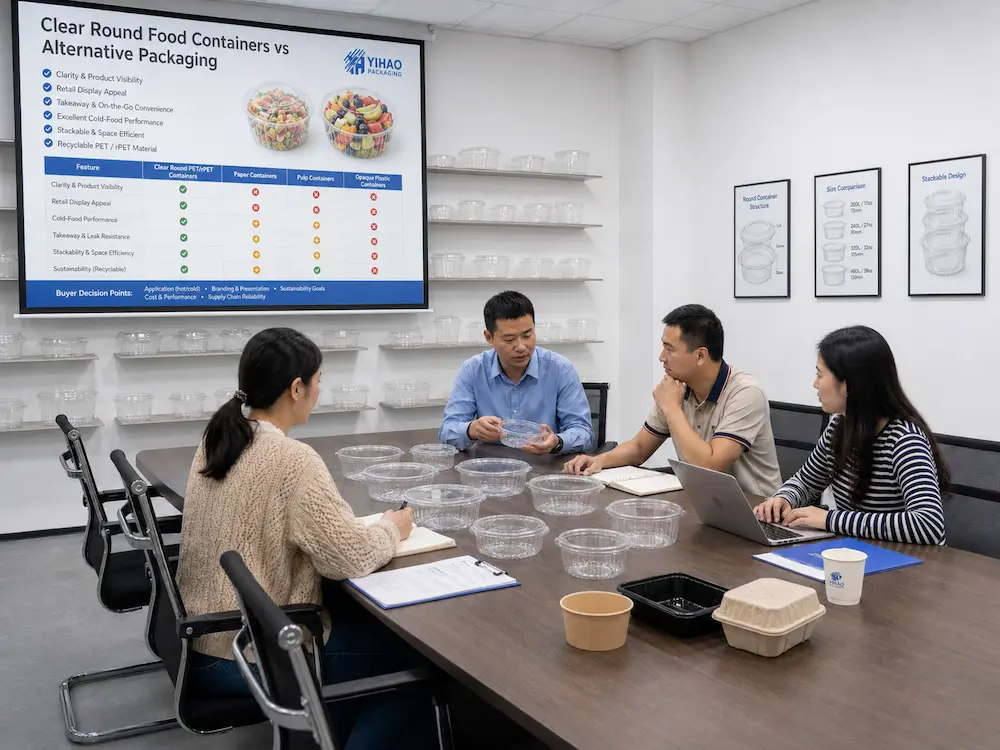
For wholesale buyers, the most important supplier questions include:
- Can the supplier provide matching lids for the selected round container?
- Can the supplier support repeat orders with stable dimensions and clear material quality?
- Can the buyer receive samples for filling, refrigeration, stacking, and transport tests?
- Can the supplier provide applicable food-contact documentation for the destination market?
- Can the supplier recommend alternative packaging when PET round bowls are not the right fit?
Strong suppliers do not only sell containers. They help buyers reduce packaging risk. They understand that clear round food containers, square PET containers, PP food containers, paper bowls, and aluminum trays each have different performance boundaries. This guidance helps buyers avoid mismatched packaging and improve long-term purchasing efficiency.
If you are comparing clear round food containers for salads, fruit bowls, deli food, chilled desserts, or grab-and-go meals, YIHAO can help you review container structure, lid compatibility, sample testing, and wholesale supply options for your target market.
Final Note / Practical Takeaway
FAQ
1. What are clear round food containers used for?
Clear round food containers are commonly used for chilled salads, fresh-cut fruit, deli food, pasta salad, snacks, desserts, yogurt portions, chilled noodles, and grab-and-go meals. They are especially useful when product visibility and fresh presentation influence purchase decisions.
2. Are clear round PET containers suitable for hot food?
Standard clear round PET containers are mainly used for chilled or cold display applications. They should not be used for high-heat, oven, or microwave applications unless the specific product is designed and verified for that use. For hot food or reheating needs, PP or verified microwave-safe packaging is usually more suitable.
3. What is the difference between round PET deli containers and PP containers?
Round PET deli containers usually provide better clarity and stronger chilled display appeal, making them suitable for salads, fruit, deli sides, and desserts. PP containers usually provide better heat resistance, making them more suitable for hot food and microwave-related applications.
4. How should wholesale buyers choose a clear round food container supplier?
Wholesale buyers should compare material quality, lid compatibility, clarity, stackability, carton packing, sample testing, production consistency, and applicable food-contact documentation. A reliable supplier should help match the container to the real food application instead of only offering a low unit price.
5. Are clear round food containers recyclable?
PET is accepted in many recycling systems, but actual recyclability depends on local collection, sorting infrastructure, material color, labels, adhesives, food contamination, and full package design. Buyers should verify recycling claims according to the destination market and packaging structure.
References
- U.S. Food and Drug Administration, Recycled Plastics in Food Packaging
- U.S. Food and Drug Administration, Guidance for Industry: Use of Recycled Plastics in Food Packaging: Chemistry Considerations
- European Commission, Packaging and Packaging Waste Regulation
- European Commission, Packaging Waste Policy and Recyclability Direction
- Association of Plastic Recyclers, Design Guide for Plastics Recyclability
- U.S. Environmental Protection Agency, Sustainable Materials Management and Recycling Guidance
- Plastics Recyclers Europe, PET Packaging and Recycling Guidance
- European Food Safety Authority, Food Contact Materials and Recycled Plastic Materials Guidance
Deep-Dive Insights: How Buyers Should Think Beyond the Container Shape
How should buyers compare clear round food containers with other packaging? Buyers should compare packaging by food temperature, shelf display, lid performance, logistics efficiency, material communication, and destination-market requirements. The best choice is not only about shape; it is about how the full packaging system performs from filling to retail sale.
Why do clear round PET containers work well for chilled food? They provide strong product visibility, clean presentation, and a ready-to-eat appearance that supports salads, fruit bowls, deli food, desserts, and grab-and-go meals in refrigerated display.
What should buyers avoid? Buyers should avoid using standard PET round containers for microwave, oven, or high-heat applications unless the product is specifically designed and verified for that use. They should also avoid broad recyclability or sustainability claims without checking local market conditions.
What is the smarter wholesale strategy? A stronger strategy is to build a packaging range: clear round food containers for premium chilled display, square PET containers for space efficiency, PP containers for hot food, and paper or fiber formats for specific brand positioning. This approach helps buyers improve both product performance and category flexibility.
© YIHAO Packaging. All rights reserved.
Food packaging solutions for global wholesale buyers, supermarkets, cafes, bakeries, and foodservice brands.