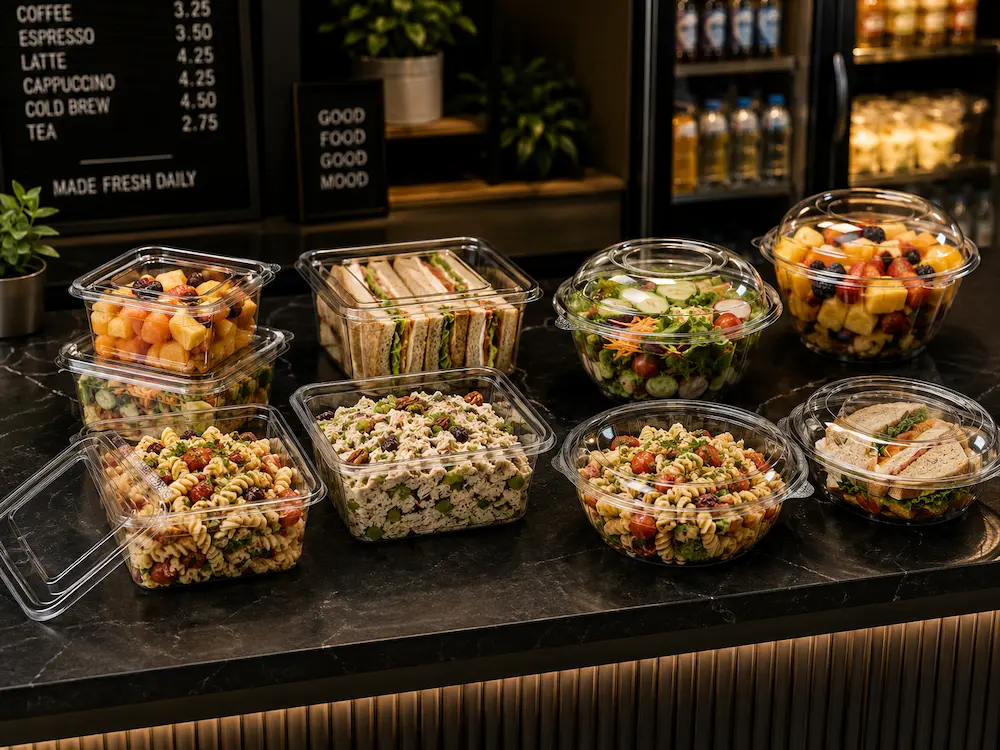
Choosing the right salad containers is not only a packaging purchase. It is a product presentation decision, a cold-chain handling decision, a labor-efficiency decision, and a wholesale supply decision. For supermarkets, salad shops, cafes, foodservice distributors, meal prep brands, and importers, the container affects how fresh food looks, how securely it travels, how efficiently it stacks, and how confidently customers buy it.
YIHAO is a food packaging manufacturer and solution provider supporting buyers with clear PET, rPET, hinged, round, square, and application-based packaging options for chilled fresh food, salads, fruit cuts, deli meals, bakery items, and grab-and-go retail programs. Buyers can explore the wider deli and salad containers range when building a packaging system for multiple food categories.
This FAQ answers the most common questions about salad containers, including materials, container shapes, common sizes, PET performance, hinged and separate-lid options, wholesale ordering questions, and supplier selection. It is written for buyers who need packaging that works in real filling, retail, delivery, and repeat-order conditions.
What Are Salad Containers Used For?
Salad containers are used for fresh, chilled, and ready-to-eat foods that require clear presentation, stable closure, portion control, and efficient handling. They are common in supermarkets, convenience stores, salad bars, cafes, catering programs, foodservice kitchens, and meal prep operations.
Typical applications include green salads, pasta salads, grain bowls, fruit mixes, cold noodles, deli sides, bakery desserts, nuts, toppings, snack portions, and chilled ready-to-eat meals. Because these products rely heavily on freshness and visual appeal, many buyers prefer clear PET deli containers or rPET options that allow customers to see the food before purchase.
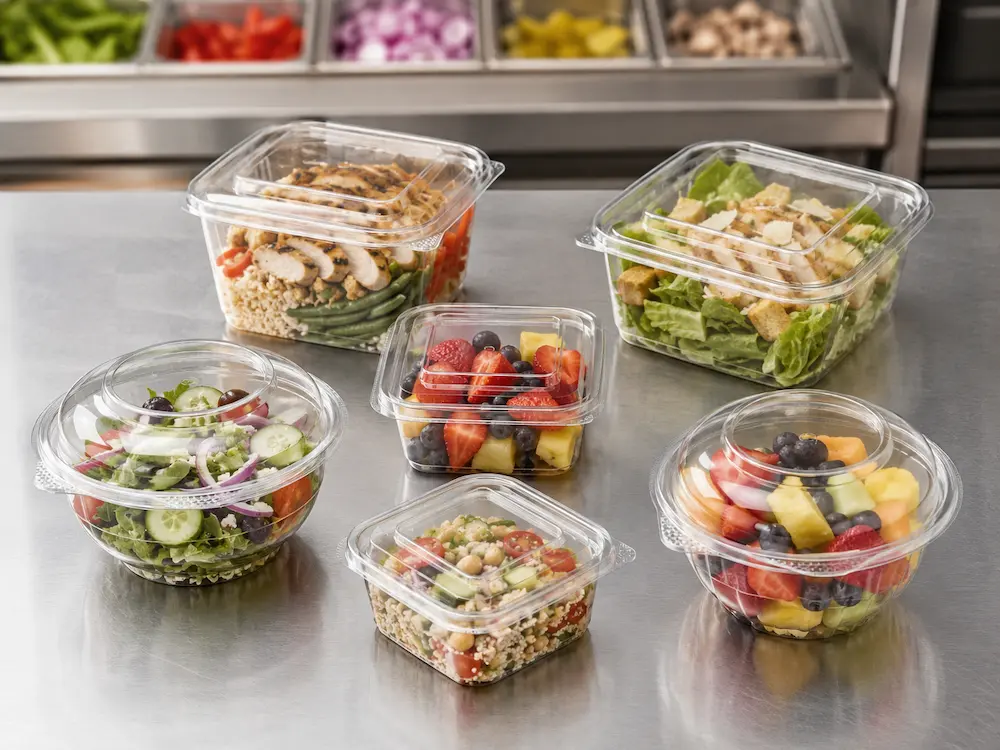
For buyers creating a complete fresh food packaging line, salad packaging often connects with fruit, deli, dessert, and grab-and-go categories. A supermarket may use one container family for leafy salads, another for fruit cuts, and another for chilled deli sides. A distributor may need standard sizes across several foodservice customers. This is why a supplier’s range matters as much as a single product price.
What Materials Are Commonly Used for Salad Containers?
The most common materials for salad containers include PET, rPET, PP, paper, and fiber-based materials. Each material has a different role. For chilled food display, PET remains one of the most practical choices because it combines clarity, lightweight handling, and clean retail presentation.
PET salad containers
PET deli containers are widely used for salads, fruit cuts, deli sides, pasta salads, and chilled ready-to-eat meals. PET gives food strong visibility, which is important when color, freshness, and ingredient layering influence purchase decisions. Clear packaging helps customers evaluate the product quickly in refrigerated displays.
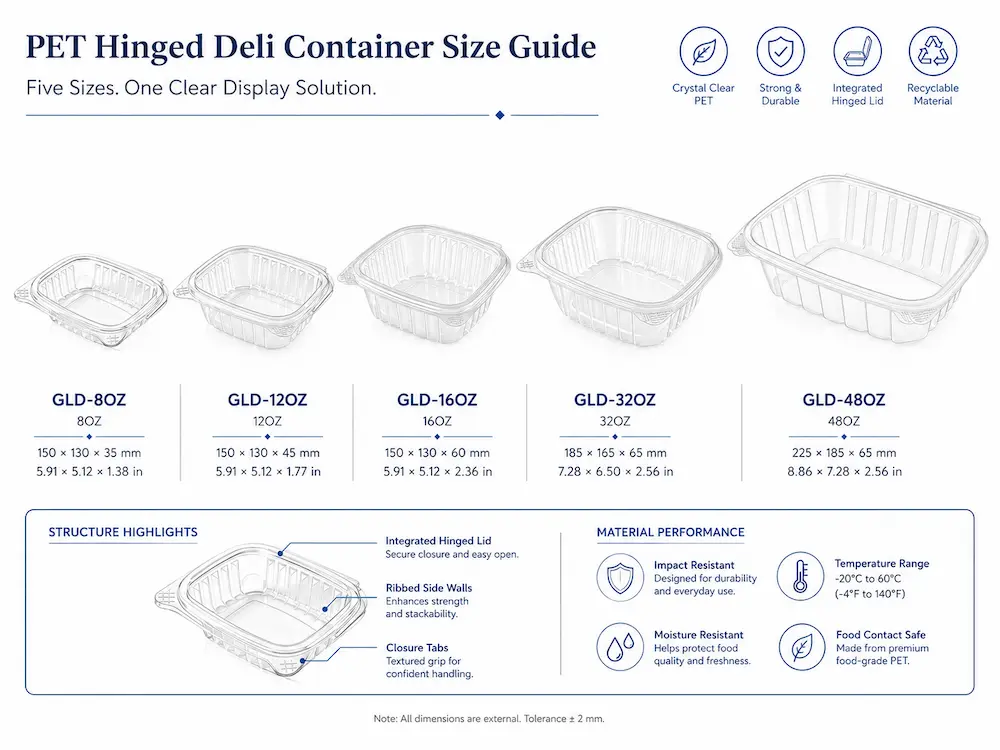
For buyers who need integrated lid convenience, PET hinged deli containers are especially practical. The attached lid reduces lid-matching mistakes, improves packing speed, and supports takeaway and retail operations where staff need to pack food quickly.
rPET salad containers
rPET is recycled PET. Buyers choose rPET when they want a recycled-content material direction while still keeping clear product visibility. rPET is common in produce, fruit, bakery, deli, and salad packaging applications. However, buyers should keep sustainability claims specific and market-appropriate, because recycling acceptance depends on local collection and processing systems.
When sourcing rPET salad packaging, ask the supplier about material appearance, recycled content direction, food-contact suitability, documentation, and supply consistency. A responsible salad containers supplier should explain material options clearly rather than relying on vague environmental wording.
PP salad containers
PP containers are often selected when buyers need higher temperature resistance than standard PET applications. For chilled salad and fresh food display, however, PP usually does not provide the same crystal-clear appearance as PET. If retail visibility is the main priority, PET is usually the stronger choice for cold salads and fruit-based products.
Paper and fiber-based salad containers
Paper and fiber-based containers are often used for a natural brand image. They can work for grain bowls, dry salads, and takeaway meals, but buyers must evaluate moisture resistance, oil resistance, lid fit, and product visibility. If the food contains dressing, juicy fruit, or wet ingredients, real-condition testing is essential before wholesale ordering.
Are PET Salad Containers Good for Fresh Food Packaging?
Yes. PET is a strong option for chilled fresh food packaging when buyers need clarity, light weight, clean presentation, and practical stacking. For salads, fruit cuts, pasta salads, and cold deli sides, clear PET helps the product sell itself through visibility.
Clear product visibility
Fresh salads often include colorful vegetables, toppings, grains, proteins, cheese, fruit, or sauce cups. A clear container allows customers to see ingredient quality and portion value. This is especially important for retail shelves, grab-and-go coolers, and convenience store displays.
Buyers using 16oz clear recycled PET hinged deli containers or larger formats can create consistent packaging for salads, snacks, fruit, and deli sides without changing the overall visual language of the product line.
Cold food compatibility
Salad containers are normally used for refrigerated display, chilled delivery, and ready-to-eat food handling. PET is commonly selected for these cold applications. Buyers should still confirm recommended use conditions, filling weight, lid performance, and food-contact documentation with the supplier before placing a bulk order.
Stacking and logistics efficiency
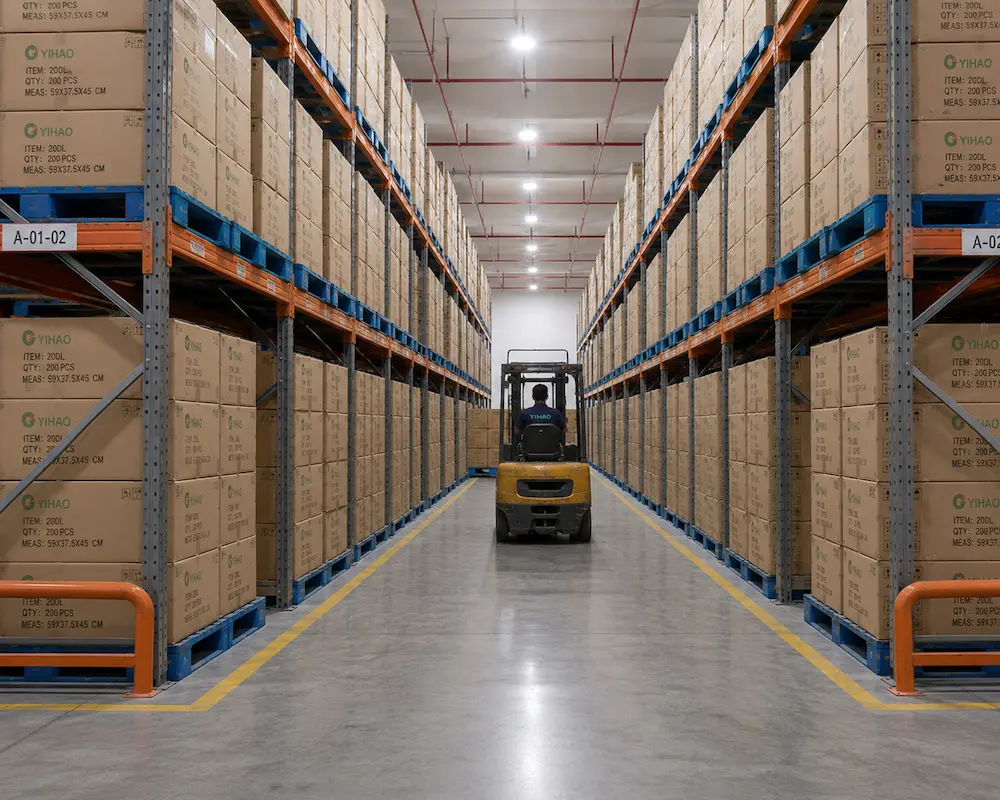
Wholesale buyers should not evaluate salad packaging by unit price alone. Carton quantity, storage space, stacking stability, filling speed, and delivery performance all affect real cost. A container that stacks well and stays closed during handling may reduce product damage, labor issues, and customer complaints.
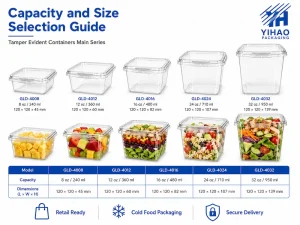
For larger fresh food portions, buyers often compare options such as 32 oz clear recycled PET hinged deli containers and 48 oz clear recycled PET hinged deli containers for grab-and-go meals, larger salads, fruit portions, and deli foods.
What Sizes of Salad Containers Do Buyers Usually Choose?
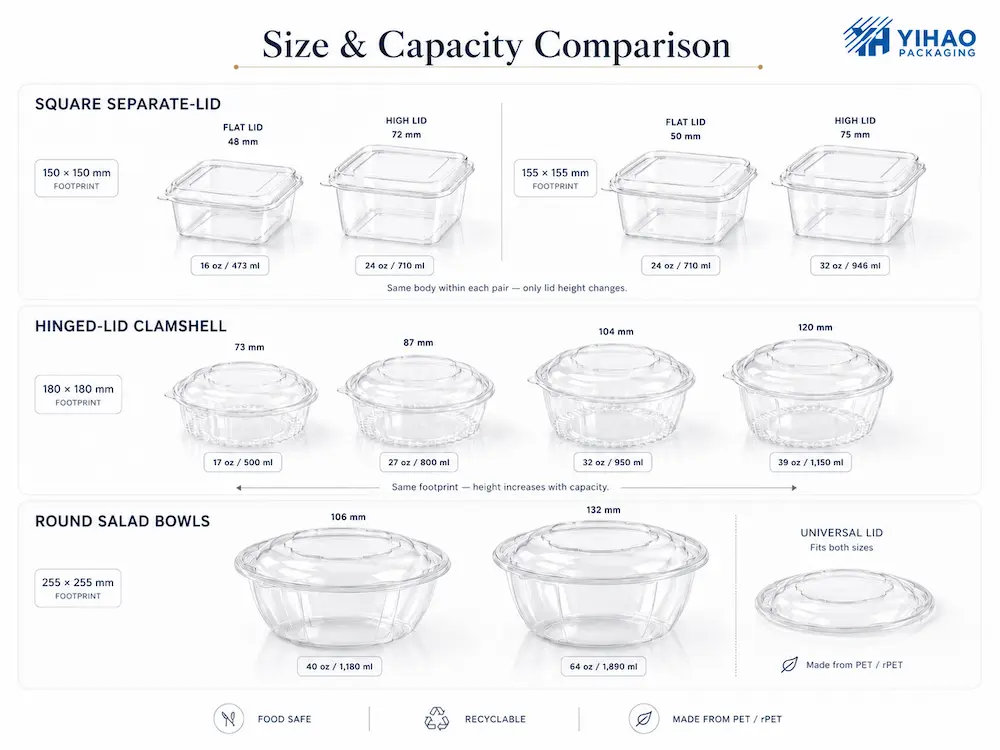
Salad container size should be selected by actual food weight, ingredient height, portion style, label placement, and shelf display method. A leafy salad may need more volume but less base strength. Pasta salad, fruit, grains, and beans are denser and create more pressure on the container base.
| Size Logic | Best-Fit Applications | Buyer Type | Selection Priority |
|---|---|---|---|
| Small portions | Fruit cuts, nuts, toppings, side salads, dessert portions | Cafes, bakeries, convenience stores, supermarkets | Clear display, compact shelf space, easy labeling |
| Medium portions | Individual salads, pasta salad, grain bowls, meal prep servings | Salad shops, meal prep brands, grab-and-go retailers | Visual fullness, lid clearance, stacking strength |
| Large portions | Family salads, catering packs, fruit platters, chilled deli display | Distributors, caterers, supermarkets, foodservice teams | Base rigidity, lid fit, carton efficiency, transport stability |
Before choosing a size, buyers should test the container with real food. The package should look full but not compressed. The lid should close without pushing down on ingredients. The label should not cover too much of the visible food area. For wholesale programs, sample testing is a serious cost-control step, not a formality.
Round PET Deli Containers vs Square PET Deli Containers: Which Should Buyers Choose?
Both round PET deli containers and square PET deli containers are suitable for salad and chilled food packaging. The better option depends on how the food is displayed, packed, stored, transported, and consumed.
Round PET deli containers
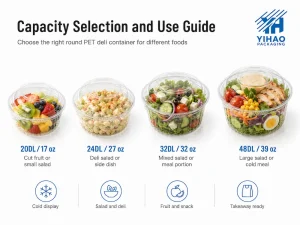
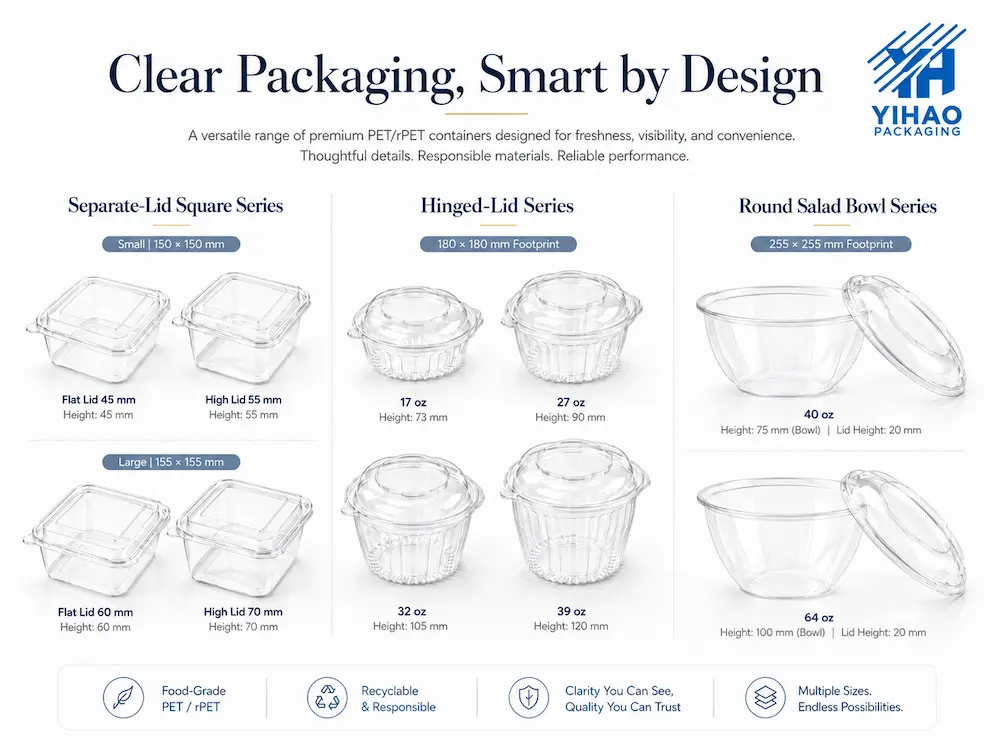
Round PET deli containers create a bowl-like presentation that feels natural for salads, fruit mixes, pasta salads, cold noodles, and ready-to-eat meals. The round format is especially useful when customers may eat directly from the container.
For grab-and-go salad programs, round bowls such as 17oz clear PET salad bowls with hinged lids, 27oz clear PET salad bowls with hinged lids, and 32oz clear PET salad bowls with hinged lids help buyers match different portion levels while keeping a consistent salad-bowl appearance.
Square PET deli containers
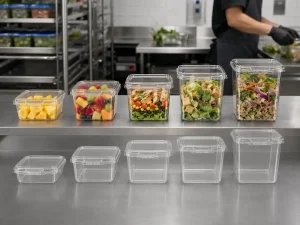
Square PET deli containers are strong choices when shelf space, carton efficiency, and organized display matter. Square containers fit neatly in refrigerators, retail shelves, delivery bags, and shipping cartons. They are useful for salads, fruit, deli meals, chilled sides, and prepared food portions.
For buyers who need compact retail packaging, 20oz PET square deli containers work well for salads, fruit, and deli meals, while 34oz PET square deli containers support larger salads, chilled meals, and family-style fresh food packs.
Which shape is better for wholesale buyers?
Round containers usually create a softer, bowl-style eating experience. Square containers usually improve space efficiency and retail organization. Many wholesale buyers use both: round bowls for premium grab-and-go salads, square containers for fruit, deli meals, and shelf-efficient chilled foods.
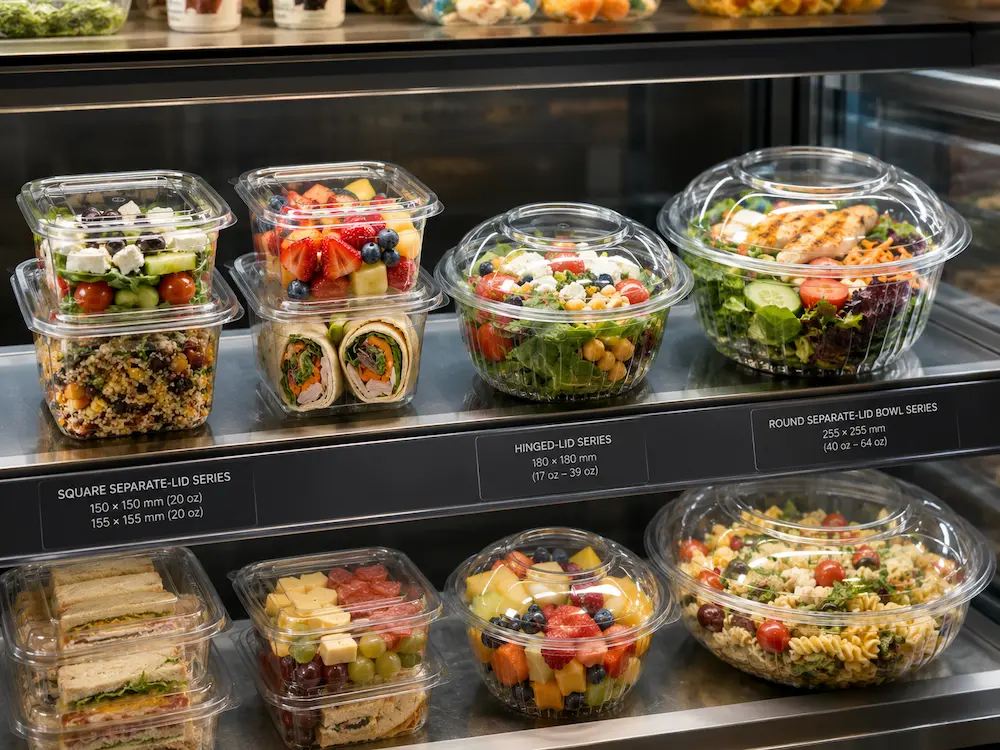
A practical salad containers supplier should help buyers compare both shapes with actual food samples, not simply recommend one universal option.
Are Hinged Salad Containers Better Than Separate-Lid Containers?
Hinged and separate-lid containers solve different problems. PET hinged deli containers are usually better for fast manual packing, takeaway, grab-and-go sales, and simple SKU management. Separate-lid containers can be better when buyers need more lid flexibility, special filling processes, or multiple lid types for one base.
Why buyers choose PET hinged deli containers
Hinged containers combine the lid and base in one piece. This reduces lid mismatch, saves packing time, and improves convenience for staff. For salad shops, cafes, supermarkets, and prepared food counters, this structure keeps daily packing simple.
Hinged packaging also improves customer handling. The lid stays connected to the base, which makes opening, closing, and eating more convenient. For takeaway salads and ready-to-eat meals, this creates a cleaner user experience.
When separate-lid containers make sense
Separate-lid containers are useful when buyers need flat lids, dome lids, high lids, or different lid options across a container family. They also support certain packing lines and filling workflows. However, they require stronger inventory control because bases and lids must be matched correctly.
For large distributors, separate-lid systems can be useful when different customers need different lid heights or label layouts. The choice depends on operation style, not just packaging appearance.
Recommended Container Types by Food Application
The fastest way to choose salad containers is to match food application with structure. The table below gives a practical starting point for B2B buyers.
| Food Application | Recommended Container Type | Why It Works | Best Buyer Scenario |
|---|---|---|---|
| Individual leafy salads | Round PET salad bowls with hinged lids | Bowl-like shape, strong visual presentation, convenient eating experience | Salad shops, supermarkets, grab-and-go coolers |
| Pasta salad and grain bowls | Medium or large PET deli containers | Supports denser foods and clear ingredient display | Meal prep brands, cafes, foodservice programs |
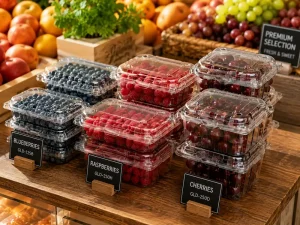
| Fruit cuts and mixed fruit | Clear PET hinged or square containers | Clean visibility, organized display, easy stacking | Supermarkets, convenience stores, fresh-cut fruit processors |
| Deli sides and chilled prepared foods | Square PET deli containers | Efficient shelf layout and stable carton packing | Deli counters, distributors, retail food brands |
| Large family salads or catering portions | Large round or square PET containers | More capacity, stronger base requirement, better transport planning | Catering, wholesale, supermarkets, foodservice buyers |
| Premium grab-and-go meal salads | Clear PET salad bowls with secure hinged lids | Improves presentation and supports direct consumption | Premium salad brands, office lunch programs, prepared meal retailers |
How Should Buyers Choose Salad Containers for Wholesale Orders?
Wholesale buyers should choose salad containers through a structured process. The best approach is to compare real food performance, not only catalog photos. A good container should match the product, fit the packing workflow, support storage and delivery, and remain stable across repeat orders.
Step 1: Define the food and portion weight
Start with the actual food. Leafy greens, pasta, fruit, grains, and deli salads behave differently inside packaging. Buyers should define the target food weight, dressing method, ingredient height, and whether sauce cups or toppings will be packed inside.
Step 2: Choose the right shape and lid structure
Choose round formats for bowl-like salads and direct eating. Choose square formats for efficient display and carton packing. Choose hinged containers for faster manual packing. Choose separate-lid systems when lid flexibility is more important than packing simplicity.
Step 3: Test lid fit, stacking, and label placement
A container must close securely after filling. It must stack without crushing the food. It must leave enough clear area for customers to see the product after labeling. Buyers should test all three points before confirming wholesale quantities.
Step 4: Confirm supplier capability
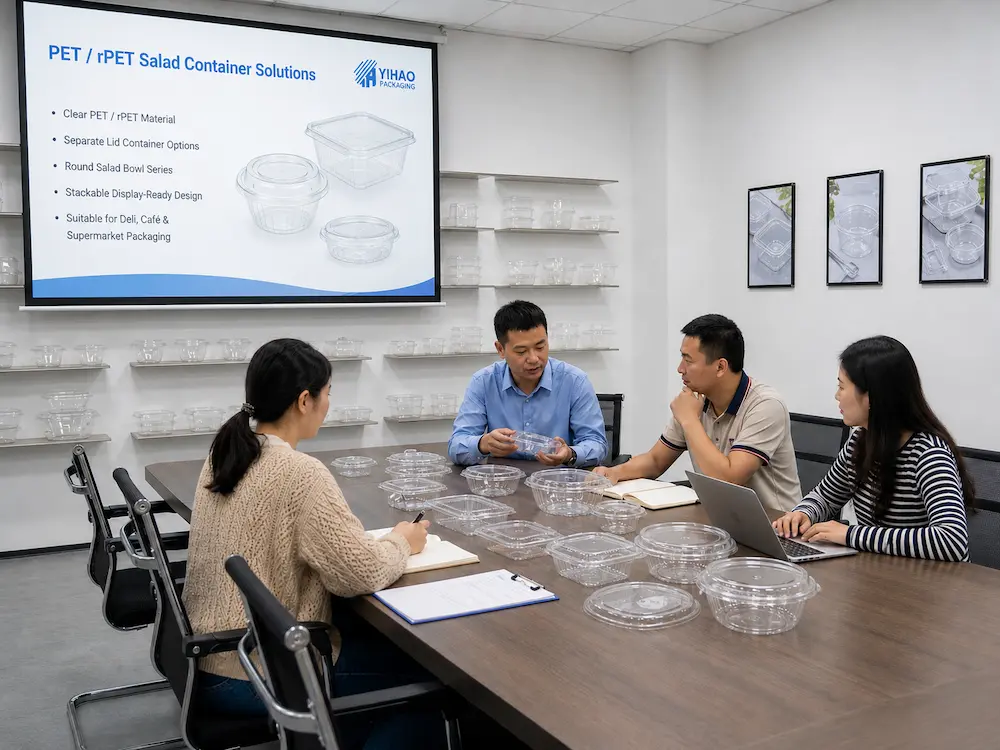
A reliable salad containers manufacturer should support product matching, sample testing, material explanation, packaging recommendations, and repeat-order planning. Buyers should also check whether the supplier can support OEM, custom packaging, carton planning, and multiple product families.
What Should You Ask a Salad Containers Manufacturer or Supplier?
Before ordering, buyers should ask practical questions that reveal whether the supplier understands food packaging applications.
| Question to Ask | Why It Matters |
|---|---|
| Do you supply PET, rPET, hinged, round, and square salad container options? | Shows whether the supplier can support a complete packaging range. |
| Can you recommend containers based on food weight and application? | Shows whether the supplier understands real food packaging, not only item sales. |
| Can you provide samples for filling, stacking, and cold-chain testing? | Reduces the risk of choosing the wrong size or structure. |
| Can you support wholesale supply and repeat orders? | Important for distributors, supermarkets, and growing food brands. |
| Can you support OEM or custom packaging? | Useful for private label programs and differentiated retail packaging. |
| What documentation can you provide for the target market? | Helps buyers prepare for import, food-contact review, and customer requirements. |
Why Work With a Salad Containers Manufacturer Instead of Only a Trader?
Working with a salad containers manufacturer gives buyers stronger control over product consistency, packaging development, communication, and supply planning. Traders may help with simple sourcing, but manufacturers are usually more useful when the buyer needs repeat orders, product matching, custom packaging, and long-term supply stability.
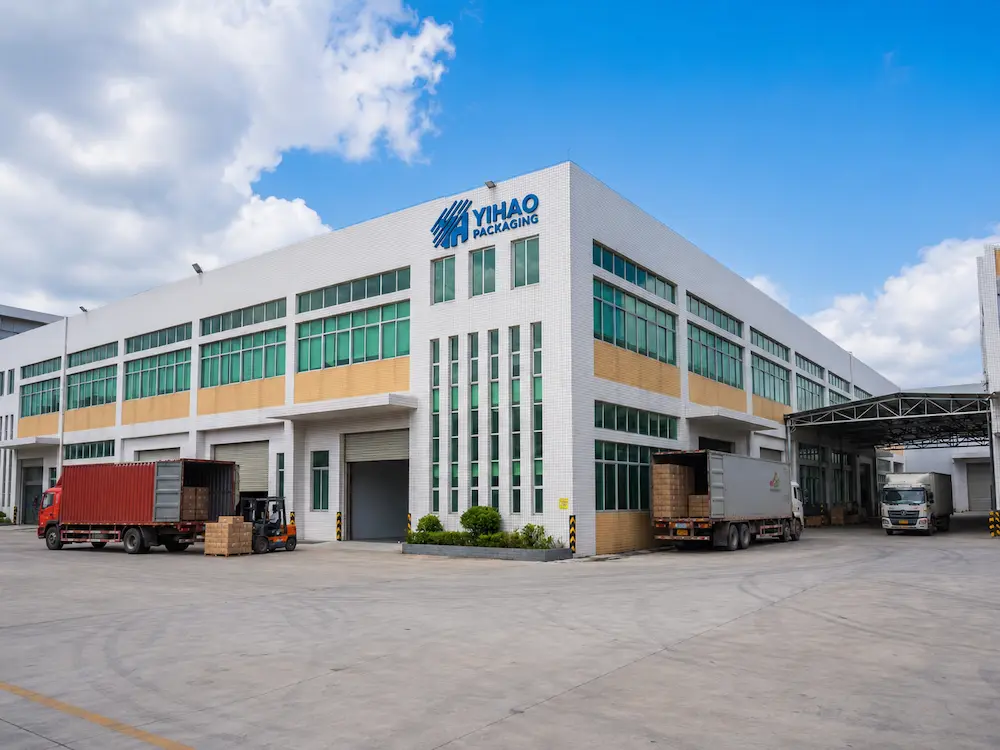
YIHAO supports buyers with food packaging solutions across fresh produce, deli and salad, bakery, cold cups and lids, tamper-evident containers, and multi-compartment packaging. Buyers can learn more about production and supply capability through the YIHAO factory page or start from the YIHAO homepage when reviewing the broader packaging range.
Better product consistency
Food packaging consistency matters. If the lid fit, clarity, rim structure, or container strength changes frequently, the buyer may face packing problems and customer complaints. A manufacturer has stronger control over production details and can maintain more consistent specifications across repeat orders.
More practical product development support
When a buyer needs a container for a specific salad weight, retail shelf layout, or foodservice program, a manufacturer can discuss shape, structure, material, lid design, carton packing, and sample testing more directly. This support becomes important when buyers move from small trial orders to larger wholesale programs.
Stronger wholesale planning
Wholesale buyers need stable supply, clear communication, and packaging that fits multiple channels. A manufacturer can help buyers build a logical product range instead of sourcing random items from different suppliers. This is especially valuable for importers, distributors, and private label food brands.
Common Ordering Questions About Salad Containers
What information should buyers provide before requesting a quote?
Buyers should provide food type, target portion weight, preferred container shape, lid style, material preference, order quantity, destination market, labeling requirement, packaging method, and whether the product will be used for retail display, takeaway, delivery, catering, or foodservice. Photos or reference samples also help suppliers recommend suitable options faster.
Can salad containers be customized?
Yes, customization may be available depending on order quantity, mold status, design requirements, and production feasibility. Custom options may include size development, shape adjustment, label area planning, logo embossing, carton packing, or private label packaging support. Buyers should discuss customization early because custom packaging requires more planning than standard items.
Are salad containers suitable for cold-chain delivery?
Many PET salad containers are suitable for chilled food packaging and refrigerated distribution, but buyers should always test under real conditions. The test should include filling weight, refrigeration time, stacking height, carton packing, delivery movement, and customer handling.
How do buyers compare price and performance?
Compare total performance, not only unit price. Buyers should review clarity, lid closure, base strength, stackability, carton efficiency, defect control, sample support, supplier communication, and repeat-order stability. A stable container that reduces packing issues and product damage often creates better value than a cheaper option with inconsistent quality.
Buyer Checklist Before Ordering Salad Containers
| Checklist Item | What to Confirm | Why It Matters |
|---|---|---|
| Food type | Leafy salad, pasta salad, fruit, grain bowl, deli side, dessert | Different foods create different pressure and moisture conditions. |
| Material | PET, rPET, PP, paper, or fiber-based material | Material affects clarity, appearance, temperature use, and brand positioning. |
| Shape | Round, square, rectangular, hinged, or separate-lid | Shape affects display, eating experience, storage, and carton efficiency. |
| Lid fit | Closure points, hinge strength, rim design, opening comfort | Lid performance affects spills, delivery risk, and customer satisfaction. |
| Stacking | Filled stacking, refrigerated storage, carton packing | Real stacking performance protects food during handling and transport. |
| Label area | Top label, side label, barcode, ingredient panel | Labels should not block too much product visibility. |
| Supplier capability | Samples, documentation, production consistency, OEM support | Wholesale buyers need more than one-time item sourcing. |
FAQ About Salad Containers
1. What are the best materials for salad containers?
The best material depends on the food application, storage condition, and sales channel. PET is widely used for chilled salad packaging because it provides clear product visibility and a clean retail appearance. rPET supports recycled-content packaging directions, while PP is often used when higher temperature resistance is needed. Paper and fiber-based containers should be tested for moisture, oil, lid fit, and product visibility.
2. Are PET salad containers suitable for cold food packaging?
Yes. PET salad containers are commonly used for cold salads, fruit cuts, deli foods, bakery portions, and chilled ready-to-eat meals. Buyers should confirm food-contact suitability, recommended use conditions, lid performance, and stacking strength before wholesale ordering.
3. What sizes of salad containers are most common?
Common sizes depend on portion style. Small containers are used for fruit cuts, nuts, toppings, and side dishes. Medium containers are used for individual salads, pasta salads, and meal prep portions. Large containers are used for family salads, catering, and deli display. Buyers should test actual food weight and visual fullness before confirming size.
4. What is the difference between round PET deli containers and square PET deli containers?
Round PET deli containers create a bowl-like presentation for salads, fruit mixes, pasta salads, and grab-and-go meals. Square PET deli containers improve shelf organization, carton efficiency, and structured retail display. The better option depends on food type, display method, packing workflow, and logistics needs.
5. How do I choose a wholesale salad containers supplier?
Choose a salad containers supplier by reviewing product range, material options, sample quality, lid fit, food-contact documentation, wholesale supply ability, customization support, and communication reliability. For long-term purchasing, working with a real manufacturer gives buyers better control over product consistency and packaging development.
References
- U.S. Food and Drug Administration, Packaging & Food Contact Substances, official food packaging and food-contact guidance.
- U.S. Food and Drug Administration, Food Packaging & Other Substances that Come in Contact with Food, consumer and regulatory information.
- U.S. Environmental Protection Agency, Plastics: Material-Specific Data, facts and figures about materials, waste, and recycling.
- European Commission, Commission Regulation (EU) No 10/2011 on plastic materials and articles intended to come into contact with food.
- EUR-Lex, consolidated legal text for plastic materials and articles intended to come into contact with food.
- Association of Plastic Recyclers, APR Design Guide for Plastics Recyclability.
- Association of Plastic Recyclers, PET Rigid Design Guidance and recyclability considerations.
- National Association for PET Container Resources, PET Recycling Reports and industry resources.
Final Note / Practical Takeaway
Deep-Dive Insights for Buyers Comparing Salad Containers
How should buyers evaluate salad containers beyond capacity?
Buyers should evaluate actual food weight, ingredient height, moisture level, lid clearance, stacking pressure, carton packing, label placement, and customer handling. Capacity is only one part of the decision. The container must protect the food and present it clearly through the full sales journey.
Why do many chilled food brands prefer PET deli containers?
Many chilled food brands choose PET deli containers because clear PET supports strong product visibility. For salads, fruit cuts, deli sides, and desserts, transparency helps customers judge freshness, color, and portion value quickly.
What option works better for fast packing: hinged or separate lid?
PET hinged deli containers usually support faster manual packing because the lid and base are connected. Separate-lid containers offer flexibility for some filling systems and product lines, but they require tighter inventory control.
What should wholesale buyers consider before choosing a supplier?
Wholesale buyers should consider product range, material options, sample quality, food-contact documentation, production consistency, carton packing, customization ability, and long-term supply stability. A qualified salad containers supplier should support both product selection and practical application testing.
What is the most practical buying strategy?
The most practical strategy is to shortlist two or three suitable structures, test them with actual food, compare lid fit and stacking performance, then confirm the best option for wholesale ordering. This reduces purchasing risk and improves packaging consistency for retail, takeaway, and foodservice channels.
© YIHAO Packaging. All rights reserved. All articles, product images, packaging designs, technical specifications, and website materials are protected by copyright. Unauthorized copying, reproduction, redistribution, modification, or commercial use is strictly prohibited without prior written permission.