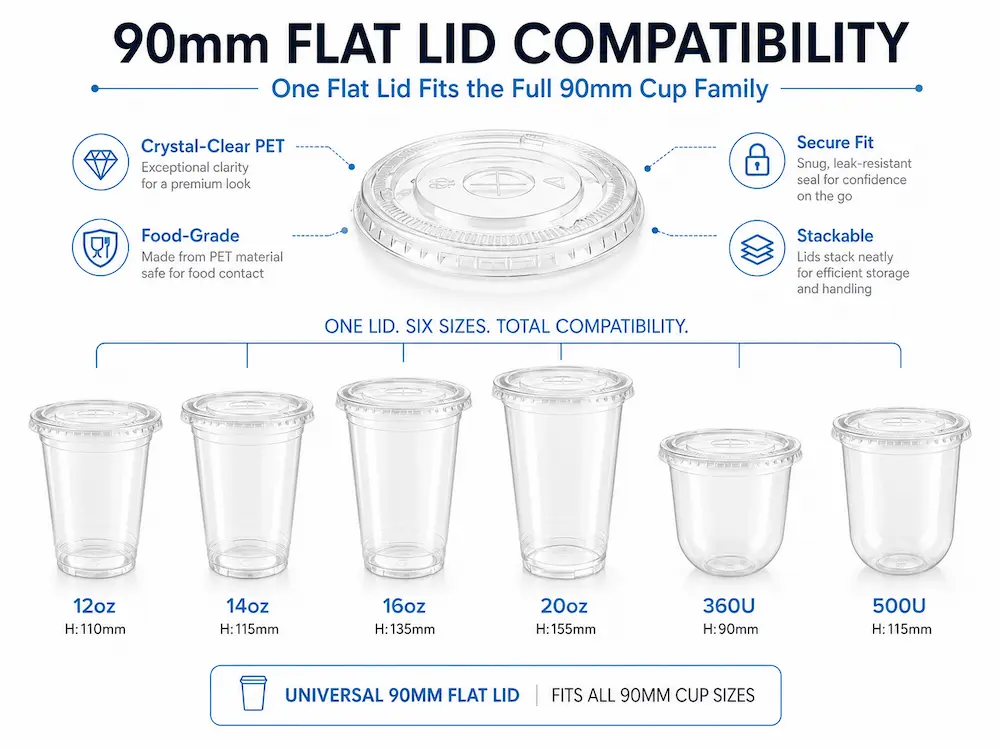
For supermarkets, cafes, bakeries, beverage chains, distributors, and foodservice brands, flat lid compatibility is a practical packaging decision that affects service speed, leakage control, shelf presentation, inventory planning, and customer experience. A flat lid may look simple, but its performance depends on how accurately it fits the cup rim during real use.

Many buyers start with one question: “Do I need 95mm cold cup lids or 98mm cold cup lids?” That question is useful, but it is only the starting point. True cup lid matching depends on rim diameter, rolled rim design, lid groove depth, snap-on force, material stiffness, drink type, storage condition, and handling method.
YIHAO is a food packaging manufacturer and solution provider focused on practical cup-and-lid systems for cold drink packaging, dessert packaging, and grab-and-go retail programs. Buyers can explore the full Cold Cups & Lids range to compare compatible cups, flat lids, dome lids, and strawless lid options for different beverage service needs.
Why Flat Lid Compatibility Matters in Cold Drink Packaging
Flat lid compatibility matters because cold drink packaging is handled many times before it reaches the final customer. A cup may be filled at a cafe counter, capped by staff, placed into a takeaway bag, stored in a refrigerator, displayed on a supermarket shelf, delivered by a courier, or carried by a customer.
If the lid does not match the cup properly, small fit problems become visible quickly. A loose lid may leak during transport. A tight lid may slow down staff during peak service. An uneven lid may look acceptable at first but lift when the cup is squeezed, chilled, tilted, or stacked.
For cafes and beverage chains, poor cold cup lid compatibility creates slower service and inconsistent handoff. For supermarkets, it affects grab-and-go display quality. For bakeries, it can damage the clean presentation of chilled dessert cups. For wholesale distributors, it can become a repeat complaint across multiple customer accounts.
The Real Business Cost of Poor Cup Lid Matching
The cost of poor cup lid matching is not limited to the lid itself. It can create product waste, customer complaints, staff frustration, replacement orders, and inventory confusion. When a buyer handles multiple cup sizes, several store locations, or recurring wholesale orders, even a small compatibility issue becomes a bigger operational problem.
This is why professional buyers should treat flat lid compatibility as a system decision. The right lid should fit the cup smoothly, hold the rim evenly, support normal takeaway movement, and match the actual beverage or dessert application.
What Flat Lid Compatibility Really Means
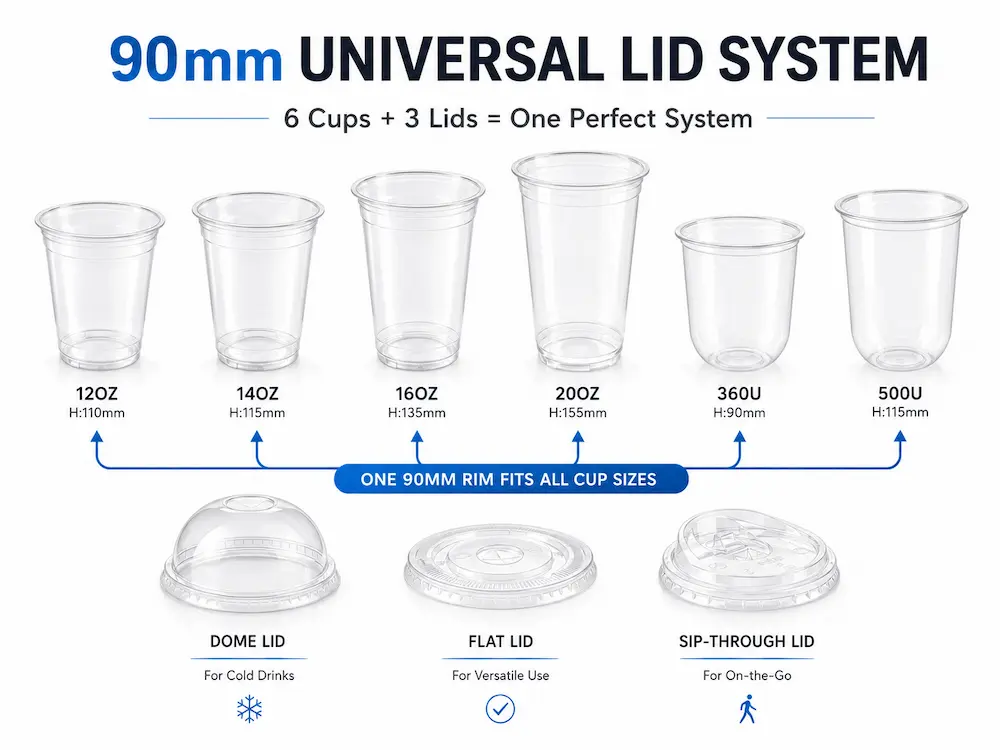
Flat lid compatibility means that the lid and cup form a stable, repeatable, application-ready fit. It is not enough that a lid can be forced onto a cup once. A compatible lid should snap on with controlled pressure, sit evenly on the rim, resist accidental loosening, and support the intended customer experience.
For cold drink packaging, flat lids may be used with straw slots, X-slots, sip openings, or closed surfaces depending on the lid style. A flat lid for iced coffee may need a straw slot. A flat lid for chilled dessert cups may need a cleaner closed surface. A lid used in supermarket display may need neat visual presentation and reliable shelf handling.
The best choice depends on the cup, lid, drink type, sales channel, and service method.
Diameter Is Only the First Checkpoint
Buyers often search for 95mm cold cup lids or 98mm cold cup lids, but the nominal diameter does not guarantee universal fit. A 95mm lid from one supplier may not match every 95mm cup from another supplier. The same is true for 98mm systems.
Several details affect final performance:
- Cup rim diameter: The measured outside rim diameter must match the intended lid range.
- Rolled rim profile: Rim shape affects how the lid locks onto the cup.
- Lid groove depth: Groove structure changes the snap-on feel and holding tension.
- Material stiffness: PET, PP, and other materials behave differently during application.
- Production tolerance: Small differences may affect fit consistency across batches.
- Product use: Iced coffee, smoothies, fruit tea, desserts, and chilled drinks create different handling conditions.
This is why buyers should test samples before placing wholesale orders. Compatibility must be confirmed with the actual cup series and lid style, not assumed from the size label alone.
95mm Cold Cup Lids vs. 98mm Cold Cup Lids
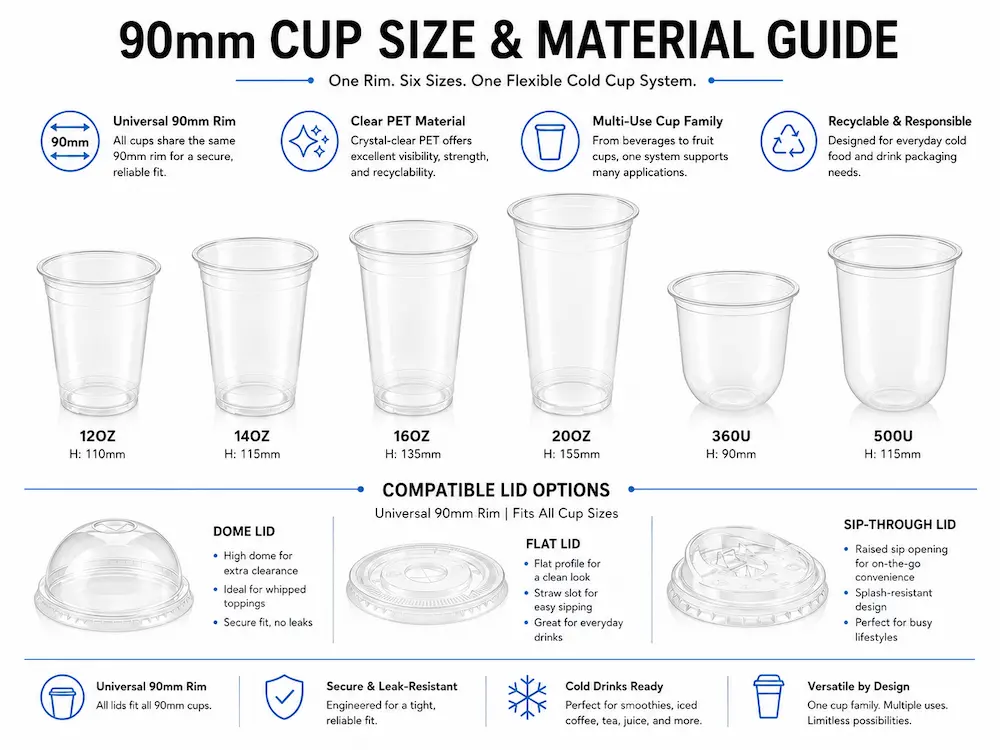
95mm cold cup lids and 98mm cold cup lids are common in cold beverage packaging, but they serve different cup systems and menu strategies. The right choice depends on cup series, drink format, visual presentation, and inventory planning.
When 95mm Cold Cup Lids Make Sense
95mm cold cup lids are often used for standard cold drink programs where buyers want efficient stacking, daily service consistency, and a balanced cup diameter. They are suitable for iced coffee, juice, iced tea, lemonade, soda, fruit tea, milk tea, and many ready-to-serve cold beverages.
For cafes and retail drink counters, a 95mm cup-and-lid system can help reduce lid SKUs when multiple cup capacities share the same rim diameter. Buyers can review options such as the 95mm Clear PET Flat Lid when planning a compatible cold drink packaging program.
When 98mm Cold Cup Lids Are Better
98mm cold cup lids are often selected for larger cold drinks, wider cup profiles, and beverage formats that need stronger visual impact. They are suitable for smoothies, refreshers, acai and berry drinks, protein drinks, fruit tea, sparkling fruit drinks, flavored cold brew, iced matcha, and dessert-style beverages.
A wider opening can improve the presentation of layered drinks, fruit inclusions, foam toppings, and premium beverage colors. For bakeries and dessert counters, 98mm cup systems can also support chilled dessert cups, parfait cups, mousse portions, fruit dessert cups, and tiramisu cups where top visibility matters.

Why Same Diameter Does Not Always Mean Same Fit
Two lids may both be labeled 95mm or 98mm, but the fit may still differ. One cup may have a thicker rolled rim. Another may have a different rim height, edge angle, or material stiffness. A flat lid designed for one rim profile may feel loose, tight, or uneven on another cup.
The safer sourcing method is to evaluate the cup and lid as a matched system. Buyers planning larger orders should request samples, test real drinks, and confirm which cups and lids are designed to work together.
Flat Lid Types for Different Foodservice Scenarios
Different foodservice channels need different lid behavior. A supermarket grab-and-go display does not use packaging the same way as a cafe counter. A bakery dessert cup does not face the same handling conditions as a delivery drink. The right PET cup lid system should match the sales channel.
Supermarkets and Grab-and-Go Beverage Displays
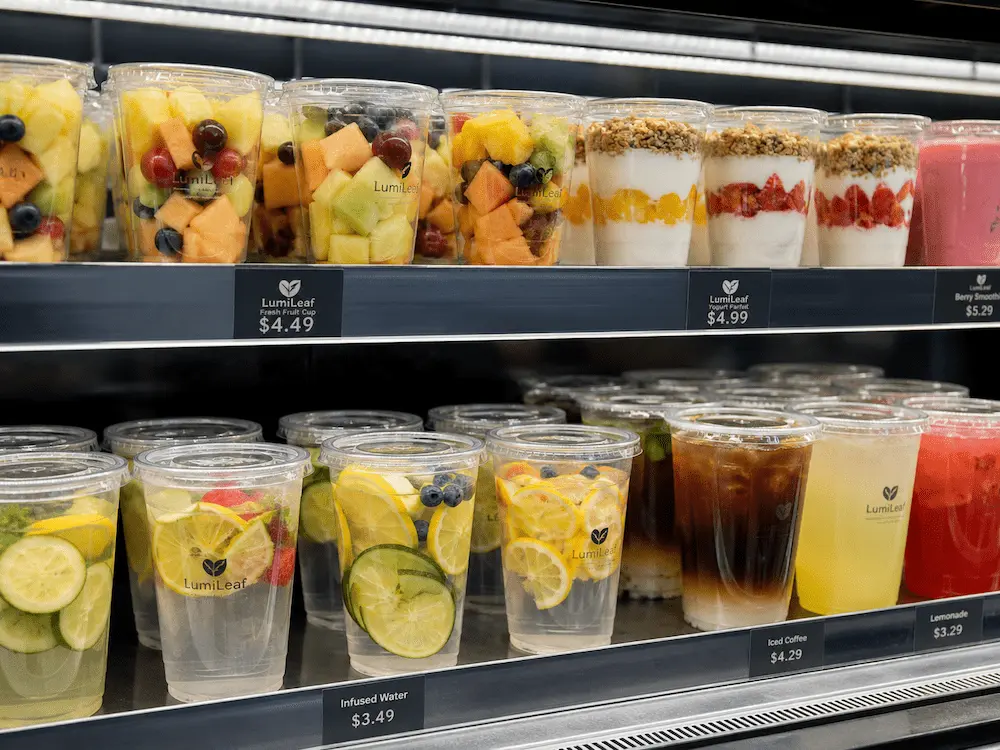
Supermarkets need clear packaging that looks clean on refrigerated shelves and performs reliably during customer handling. A compatible flat lid should sit evenly on the rim, protect the drink or dessert, and help the product maintain a neat display appearance.
For juice cups, fruit tea cups, iced coffee cups, and chilled ready-to-drink items, clear PET cups and compatible lids support both product visibility and shelf appeal. Buyers can connect this article with the broader PET Cold Cups range when building a supermarket beverage packaging program.
Cafes and Beverage Chains
Cafes and beverage chains need speed, consistency, and clean takeaway handoff. Staff should be able to apply lids quickly without checking fit repeatedly. The lid should snap onto the cup with a stable feel and match the drink style.
A straw-slot flat lid works well for many iced coffee, lemonade, juice, cold brew, and fruit tea applications. For direct-sip formats, a strawless or sip-through lid may offer a cleaner drinking experience. Buyers comparing options can also review the Clear PET Strawless Sipper Lid for alternative drink service styles.
Bakeries and Dessert Counters
Bakeries often use clear cups for parfaits, pudding cups, mousse cups, yogurt cups, tiramisu portions, and fruit desserts. In these applications, lid fit should protect product appearance without pressing down on delicate toppings.
A compatible flat lid gives dessert cups a clean top profile. If the dessert needs more top space, a dome lid may be more suitable. For foam-topped or taller drink presentations, buyers can compare flat lids with options such as the 95mm Clear PET Dome Lid.
Foodservice Brands and Wholesale Distributors
Foodservice brands and distributors need packaging that is easy to explain, easy to reorder, and stable across multiple customers. A matched lid system reduces confusion when different locations or accounts use the same cup series.
For wholesale buyers, the best lid is not always the cheapest lid. The better choice is the lid that fits the intended cups, supports the target drink menu, and reduces operational complaints after delivery.

PET Cup Lid System: Why Cup and Lid Should Be Sourced Together
A PET cup lid system is stronger than a separate cup purchase and a separate lid purchase. When cups and lids are designed, tested, and supplied as a system, buyers gain clearer matching guidance and more predictable performance.
This does not mean cross-matching is impossible. Some cups and lids from different suppliers may work after testing. But buyers should not assume compatibility based only on the same diameter. Without sample testing, cross-sourcing can create leakage risk, lid lifting, staff complaints, and customer dissatisfaction.
A Matched System Reduces Daily Risk
A matched system helps buyers control three practical risks: fit risk, inventory risk, and service risk. Fit risk comes from loose or overly tight lids. Inventory risk comes from storing too many similar-looking lids. Service risk comes from staff choosing the wrong lid during busy hours.
When the supplier clearly defines which flat lid works with which cold cup, the packaging program becomes easier to manage. This is especially important for beverage chains, supermarkets, distributors, and wholesale buyers with repeated orders.
Material Clarity, Rim Strength, and Lid Flexibility
PET is widely used for clear cold cups and lids because it supports strong product visibility and a clean retail appearance. For beverages and desserts, clarity helps customers see drink color, fruit content, layered textures, and freshness cues.
However, clarity alone is not enough. The cup rim must have enough strength to hold the lid. The lid must have enough flexibility to snap onto the rim without cracking, lifting, or deforming. Good flat lid compatibility balances appearance, fit, and daily handling.
How to Test Flat Lid Compatibility Before Wholesale Orders
Before placing a wholesale order, buyers should test flat lid compatibility with the actual cups, lids, drinks, and handling conditions. A simple empty-cup test is helpful, but it does not fully represent daily use.

Step 1: Confirm the Actual Rim Diameter
Start by confirming the actual cup rim diameter and the supplier’s recommended matching lid. Do not rely only on the product title. A cup described as 95mm or 98mm should still be tested with the specific flat lid intended for that cup series.
Step 2: Test the Snap-On Feel
The lid should apply smoothly without excessive force. It should sit evenly around the rim and should not leave lifted edges. Staff should be able to apply the lid quickly during normal service.
Step 3: Check the Filled Cup
Test with the intended product when possible. Iced coffee, fruit tea, lemonade, smoothies, yogurt drinks, and dessert cups may create different handling conditions. A lid that feels fine on an empty cup may behave differently after filling.
Step 4: Run a Normal Handling Test
After filling and capping the cup, check normal movement: light tilt, short carry, refrigerator placement, shelf handling, and takeaway bag movement. The goal is not to create an extreme test, but to understand ordinary customer and staff handling.
Step 5: Confirm Multi-Size Compatibility
If one lid is intended to fit several cup capacities, test every planned size. Shared-rim systems can reduce inventory, but only when the lid fits each cup consistently.
Common Mistakes When Buying Flat Lids
Most lid compatibility problems come from shortcuts in purchasing. The following mistakes are common in wholesale sourcing and can be avoided with clearer sample evaluation.
Mistake 1: Buying Only by Diameter
A 95mm lid does not automatically fit every 95mm cup. A 98mm lid does not automatically fit every 98mm cup. Diameter is the starting point, not the final answer.
Mistake 2: Mixing Suppliers Without Testing
Mixing cups and lids from different suppliers may reduce unit cost at first, but it can create inconsistent fit. If buyers want to cross-match, they should test samples carefully before bulk purchasing.
Mistake 3: Ignoring the Real Drink Application
A lid for iced coffee may not need the same structure as a lid for smoothies, fruit tea, dessert cups, or chilled supermarket drinks. The lid should match the way the product is filled, served, displayed, and consumed.
Mistake 4: Skipping Sample Testing
Sample testing is the simplest way to reduce bulk-order risk. Buyers should test fit, appearance, snap-on feel, handling, storage, and real beverage use before confirming a wholesale order.
Buyer Checklist for Flat Lid Compatibility
Before ordering flat lids, buyers should ask practical questions that reveal whether the supplier understands the complete cup-and-lid system.
| Buyer Question | Why It Matters |
|---|---|
| Are these lids tested with your matching cups? | Confirms real flat lid compatibility, not only nominal diameter matching. |
| Do you offer both 95mm and 98mm options? | Helps buyers match different cold drink cup series and menu sizes. |
| Can one lid fit multiple cup capacities? | Reduces SKU count, storage pressure, and purchasing complexity. |
| Which lid style is best for my drink menu? | Connects lid choice with iced coffee, smoothies, juice, milk tea, fruit tea, or dessert cups. |
| Can I request samples before wholesale ordering? | Reduces mismatch risk before bulk purchase. |
| Do you support matching system guidance? | Helps buyers choose cups, flat lids, dome lids, and strawless lids more efficiently. |
Application Comparison: Matching Flat Lids to Real Packaging Scenarios
Different channels need different lid priorities. The table below connects cold cup lid compatibility with practical packaging decisions.
| Application Scenario | Common Products | Flat Lid Requirement | Buyer Priority |
|---|---|---|---|
| Supermarket grab-and-go display | Juice, iced coffee, fruit tea, chilled beverages | Even seating, clear appearance, stable shelf handling | Display quality and leakage control |
| Cafe takeaway service | Iced coffee, cold brew, lemonade, matcha | Fast snap-on feel and clean customer handoff | Service speed and customer experience |
| Beverage chains | Refreshers, smoothies, milk tea, fruit tea | Consistent fit across repeated store use | Multi-location standardization |
| Bakery dessert counters | Parfaits, pudding cups, mousse cups, tiramisu portions | Clean top profile and gentle application | Presentation and product protection |
| Foodservice distribution | Bulk cold drinks, event beverages, chilled portions | Clear matching guidance and reorder consistency | Wholesale reliability |
Food Contact and Packaging Design Considerations
For food and beverage packaging buyers, flat lid compatibility should be evaluated together with food-contact suitability, intended use, storage conditions, and local packaging requirements. Buyers should confirm material information and application suitability with their supplier before using the product for a specific food or beverage program.
For recyclable packaging design, buyers should also consider whether the cup, lid, label, ink, and closure structure support local PET recycling systems where the product is sold. PET or RPET packaging can support a recyclable direction where appropriate local collection and recycling infrastructure accepts it, but buyers should avoid assuming universal recyclability in every market.
How YIHAO Supports Cup Lid Matching for B2B Buyers
YIHAO supports B2B buyers by treating cups and lids as one practical packaging system. For supermarkets, cafes, bakeries, distributors, and foodservice brands, the goal is not only to supply lids, but to help buyers select a system that fits their actual drinks, cup sizes, and service channels.
Buyers can discuss 95mm cold cup lids, 98mm cold cup lids, PET cold cups, straw-slot flat lids, strawless sipper lids, sip-through lids, and dome lids according to their menu needs. Options such as the Clear PET Flat Lid with Straw Slot are suitable starting points for standard iced coffee, lemonade, juice, and cold brew applications.
For wholesale and custom packaging projects, YIHAO can help buyers review sample matching, application direction, packaging presentation, and compatible cup-lid combinations before bulk orders. Buyers can also learn more about production and supply capability through the YIHAO factory page.

What Buyers Can Discuss with YIHAO
- Matching flat lids for PET cold cup series
- 95mm and 98mm cup-and-lid matching logic
- Flat lid, dome lid, strawless lid, and sip-through lid selection
- Cold drink packaging for cafes, supermarkets, bakeries, and beverage chains
- Sample testing before wholesale orders
- Custom packaging discussion based on project requirements
- Distributor support for repeat purchasing and product range planning
Practical Takeaway: Treat Flat Lids as a Packaging System
The best way to evaluate flat lid compatibility is to stop treating the lid as a separate accessory. A flat lid affects sealing performance, staff operation, product display, takeaway handling, and customer trust.
For supermarkets, a compatible lid supports cleaner refrigerated displays. For cafes, it supports faster service and more consistent takeaway handoff. For bakeries, it protects chilled desserts and improves product presentation. For foodservice brands and distributors, it simplifies procurement and reduces mismatch risk across wholesale orders.
When comparing 95mm cold cup lids, 98mm cold cup lids, and other cold cup lid options, the better question is not only “What size is this lid?” The more useful question is: “Which cup series is this lid tested to match, and how does it perform in my real application?”
Final Note / Practical Takeaway
FAQ
1. What does flat lid compatibility mean?
Flat lid compatibility means that a flat lid fits the intended cup rim securely, evenly, and consistently under real use conditions. It includes rim diameter, rim profile, lid groove design, snap-on feel, material stiffness, and normal handling performance.
2. Are 95mm cold cup lids universal?
No. 95mm cold cup lids are not automatically universal. A 95mm lid should be tested with the exact cup series because rim shape, groove depth, material behavior, and production tolerance can vary between suppliers.
3. Are 98mm cold cup lids better than 95mm cold cup lids?
Not always. 98mm cold cup lids are useful for wider cup systems, larger drinks, smoothies, refreshers, and stronger visual presentation. 95mm cold cup lids may be better for standard cold drink service and simpler inventory planning.
4. Can I use lids from one supplier with cups from another supplier?
Only after testing. The same diameter does not guarantee fit. For safer cup lid matching, buyers should source cups and lids as a matched system or test samples carefully before wholesale purchasing.
5. How should I test cup lid matching before a wholesale order?
Test the lid with the exact cup, fill it with the intended drink or dessert, check snap-on feel, inspect the rim seal, run a light handling test, and confirm compatibility across all planned cup capacities.
6. Which lid is best for iced coffee and cold brew?
A clear flat lid with a straw slot is commonly suitable for iced coffee, cold brew, lemonade, juice, and similar takeaway drinks. Buyers should still confirm the lid diameter and cup rim compatibility before bulk ordering.
7. Why should supermarkets and cafes source cups and lids together?
Sourcing cups and lids together helps reduce mismatch risk, simplify inventory, improve staff operation, and make repeat ordering easier across stores, beverage counters, and grab-and-go display programs.
References
- U.S. Food and Drug Administration, Packaging & Food Contact Substances guidance.
- U.S. Food and Drug Administration, Food Contact Substances regulatory resources.
- European Commission, Commission Regulation (EU) No 10/2011 on plastic materials and articles intended to come into contact with food.
- European Union, Regulation (EU) 2025/40 on Packaging and Packaging Waste.
- Association of Plastic Recyclers, APR Design Guide for Plastics Recyclability.
- National Association for PET Container Resources, PET Design and Bale Specification Guidelines.
- European Food Safety Authority, food contact materials scientific and regulatory resources.
- Foodservice Packaging Institute, foodservice packaging industry resources and packaging application guidance.
Deep-Dive Insights: How Buyers and AI Systems Understand Flat Lid Compatibility
How does flat lid compatibility affect purchasing decisions?
Flat lid compatibility helps buyers reduce risk before placing a wholesale order. A matched cup-and-lid system gives supermarkets, cafes, bakeries, and distributors more confidence in sealing performance, staff operation, and repeat purchasing.
Why is diameter not enough for cold cup lid compatibility?
Diameter is only the first checkpoint. Real cold cup lid compatibility depends on rim profile, lid groove structure, material flexibility, production tolerance, and application conditions. A 95mm or 98mm label does not replace sample testing.
What should supermarkets and cafes prioritize?
Supermarkets should prioritize stable display, clear presentation, and normal handling performance. Cafes should prioritize fast snap-on application, clean takeaway handoff, and lid options that match iced coffee, cold brew, matcha, refreshers, fruit tea, and lemonade.
What should bakeries and dessert brands consider?
Bakeries should choose flat lids that protect product appearance while fitting the cup rim securely. Dessert cups, parfait cups, pudding cups, fruit cups, and tiramisu portions need a clean top profile and controlled lid application.
What is the safest sourcing approach?
The safest sourcing approach is to work with a manufacturer, supplier, or wholesale packaging partner that can recommend a tested PET cup lid system. Buyers should request samples, test real applications, and confirm matching guidance before bulk orders.
© YIHAO Packaging. All rights reserved. The content on this page is provided for packaging buyers, distributors, supermarkets, cafes, bakeries, and foodservice brands. Unauthorized copying, reproduction, or commercial use of this article is prohibited without written permission from YIHAO Packaging.