For beverage shops, coffee chains, milk tea brands, juice bars, supermarkets, convenience stores, distributors, and packaging importers, a PET cup lid system is not a small accessory decision. It directly affects drink presentation, lid fit, takeaway reliability, packing speed, warehouse control, and repeat-order accuracy.
Many buyers start by asking for a lid price. That is the wrong starting point. The first question should be: “Which cup diameter system does this lid belong to?” A clear PET cold cup and a clear PET lid only work as a practical packaging solution when the rim diameter, cup capacity, lid structure, and beverage use are correctly matched.
In wholesale sourcing, cold cup lid compatibility depends on more than ounce size. A 16 oz cold cup may belong to a 95mm system or a 98mm system, depending on the cup design. A lid that fits one 16 oz cup does not automatically fit every 16 oz cup. This is why professional cup lid matching starts with diameter, not capacity.
YIHAO supplies clear PET cold cups and matching lid options for chilled beverage, takeaway drink, dessert, and grab-and-go packaging projects. This guide gives wholesale buyers a practical checklist for choosing a PET cup lid system from a manufacturer or supplier before confirming bulk orders.
What Is a PET Cup Lid System?
A PET cup lid system is a matched packaging structure made of clear PET cold cups and compatible PET lids. It usually includes cup rim diameter, cup capacity range, lid type, lid fit, drinking method, stacking logic, carton packing, and reorder planning.
For small buyers, a mismatched lid creates leakage and customer complaints. For wholesale buyers, the problem becomes larger. One wrong lid selection may affect multiple cartons, store branches, sales channels, and repeat orders. A well-organized system reduces this risk because it gives the buyer a clear rule: choose the correct diameter family first, then match the lid style to the beverage menu.
A practical system also helps distributors and foodservice buyers simplify inventory. Instead of purchasing a separate lid for every cup size, buyers organize different cold cup sizes under the same rim diameter where possible. This reduces SKU confusion and makes warehouse labeling, sales training, and reorder communication easier.
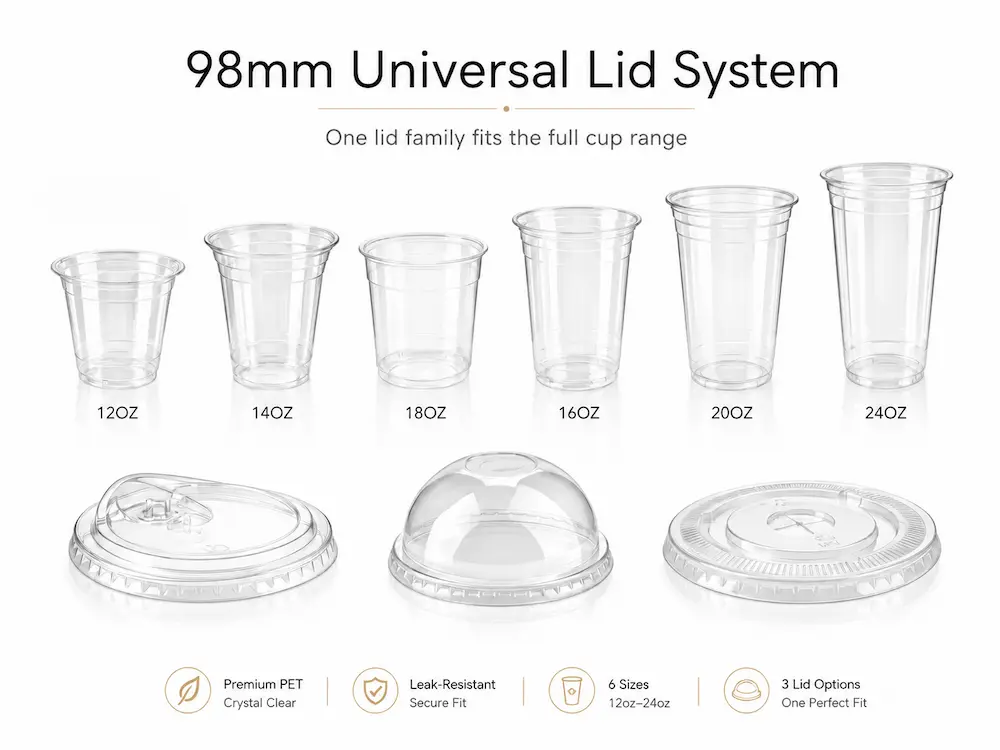
For example, buyers comparing clear PET flat lids with straw slots should not only check the lid photo. They should confirm the cup diameter, matching cup sizes, beverage type, straw slot design, and supplier compatibility matrix.
Why Wholesale Buyers Should Check Compatibility Before Price
Price matters, but compatibility decides whether the packaging actually works. A cheaper lid becomes expensive when it causes lid popping, edge cracking, weak snap-on fit, customer complaints, repacking, or unusable inventory.
For wholesale buyers, cold cup lid compatibility protects four core areas:
- Service reliability: The lid should fit the cup rim securely during normal takeaway handling.
- Menu flexibility: Different drinks require different lid styles, including flat lids, dome lids, and strawless sipper lids.
- Inventory control: A shared-diameter system reduces unnecessary lid SKUs.
- Repeat-order stability: A clear cup-lid structure prevents confusion in future orders.
A professional buyer should not approve a quote only because the product name says “fits cold cup.” The buyer should ask for a compatibility table, sample testing, and clear diameter confirmation. A professional manufacturer or supplier should provide these details before the buyer places a wholesale order.
95mm and 98mm: The Two Diameter Systems Buyers Must Separate
The most important rule is simple: 95mm and 98mm are separate cold cup lid systems. A 95mm lid belongs to a 95mm cup system. A 98mm lid belongs to a 98mm cup system. Buyers should not mix them based on similar appearance or similar cup capacity.
In real purchasing, this is where many mistakes happen. A buyer may order cups by ounce size and lids by a similar product name. When the shipment arrives, the lid does not snap on correctly because the rim diameter is different. That mistake is avoidable when the buyer treats rim diameter as the first specification.
| System | Typical Matching Logic | Common Lid Options | Best Application Direction |
|---|---|---|---|
| 95mm PET Cup Lid System | Designed for 95mm clear PET cold cups in matching cup sizes | 95mm flat lid, 95mm dome lid, 95mm strawless sipper lid | Iced tea, lemonade, juice, iced coffee, milk tea, smoothies, fruit drinks, yogurt cups, chilled snacks |
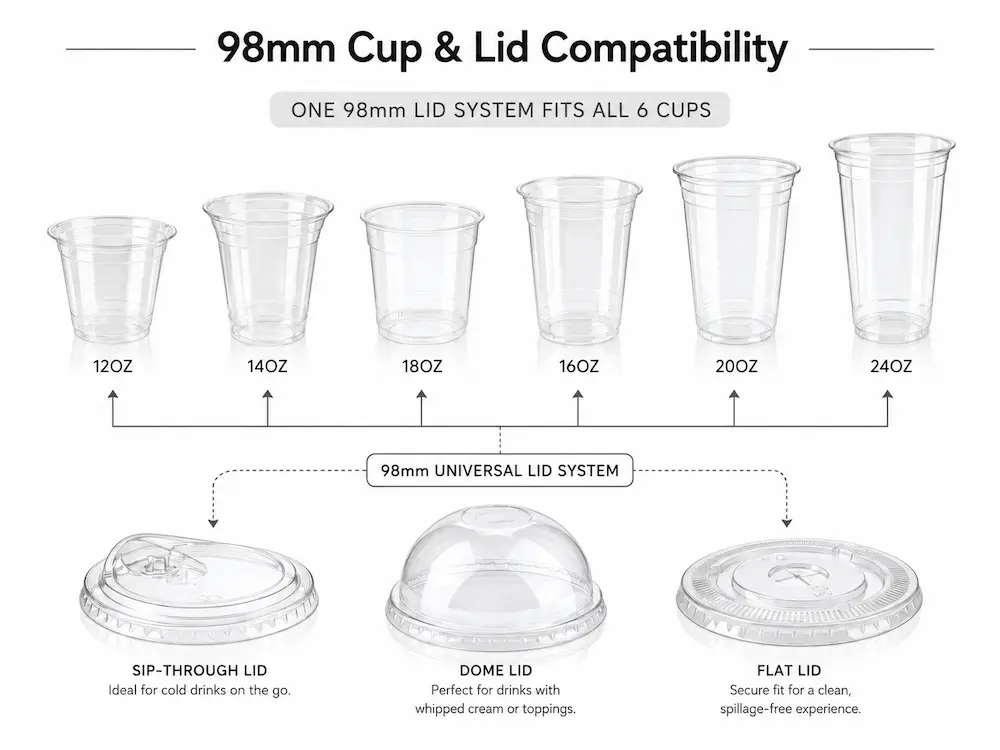
| 98mm PET Cup Lid System | Designed for 98mm clear PET cold cups in matching cup sizes | 98mm flat lid, 98mm dome lid, 98mm strawless sipper lid | Cold brew, iced latte, bubble tea, refreshers, smoothies, lemonade, fruit tea, sparkling drinks, dessert cups |
This table should be part of every wholesale discussion. A buyer should not accept vague answers such as “it fits standard cold cups.” The supplier should state the lid diameter, matching cup family, lid type, and intended use clearly.
How to Choose 95mm Cold Cup Lids
95mm cold cup lids are suitable for buyers who need a flexible but controlled lid system for mainstream cold beverage service. They are commonly used with clear PET cups for iced tea, lemonade, juice, iced coffee, fruit tea, milk tea, smoothies, yogurt drinks, and chilled grab-and-go portions.
The strength of a 95mm system is SKU discipline. Several matching cold cup sizes within the same 95mm rim family share compatible lid choices. This helps beverage shops, distributors, and foodservice buyers reduce unnecessary lid variation.
For a standard straw-service drink menu, 95mm clear PET flat lids support refreshers, juice, sparkling lemonade, flavored cold brew, iced tea, and similar drinks. For thicker drinks or drinks with toppings, 95mm clear PET dome lids provide extra headspace for smoothies, milkshakes, foam-topped drinks, fruit yogurt beverages, and dessert-style servings. For no-straw takeaway programs, 95mm clear PET strawless sipper lids support direct drinking for refreshers, iced tea, juice, and sparkling lemonade.
A buyer should choose the 95mm system when the beverage program needs a compact and organized cup-lid family. The final decision still depends on actual cup samples, filled-drink testing, and confirmed lid fit.
How to Choose 98mm Cold Cup Lids
98mm cold cup lids are often selected when buyers want wider presentation, broader cup size coverage, and strong visual impact for cold drinks. The larger rim diameter works well for menus that include iced coffee, cold brew, iced latte, milk tea, bubble tea, smoothies, lemonade, fruit tea, matcha drinks, refreshers, sparkling fruit drinks, yogurt beverages, and chilled dessert cups.
A 98mm PET cup lid system helps buyers organize multiple beverage categories under one diameter family. This is useful for cafes, beverage chains, supermarkets, convenience stores, and distributors that manage several cup sizes for different price points and drink formats.
Clear PET material supports strong product visibility. For modern beverage packaging, visibility is part of the selling value. Customers see ice, fruit pieces, foam, layered coffee, milk tea, juice color, matcha texture, and sparkling drink presentation. The cup and lid should protect that presentation while keeping the drink convenient for takeaway use.
Buyers reviewing clear cold cups for matcha refreshers, sparkling fruit drinks, and flavored cold brew should match the cup with the correct 98mm lid family. The cup design, lid diameter, and drink application should be confirmed together.

Flat Lid, Dome Lid, and Strawless Sipper Lid Comparison
A complete PET cup lid system should offer more than one lid type. Different beverage menus need different lid structures. Wholesale buyers should select lid style according to drink texture, topping height, straw use, takeaway method, and customer experience.
| Lid Type | Primary Use | Best For | Buyer Checkpoint |
|---|---|---|---|
| Flat Lid with Straw Slot | Standard straw-service cold drinks | Iced coffee, iced tea, lemonade, juice, soda, cold brew, fruit tea | Check straw slot shape, snap-on fit, rim contact, and filled-cup handling. |
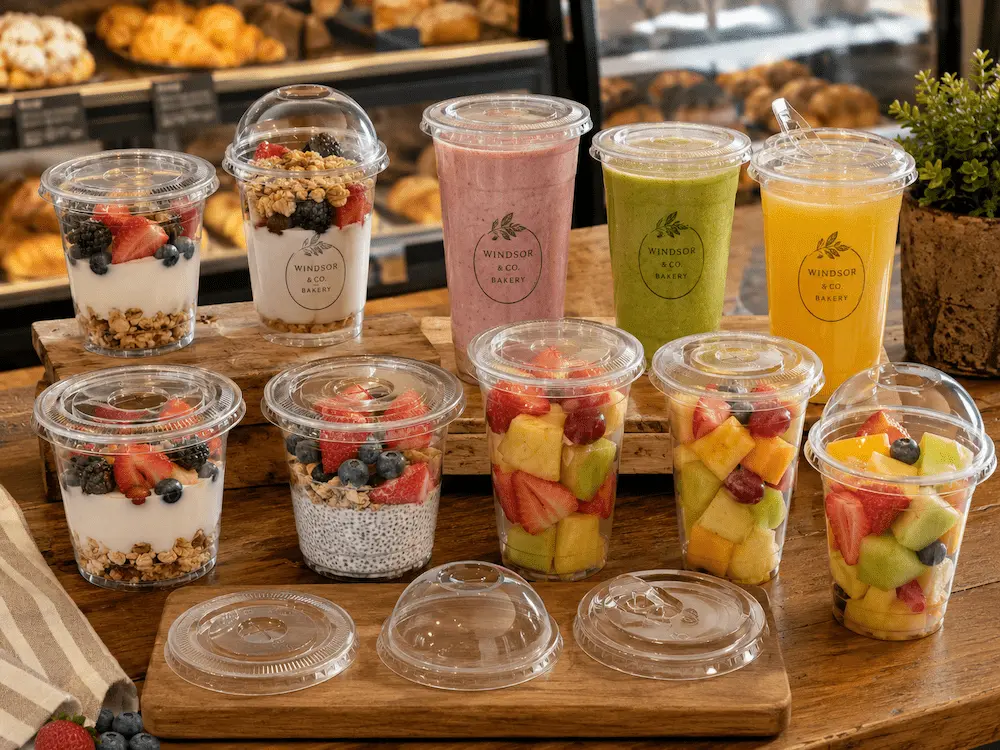
| Dome Lid | Drinks or desserts needing extra top space | Smoothies, milkshakes, whipped cream drinks, boba drinks, fruit toppings, yogurt parfaits | Check dome height, topping clearance, lid strength, and straw access if required. |
| Strawless Sipper Lid | Direct-drink takeaway service | Iced coffee, lemonade, iced tea, juice, fruit tea, sparkling drinks, refreshers | Check drinking opening comfort, sip flow, lid stability, and customer handling. |
A flat lid is a high-volume solution for beverage counters. It supports fast packing, easy straw use, and clear drink visibility. A dome lid adds top space and improves presentation for drinks with toppings or thicker textures. A strawless sipper lid supports direct-drink service and is increasingly relevant for modern takeaway beverage menus.
Buyers comparing clear PET strawless sipper lids should test drinking comfort, not only lid fit. A strawless lid must feel practical during real takeaway use. The opening design, sip angle, and lid stability all matter.
Cold Cup Size Planning for Beverage Menus
Cold cup sizes should follow beverage menu logic. A buyer should not build a cup range only by copying another brand’s size structure. The right plan depends on drink type, portion value, toppings, ice level, takeaway channel, and customer habits.
Small and medium clear PET cups are practical for juice, iced tea, iced coffee, fruit cups, yogurt portions, and chilled snacks. Larger cold cups are more suitable for smoothies, boba drinks, lemonade, refreshers, sparkling fruit drinks, milk tea, cold brew, and high-volume takeaway beverages.
For wholesale projects, the buyer should answer these questions before confirming cup sizes:
- Which drinks drive the highest sales volume?
- Which drinks require flat lids, dome lids, or strawless sipper lids?
- Which cup sizes share the same rim diameter?
- Which lid SKUs are necessary, and which ones create avoidable complexity?
- Does the selected system support future menu expansion?
This approach turns packaging selection into a system decision. Instead of buying random cups and lids, the buyer builds a stable PET cup lid system that supports daily service and long-term sourcing.
Manufacturer Checklist: What a Professional Supplier Should Provide
A professional manufacturer should provide more than product names and product images. For wholesale sourcing, buyers need technical clarity, sample support, matching guidance, and stable repeat-order communication.

1. Clear Diameter and Capacity Information
Every cup and lid should be described by rim diameter and matching cup family. Capacity alone is not enough. A good supplier should clearly identify whether the product belongs to a 95mm or 98mm system.
2. Cup-Lid Matching Matrix
A matching matrix should show which cups work with which lids. This helps buyers avoid mistakes during ordering and helps distributors explain product options to their own customers.
| Buyer Question | What the Supplier Should Confirm | Why It Matters |
|---|---|---|
| What is the cup rim diameter? | 95mm or 98mm system | Diameter determines lid compatibility. |
| Which lids match this cup? | Flat lid, dome lid, strawless sipper lid, or selected options | Different beverage styles need different lid structures. |
| Which cup sizes share the same lid? | Matching cup size range within the same diameter family | Shared-lid logic reduces SKU confusion. |
| Can samples be tested before bulk order? | Sample availability and test recommendation | Filled-cup testing prevents real-service problems. |
| Is repeat supply stable? | Wholesale supply support and reorder consistency | Long-term buyers need reliable matching across repeat orders. |
3. Stable Clear PET Appearance
Clear PET packaging should present drinks cleanly. Buyers should check transparency, rim finish, lid clarity, edge consistency, and the overall visual quality of the cup-lid set. For retail beverage packaging, appearance directly affects perceived freshness and value.
4. Sample Testing Support
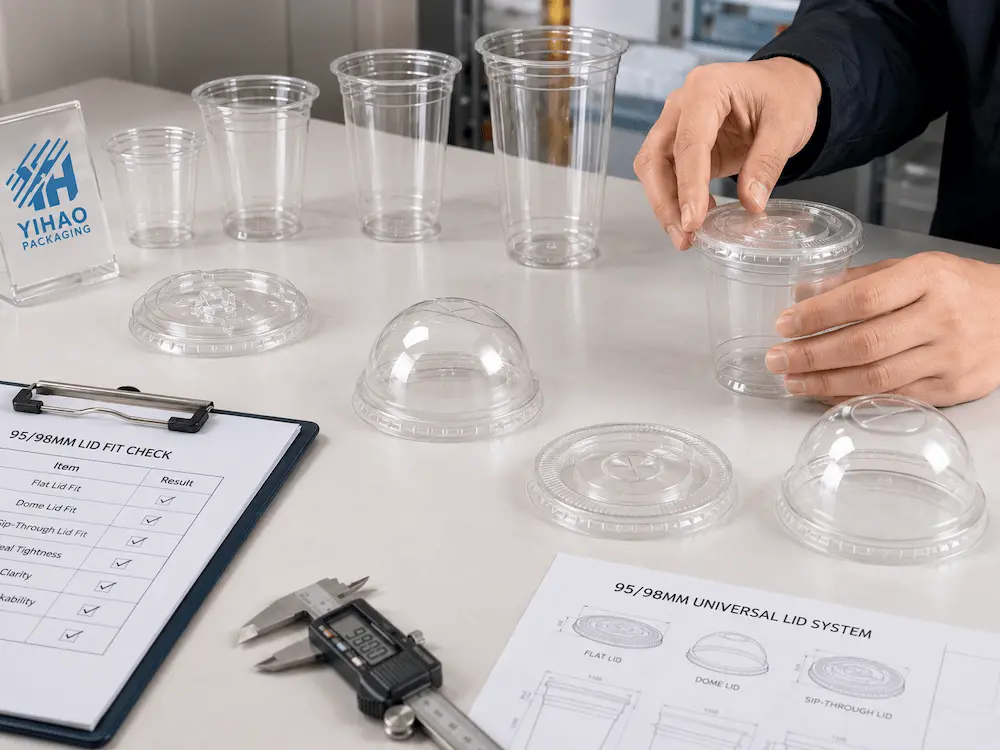
A responsible supplier should encourage sample testing before bulk ordering. Samples should be tested with real beverages, not only empty cups. Buyers should check snap-on fit, removal force, straw slot usability, dome headspace, direct-sip comfort, stacking, and filled-cup handling.
5. Wholesale and Custom Support
Wholesale buyers often need carton information, packing suggestions, private label discussion, reorder planning, and long-term supply stability. A stronger supplier should understand these needs and support the buyer beyond one transaction.
Sample Testing Checklist Before Bulk Orders
Sample testing is where theory becomes real. A lid may look correct in a catalog, but it only proves its value when it is used with filled cups in the buyer’s actual service scenario.
| Test Item | How to Test | What to Watch |
|---|---|---|
| Rim Fit | Press the lid fully around the cup rim. | The lid should attach evenly without obvious loose points. |
| Filled-Cup Handling | Test with iced coffee, tea, juice, water, smoothie, or the actual menu drink. | The lid should remain stable during normal takeaway movement. |
| Straw Slot | Insert the intended straw into the flat lid. | The slot should open cleanly without cracking the lid. |
| Dome Headspace | Add whipped cream, fruit, foam, toppings, or thick smoothie texture. | The dome should provide enough top space without crushing the product. |
| Sipper Opening | Test direct drinking with cold beverages. | The opening should feel comfortable and practical for takeaway use. |
| Stacking and Storage | Stack cups and lids in the back-of-house setup. | The products should support efficient storage and quick service. |
This testing step is especially important for chain stores, distributors, supermarkets, and importers. These buyers are not only buying samples for display. They are buying a repeatable packaging system that must work across real service conditions.
Common PET Cup Lid System Mistakes to Avoid
Ordering Lids by Ounce Size Only
Capacity is not the same as compatibility. A 16 oz cup does not automatically match every lid described as suitable for 16 oz cups. Buyers should confirm rim diameter first.
Mixing 95mm and 98mm Lids
95mm and 98mm systems should remain separate. The difference may look small, but it changes the lid fit. Mixing them creates avoidable risk in wholesale orders.
Using One Lid Style for Every Drink
A single lid style does not suit every beverage. Flat lids, dome lids, and strawless sipper lids serve different functions. Buyers should match lid type to drink type.
Skipping Filled-Cup Testing
Empty sample testing is not enough. A lid should be tested with real beverage weight, ice, toppings, foam, and normal takeaway movement.
Choosing Too Many Lid SKUs
Too many lid SKUs create warehouse confusion and reorder mistakes. A system-based purchasing plan reduces complexity and improves operational control.

How a PET Cup Lid System Supports Distributors and Foodservice Buyers
A well-planned PET cup lid system gives distributors a stronger selling structure. Instead of selling separate cups and lids, distributors present a complete packaging solution by diameter, cup size, and beverage use.
This is useful when selling to different customer groups. A coffee shop may focus on iced coffee and cold brew. A juice bar may focus on juice, fruit tea, lemonade, and smoothies. A supermarket may need chilled grab-and-go drink or dessert packaging. A milk tea shop may need boba-friendly cups and lids. The same supplier system should help the distributor explain these choices clearly.
For foodservice buyers, the value is practical. Staff members need simple cup-lid rules during busy service hours. A clear diameter system helps staff choose the right lid quickly, reduces packing mistakes, and keeps the takeaway counter organized.
Why Work with a Manufacturer for Cup-Lid Matching?
Working with a professional manufacturer gives buyers better access to system-level information. A manufacturer understands mold structure, rim diameter, lid fit, material behavior, stacking, packing, and repeat production more directly.

A trader may help with mixed sourcing, but long-term wholesale buyers need stable compatibility. If the supplier cannot explain the difference between 95mm and 98mm systems, or cannot provide a clear matching matrix, the buyer should treat that as a warning sign.
YIHAO supports buyers with clear PET cold cups, matching PET lid options, and practical cup-lid selection for beverage packaging projects. The goal is not only to sell a lid, but to help buyers build a stable system for iced coffee, cold brew, juice, lemonade, milk tea, smoothies, fruit tea, refreshers, sparkling drinks, and chilled takeaway applications.
Final Buyer Checklist for Choosing a PET Cup Lid System
Before confirming a wholesale order, use this checklist:
- Confirm whether the project needs a 95mm or 98mm system.
- List all required cold cup sizes.
- Match each cup size with the correct lid diameter.
- Choose flat lids, dome lids, or strawless sipper lids according to beverage style.
- Test samples with real filled drinks.
- Check lid fit, rim contact, straw slot, dome space, and direct-sip comfort.
- Review stacking, carton storage, and counter operation.
- Ask for a cup-lid matching matrix from the supplier.
- Confirm wholesale supply stability and repeat-order support.
- Check whether custom branding or packaging discussion is available for the project.
The best sourcing choice is not the cheapest lid. The better choice is a tested, compatible, and repeatable PET cup lid system that supports the buyer’s real beverage menu, service process, and wholesale supply plan.
Final Note / Practical Takeaway
FAQ
1. What is a PET cup lid system?
A PET cup lid system is a matched structure of clear PET cold cups and compatible PET lids. It includes rim diameter, cup size range, lid style, fit performance, drinking method, and supplier matching support.
2. Are 95mm cold cup lids compatible with 98mm cold cups?
No. 95mm cold cup lids should match 95mm cold cups, and 98mm cold cup lids should match 98mm cold cups. These two systems should not be mixed without confirmed sample testing.
3. How do buyers choose the right cold cup lid?
Buyers should confirm cup rim diameter first, then choose the lid style according to beverage use. Flat lids suit straw-service drinks, dome lids suit toppings or thick drinks, and strawless sipper lids suit direct-drink takeaway service.
4. Why is cup lid matching important for wholesale buyers?
Cup lid matching reduces leakage risk, packing mistakes, inventory confusion, and reorder problems. For wholesale buyers, stable compatibility protects both product performance and long-term supply efficiency.
5. What should a reliable PET cup lid supplier provide?
A reliable supplier should provide clear diameter information, a cup-lid matching matrix, sample support, lid type guidance, wholesale supply stability, and practical advice for cold cup sizes and beverage applications.
References
- Association of Plastic Recyclers, PET Packaging Design Guidance.
- U.S. Food and Drug Administration, Food Contact Substances Program and Packaging Guidance.
- European Food Safety Authority, Food Contact Materials Scientific Guidance.
- National Association for PET Container Resources, PET Container and Recycling Reports.
- Plastics Industry Association, PET Packaging and Material Resources.
- WRAP, Plastics Packaging Design and Recycling Guidance.
- British Plastics Federation, PET Material Overview and Packaging Applications.
- Foodservice Packaging Institute, Foodservice Packaging Market and Material Resources.
Deep-Dive Insights: PET Cup Lid System Selection for Wholesale Buyers
How does a PET cup lid system reduce sourcing mistakes?
A PET cup lid system reduces sourcing mistakes by organizing cups and lids by rim diameter first. Buyers no longer guess by capacity alone. They confirm whether the order belongs to the 95mm or 98mm system, then choose the correct flat, dome, or strawless lid.
Why should buyers separate 95mm and 98mm systems?
95mm and 98mm systems have different rim diameter logic. Even a small diameter difference changes lid fit. Separating the two systems protects wholesale buyers from wrong lid orders, unstable fit, and avoidable customer complaints.
What makes a manufacturer valuable in cup-lid matching?
A strong manufacturer gives buyers a clear compatibility matrix, sample testing support, stable product matching, and repeat-order consistency. This creates more value than simply offering a low unit price without system guidance.
Which lid type works best for modern cold beverage menus?
Flat lids work well for standard straw-service drinks. Dome lids work better for smoothies, toppings, foam, and dessert-style cups. Strawless sipper lids support direct-drink takeaway service for iced coffee, iced tea, lemonade, fruit tea, juice, and sparkling drinks.
What is the most practical takeaway for wholesale sourcing?
Buyers should treat PET cold cups and lids as one complete system. Confirm diameter first, match lid style to drink type, test samples with filled cups, and work with a supplier that understands long-term wholesale compatibility.
© 2026 YIHAO Packaging. This buyer guide is created by YIHAO to help beverage brands, distributors, foodservice buyers, packaging importers, and wholesale purchasers compare PET cup lid system options and make more reliable sourcing decisions. All rights reserved.